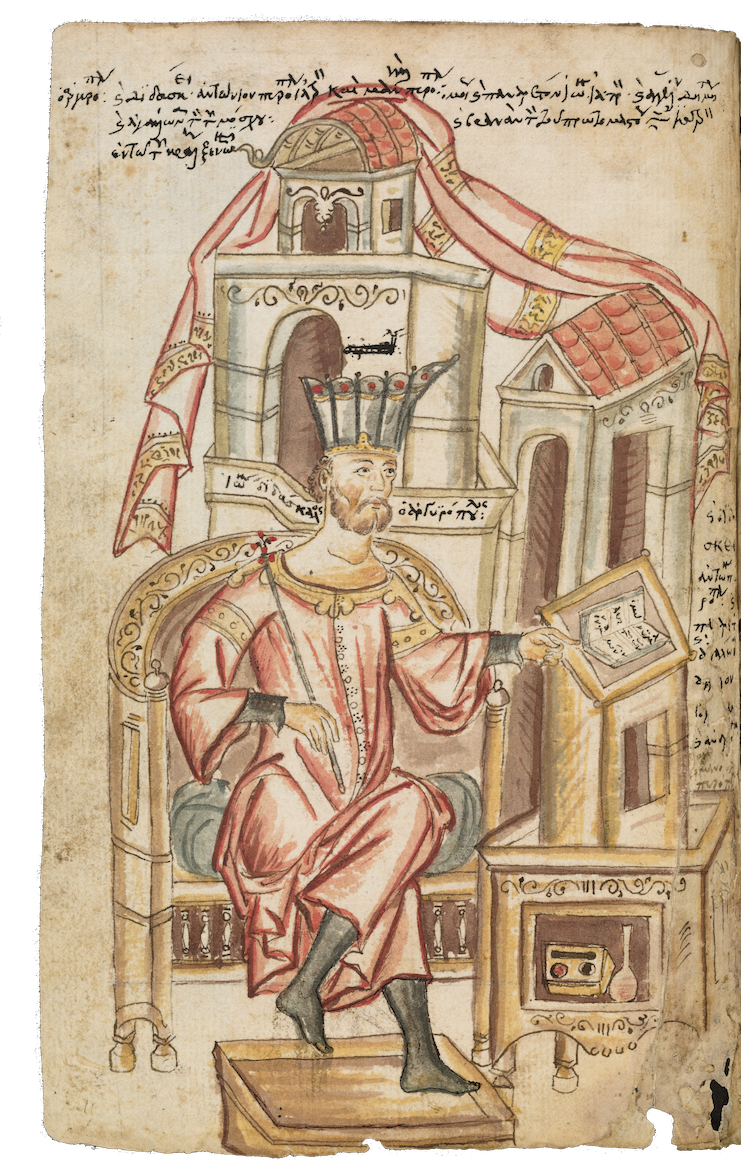
Welcome to the MediManus platform, a virtual research environment built to revive the interest in Ancient Medicine as an uninterrupted practice throughout millenia. The field calls for renewed attention: as the Touwaide 2016 Census attests, only 50% of this rich tradition has been explored; there is a lot yet to discover and redefine. The main reasons for this gap are twofold: the difficulty in accessing objects as rare and delicate as manuscripts, and the fact that research in Ancient Medicine requires a combination of competencies— philological, scientific, philosophical, a profile not easy to find in our hyperspecialized academic worlds. Effective interdisciplinarity based on deep expertise and a focus on primary sources are the founding principles of MediManus, which proudly relies on renowned specialists in the field.
For MediManus our dedicated IT team produced a digital environment that reflects closely the research orientations of the project. Each item within the collection is paired with a meticulously curated set of metadata, derived from first-hand scholarly examination, accessible under Medical manuscripts. Under this section users will find detailed analysis not only of the manuscripts, but of each of the medical works they contain—a distinctive feature of MediManus. The search interface, of which ReadMe gives a detailed description, is specifically designed for the exploration of medical literature, setting the platform apart from general manuscript collections that may include nonmedical content, and allowing users to discover connections across authors, historical periods, and collections. To facilitate the use of the platform, we included introductory texts under Overview about all the sections, designed for the publication of original research, from the history of manuscripts, to plant identification and pharmacotherapeutics. To encourage beginners to use MediManus as well, we included a brief but substantial general introduction to the field of manuscript studies under Overview/ Fundamentals, which should be read before any other section, together with Readme. An additional feature, particularly useful for less experienced users, is the digital assistant, which facilitates the discovery of items within the extensive collection of medical works; more experienced users will appreciate the accuracy of the results obtained through the different levels of the Search function.
MediManus will continue to evolve as a multicomponent research structure; the team will progressively release detailed analysis and related scholarship for the works in the 2,500 medical manuscripts identified by the aforementioned Census, of which currently about a half are digitized. The current release includes 456 manuscripts and original publications, of which an important part is based on the Appetiti and Touwaide archives. Special thanks are due to the libraries that responded to our plea to digitize manuscripts that were important for the project; we hope that MediManus will inspire more libraries to follow suit. Grateful acknowledgements are due as well to Alain Touwaide and Emanuela Appetiti for releasing original material for this project from their unique library; and to the remarkable IT team that worked tirelessly to make MediManus happen.
Team
- Project Director: Mark Schiefsky
- Executive Editor: Ioanna Papadopoulou
- Chief Scientific Editor: Alain Touwaide
- Web Content Curator: Emanuela Appetiti
- Information Technology:
- In collaboration with SQUAREDEV
Esteban Belmehdi
Theodoros Michalareas
Julien Razanajao
Eleni Belmehdi