Alain Touwaide
and
Emanuela Appetiti
Solanaceae in Antiquity
Botany, Pharmacotherapeutics, Pharmacy
A Preliminary Study
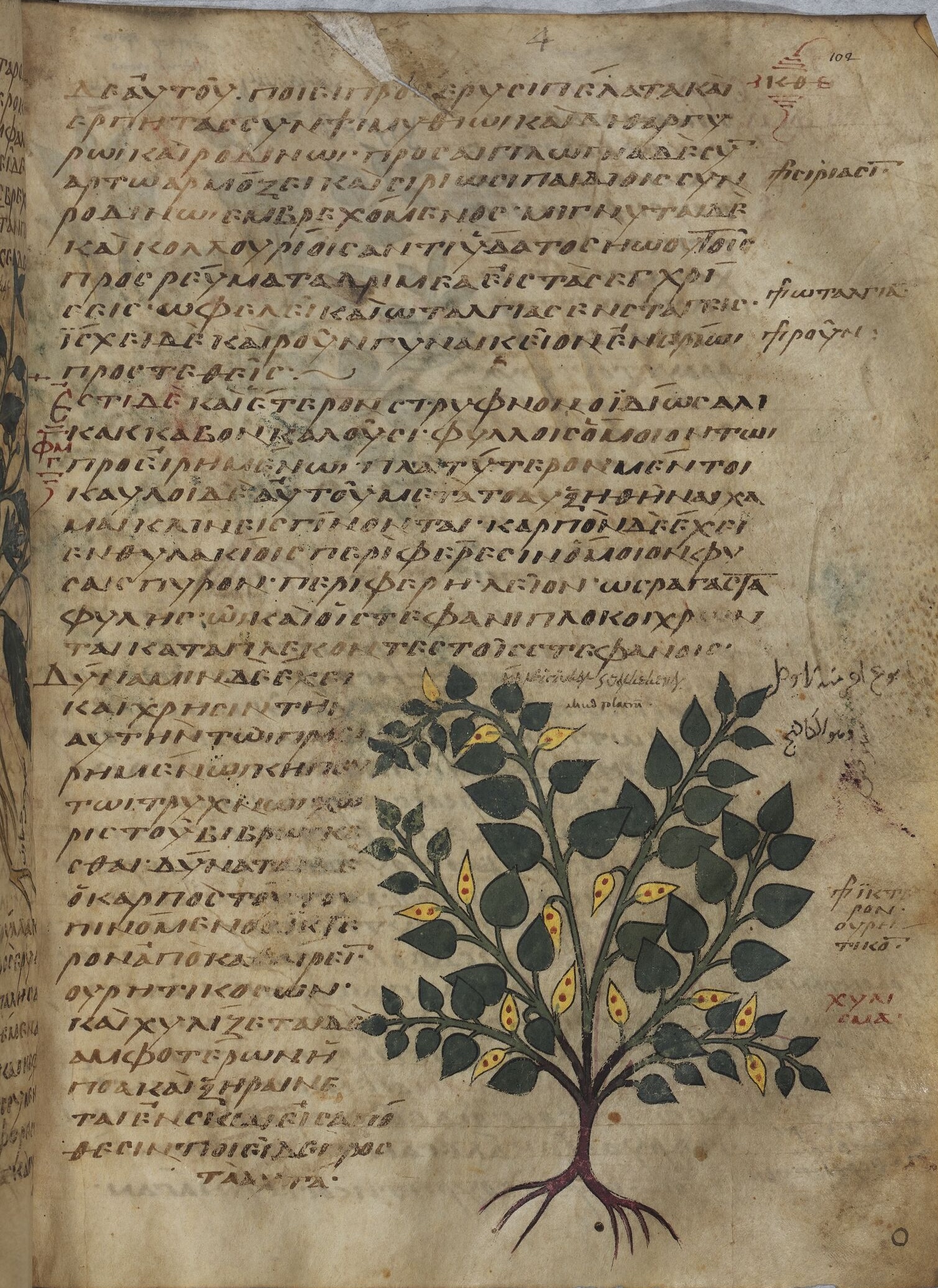
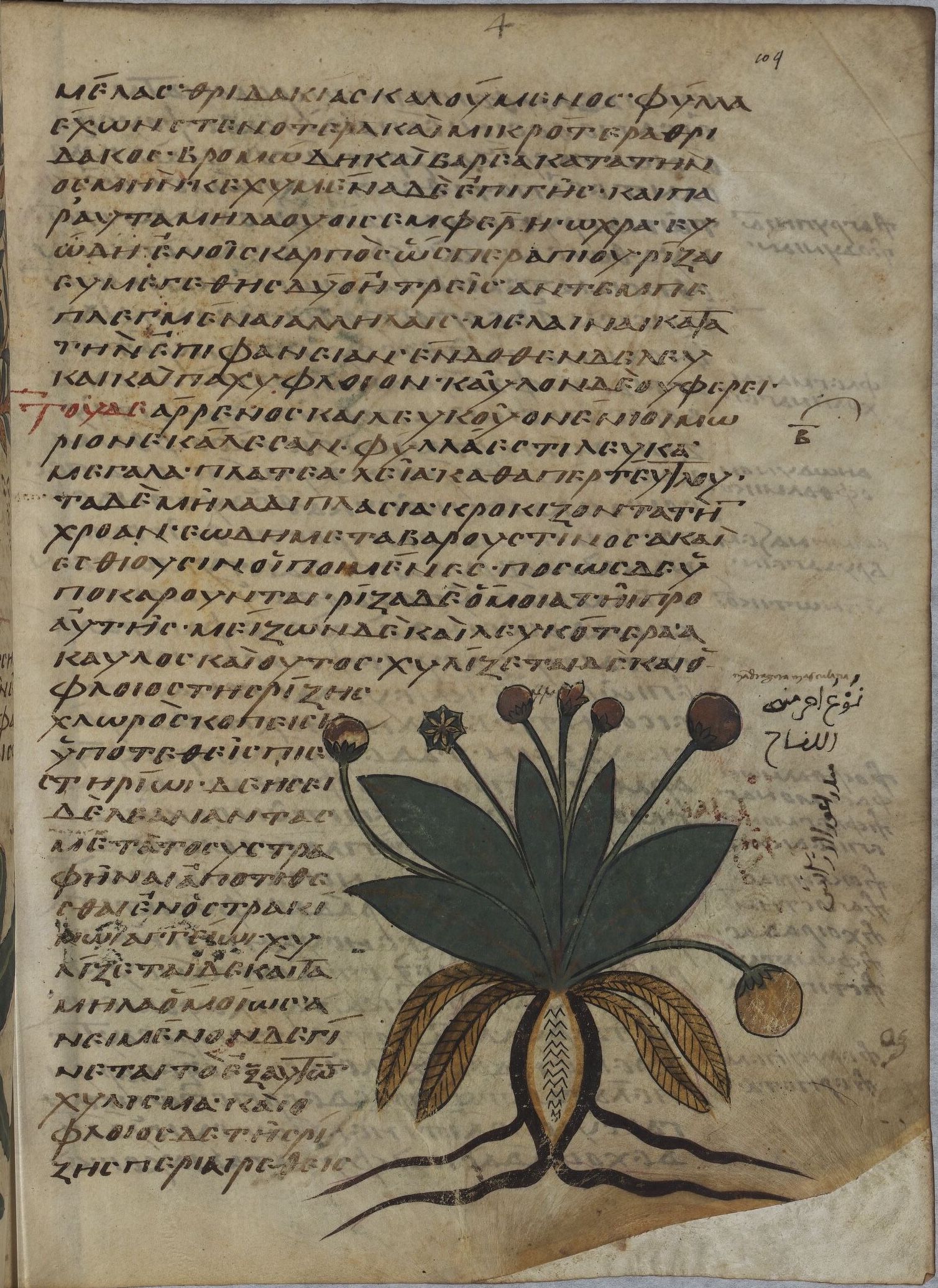
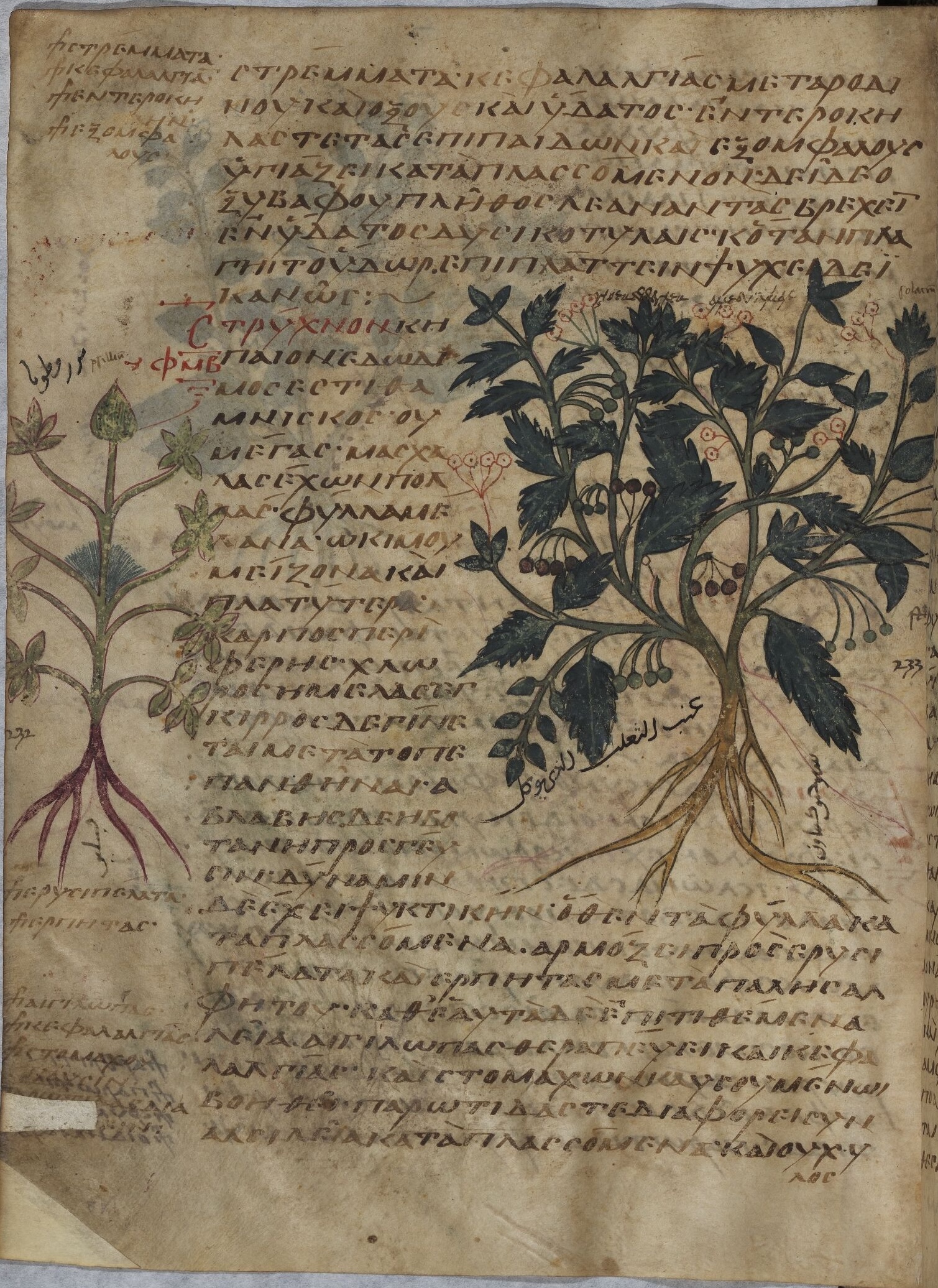
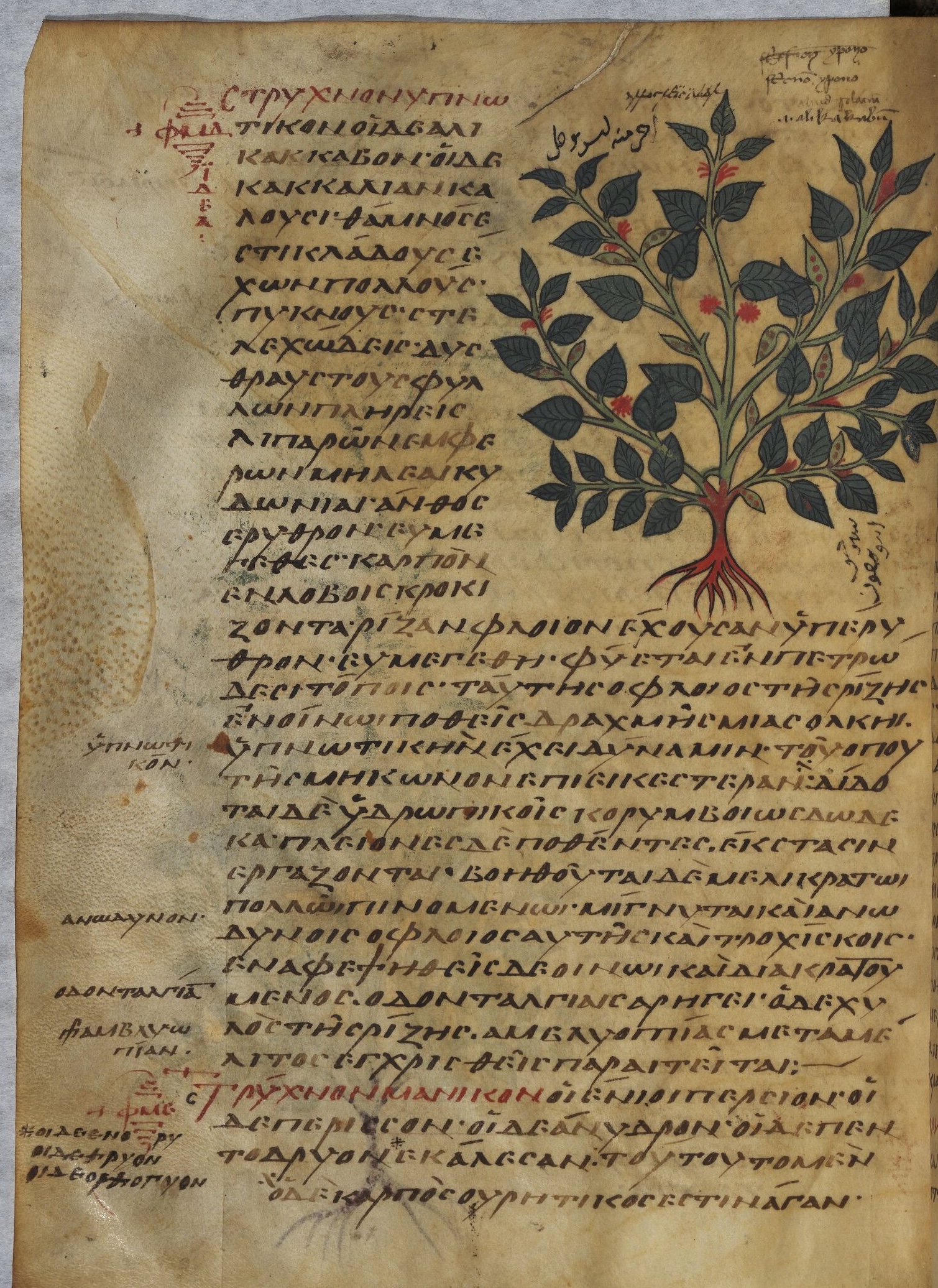
Several taxa of the family identified since Linnaeus as Solanaceae can be recognized in the ancient Greek botanical and medical literature. The family is complex and is still studied to fully understand its phylogenesis. This complexity is reflected in the ancient Greek texts, without confusions, however. Based on textual and iconographic documentation, this study focuses on botanical description and representations with ensuing identification according to contemporary taxonomy, as well as on therapeutic indications and pharmaceutical preparations. It is based on the two major oeuvres on medicinal plants and pharmacotherapeutics of classical antiquity, De materia medica by Dioscorides (1st cent. A.D.) and treatises by Galen (129-after [?] 216 A.D.). This Preliminary Study aims make the ancient botanico-therapeutic literature available and accessible beyond the circles of classical scholarship. It is textually comprehensive, philologically accurate, and scientifically specific, and opens the way for an extensive analysis of the genus in Antiquity

List of illustrations
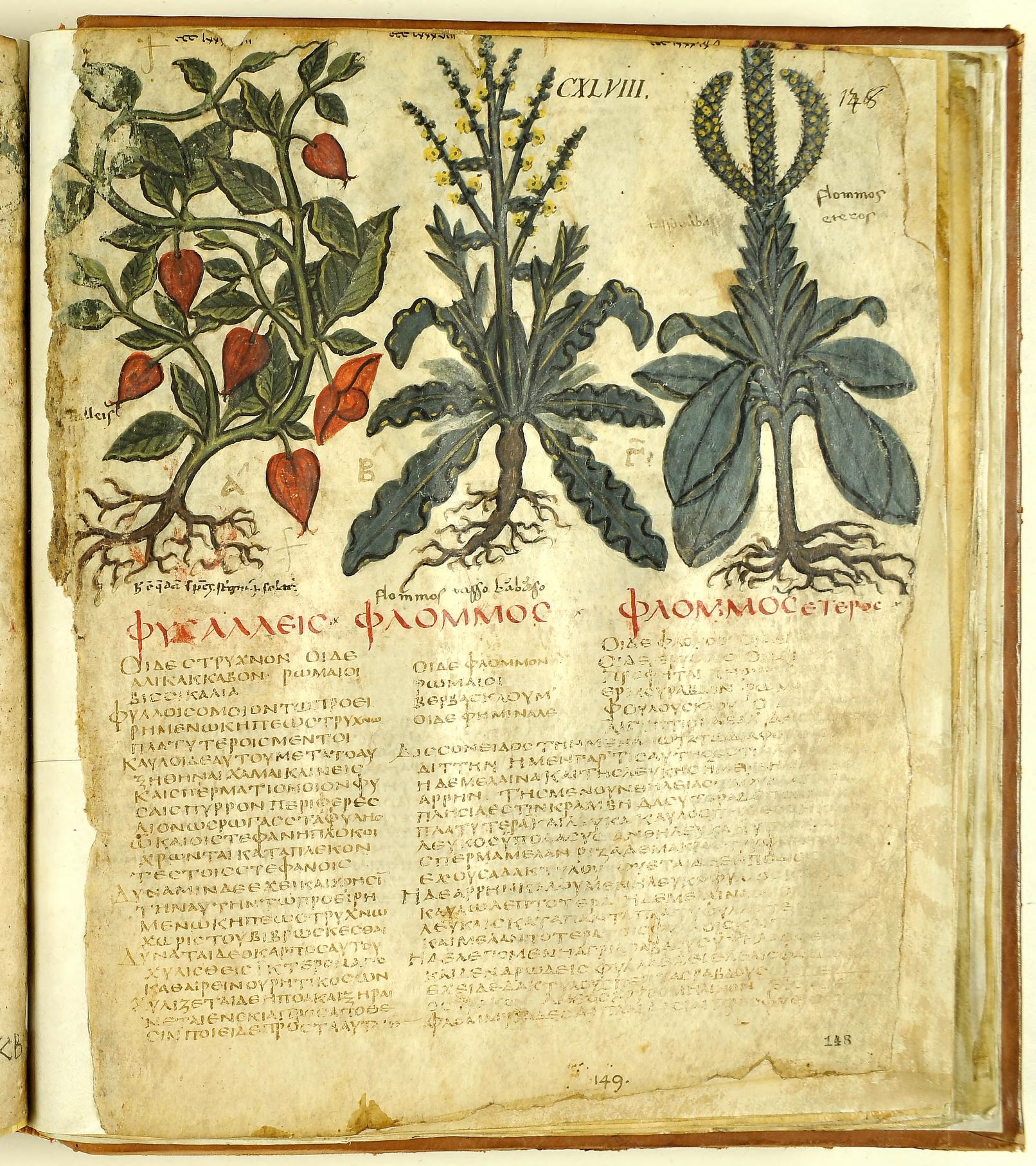
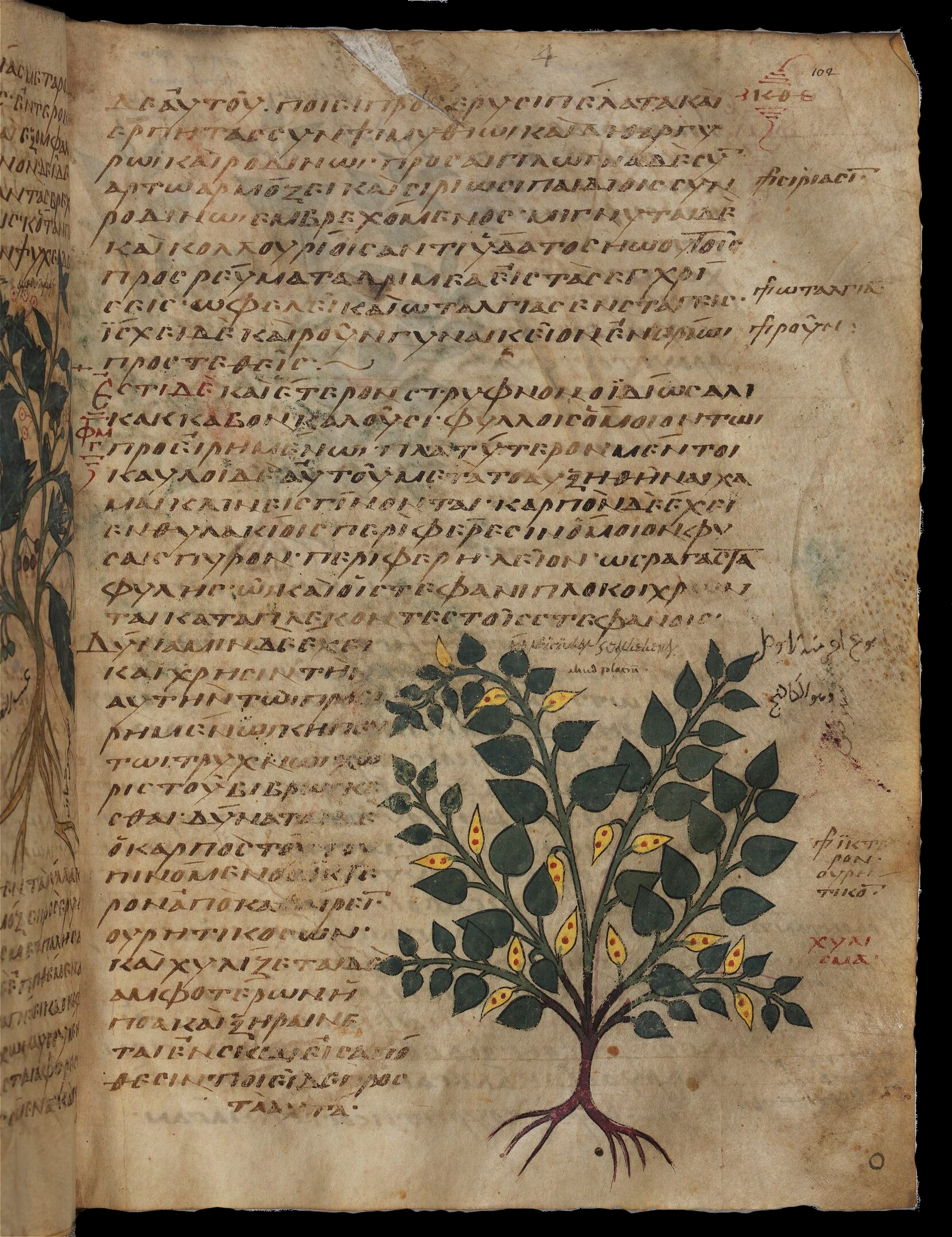
1. Paris, Bibliothèque nationale de France, graecus 2179, f. 102r
(στρύχνον-ἁλικάκκαβον-struchnon alikakkabon)
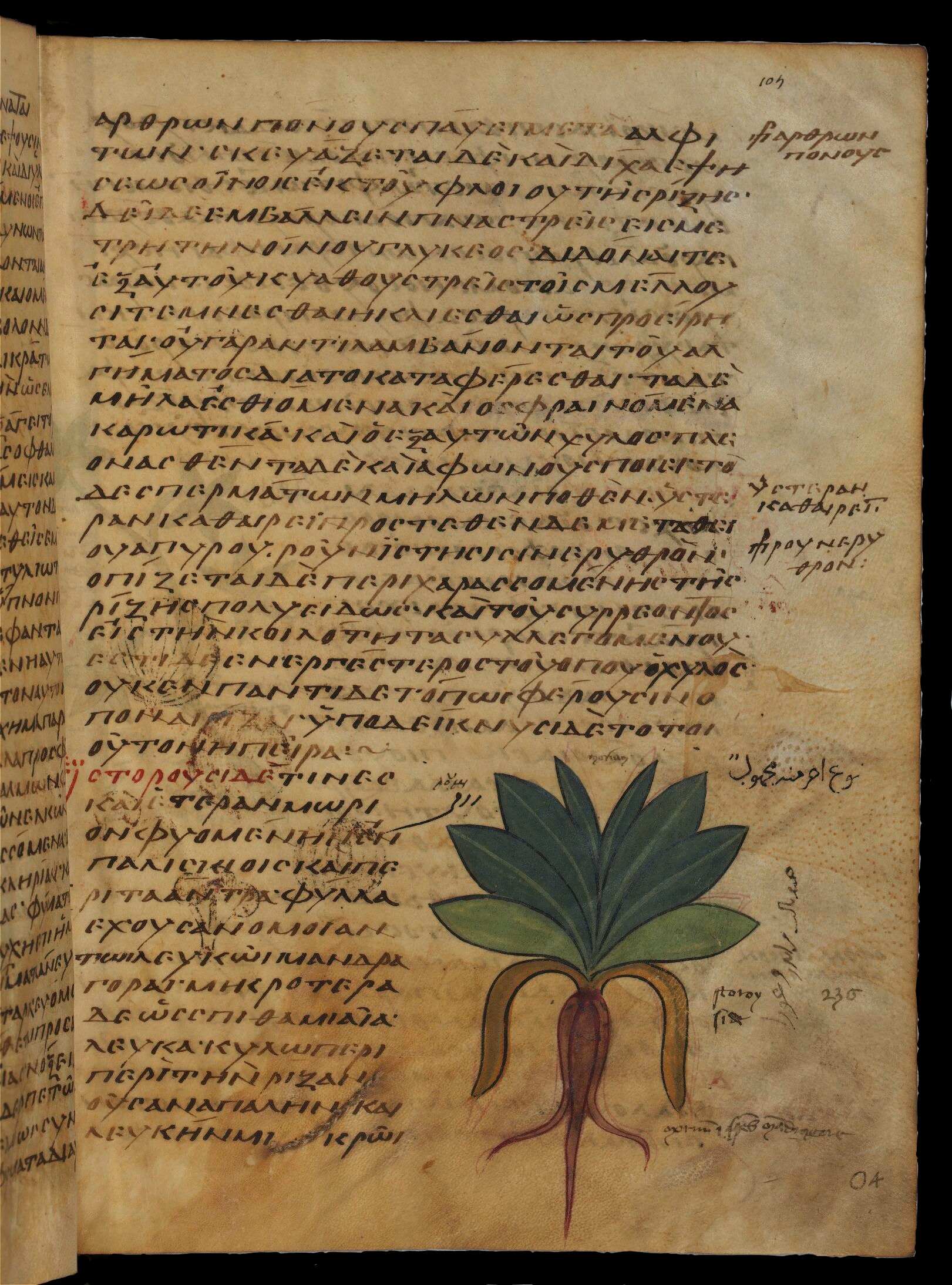
2. Paris, Bibliothèque nationale de France, graecus 2179, f. 104r
(μανδραγόρα ἄρρεν-mandragora arren)
3. Paris, Bibliothèque nationale de France, graecus 2179, f. 101v
(στρύχνον κηπαῖον-struchnon kēpaion)
4. Paris, Bibliothèque nationale de France, graecus 2179, f. 102v
(στρύχνον ὑπνωτικόν-struchnon upnōtikon)
5. Naples, National Library, Ex Vindobonensis graecus 1, f. 148r
(φυσαλλείς-fusallis)
6. Paris, Bibliothèque nationale de France, graecus 2179, f. 102r
(στρύχνον-ἁλικάκκαβον-struchnon alikakkabon)
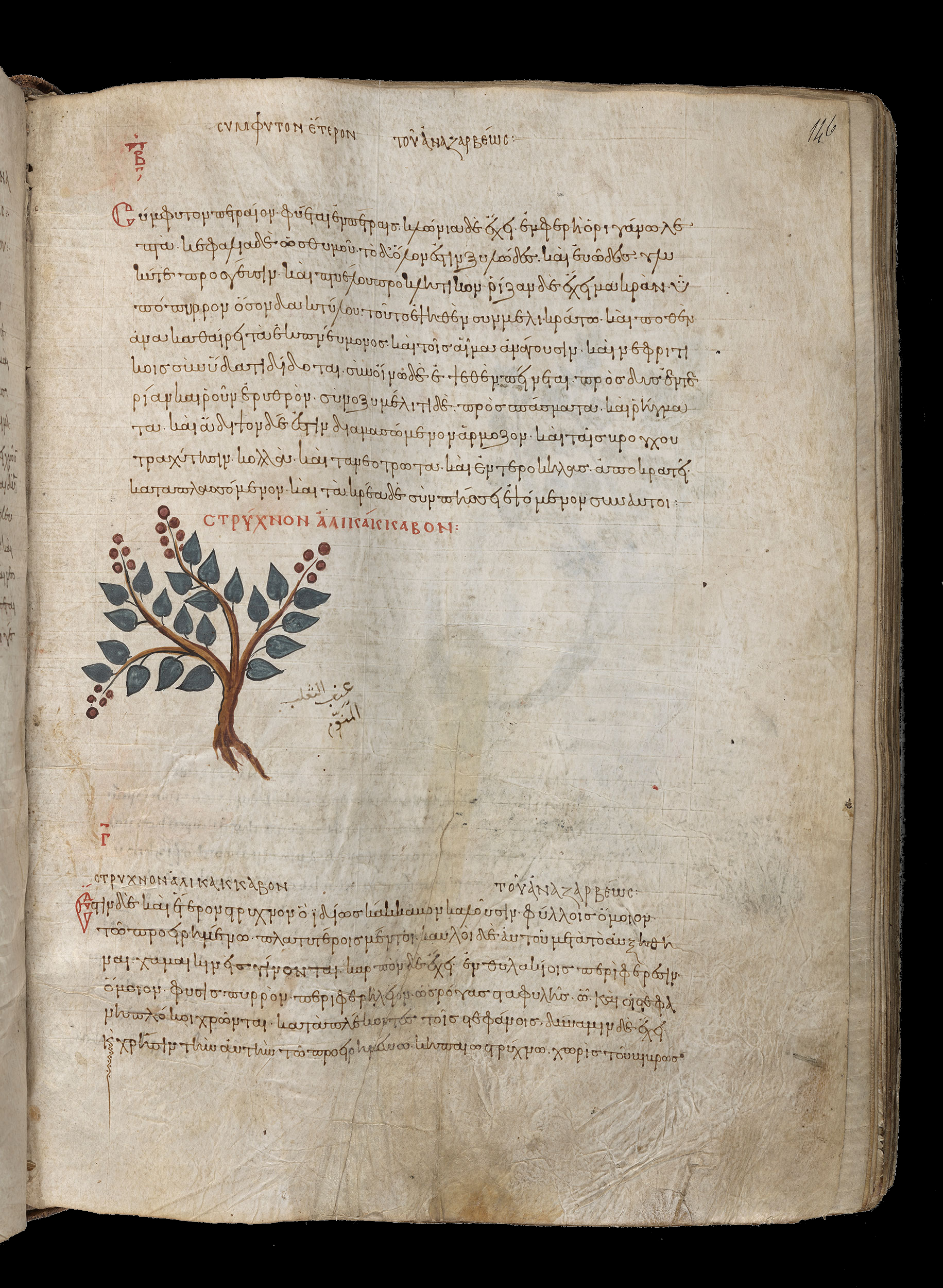
7. New York, Pierpont Morgan Library M 652, f. 146r
(στρύχνον-ἁλικάκκαβον-struchnon alikakkabon)
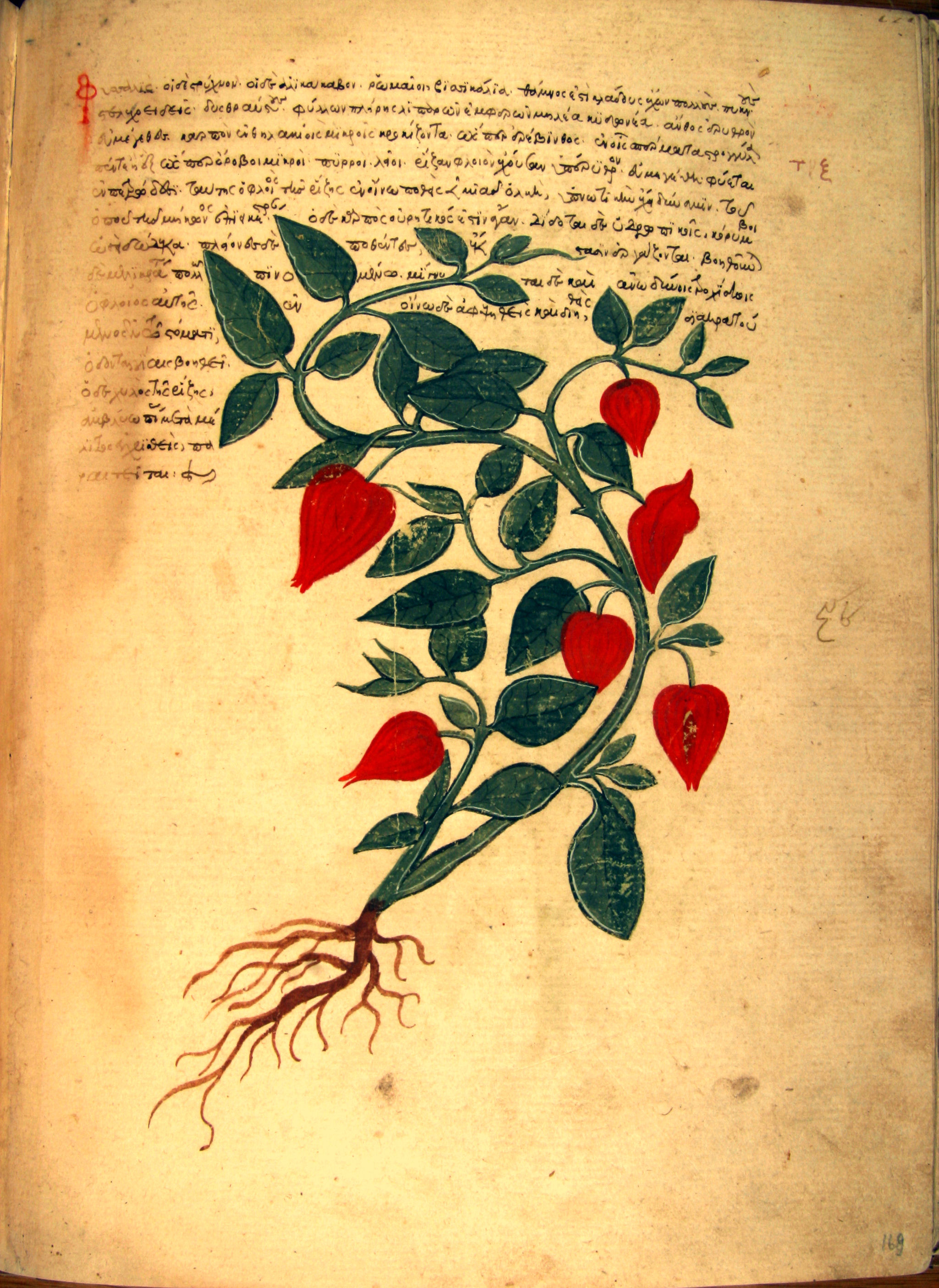
8. Padua, Biblioteca del Seminario Vescovile, 194, f. 169r
(φυσαλλίς-fusallis)
9. Padua, Biblioteca del Seminario Vescovile, 194, f. 197r
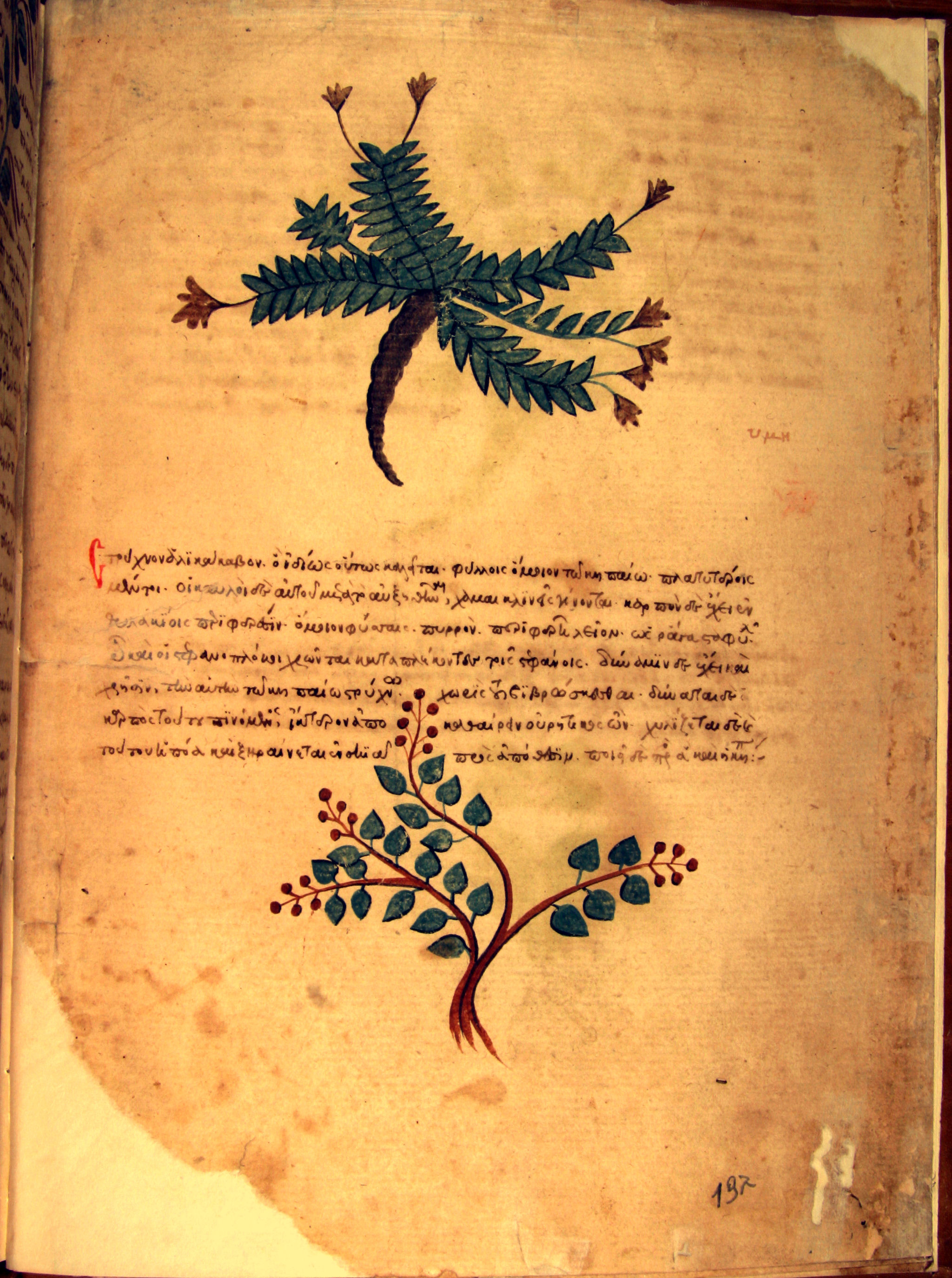
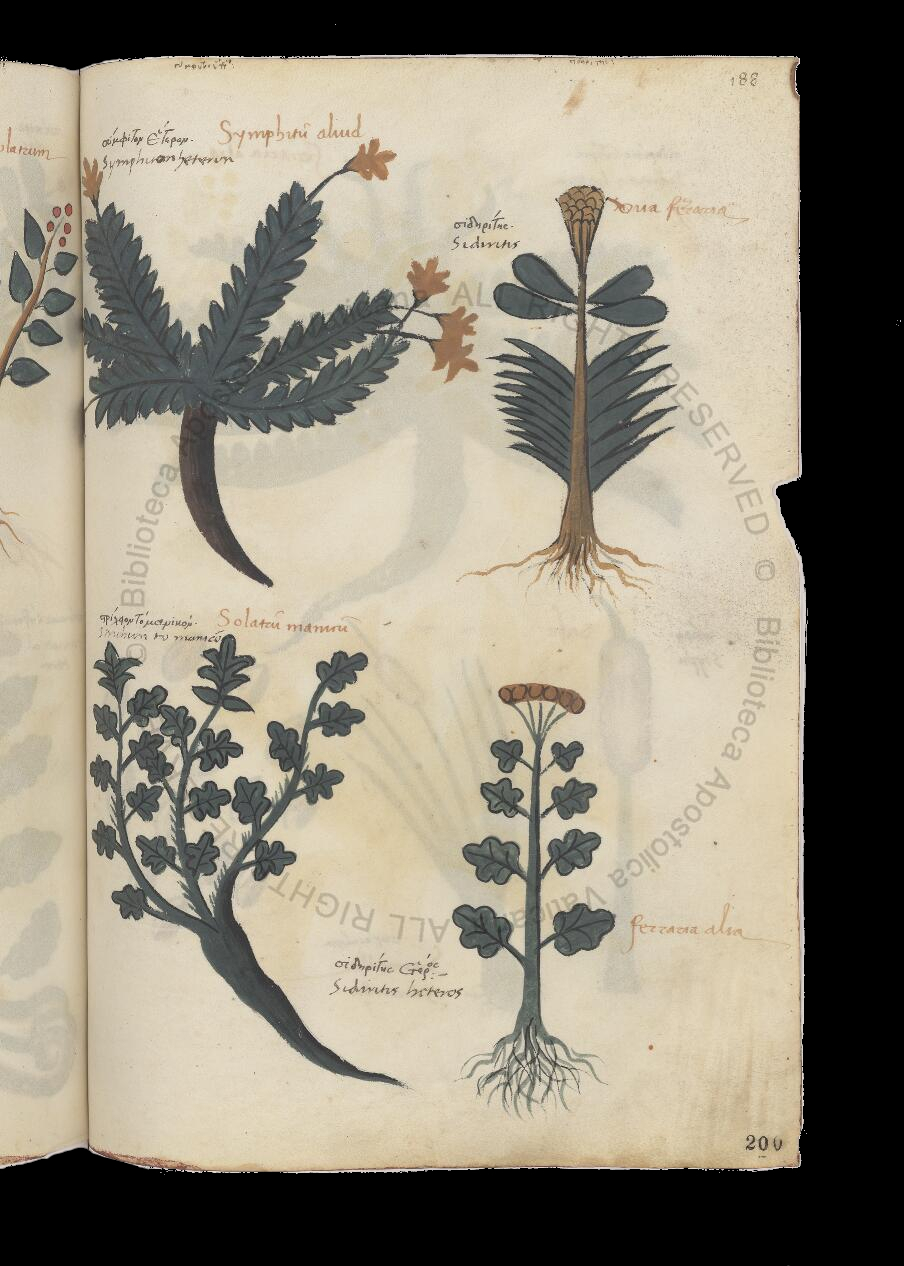
(στρύχνον-ἁλικάκκαβον-struchnon alikakkabon)
10. Vatican, Biblioteca Apostolica Vaticana, Chigi F.VII.159, f. 199v
(στρύχνον-ἁλικάκκαβον-struchnon alikakkabon)
11. New York, Pierpont Morgan Library M 652, f. 255v
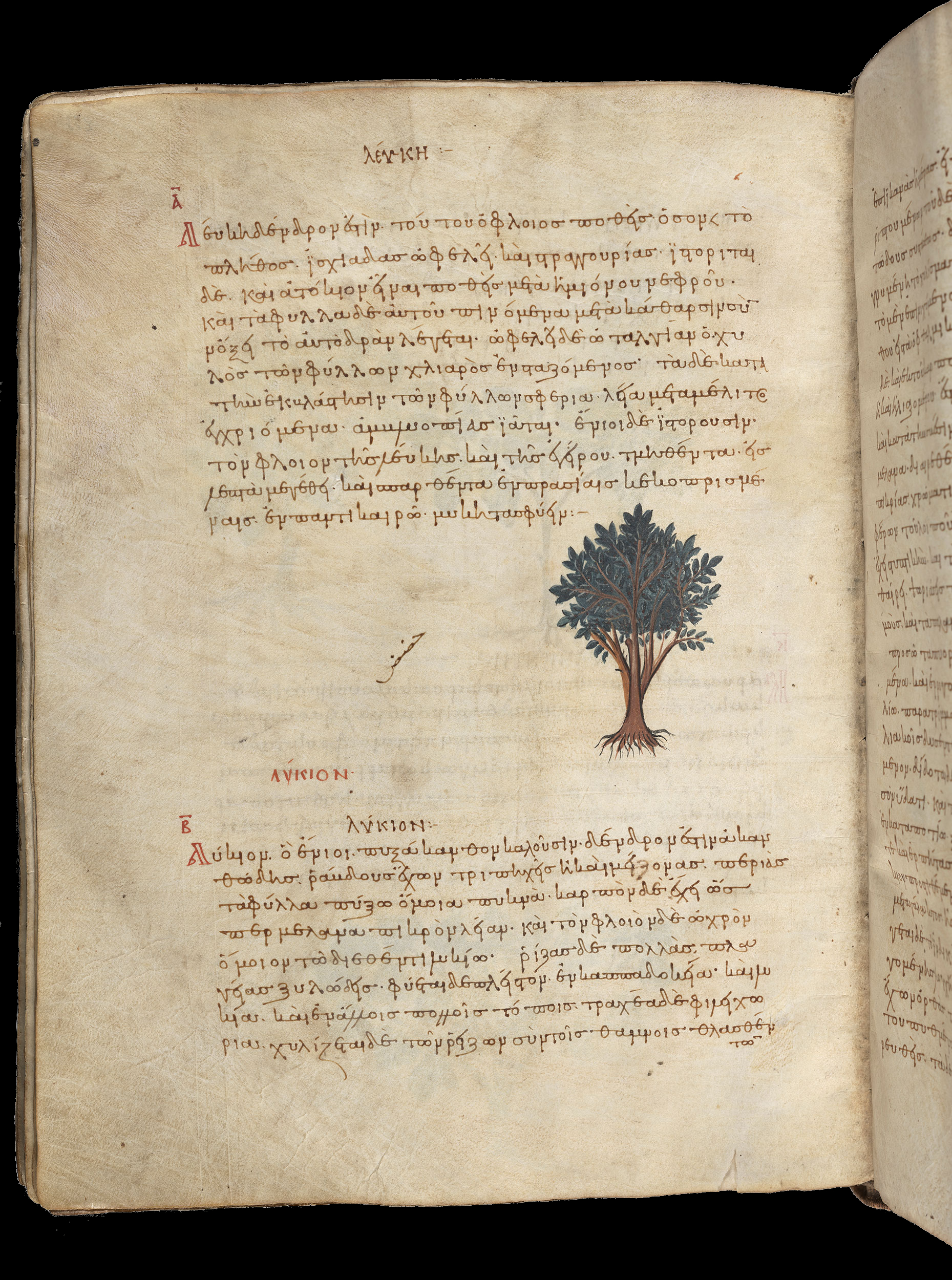
(λύκιον-lukion)
12. Vatican, Biblioteca Apostolica Vaticana, Chigi F.VII.159, f. 215v
(λύκιον-lukion)
13. Paris, Bibliothèque nationale de France, graecus 2179, f. 103v
(μανδραγόρα θῆλυ-mandragora thelu)
14. New York, Pierpont Morgan Library M 652, f. 104v
(μανδραγόρα θῆλυ-mandragora thelu)
15. Padua, Biblioteca del Seminario Vescovile, 194, f. 190v
(μανδραγόρα-mandragora)
16. Paris, Bibliothèque nationale de France, graecus 2179 , f. 104r
(μανδραγόρα ἄρρεν-mandragora arren)
17. New York, Pierpont Morgan Library M 652, f. 103v
(μανδραγόρα ἄρρεν-mandragora arren)
18. Padua, Biblioteca del Seminario Vescovile, 194, f. 190r
(μανδραγόρα-mandragora)
19. Paris, Bibliothèque nationale de France, graecus 2179, f. 101v
(στρύχνον κηπαῖον-struchnon kēpaion)
20. Padua, Biblioteca del Seminario Vescovile, 194, f. 138r
(στρύχνον κηπαῖον-struchnon kēpaion)
21. Vatican, Biblioteca Apostolica Vaticana, Chigi F.VII.159, f. 143v
(στρύχνον κηπαῖον-struchnon kēpaion)
22. Paris, Bibliothèque nationale de France, graecus 2179, f. 102v
(στρύχνον ὑπνωτικόν-struchnon upnōtikon)
23. New York, Pierpont Morgan Library M 652, f. 146v
(στρύχνον τὸ μανικόν-struchnon to manikon)
24. Padua, Biblioteca del Seminario Vescovile, 194, f. 197v
(στρύχνον μανικόν-struchnon manikon)
25. Vatican, Biblioteca Apostolica Vaticana, Chigi F.VII.159, f. 200r
(στρύχνον τὸ μανικόν-struchnon to manikon)
26. Paris, Bibliothèque nationale de France, graecus 2179, f. 103r
(στρύχνον τὸ μανικόν-struchnon to manikon)
27. New York, Pierpont Morgan Library M 652, ff. 41v
(δορύκνιον-doruknion)
28. Padua, Biblioteca del Seminario Vescovile, 194, f. 185v
(δορύκνιον-doruknion)
29. Paris, Bibliothèque nationale de France, graecus 2179, f. 105r
(μώριον-mōrion)
30. New York, Pierpont Morgan Library M 652, f. 107r
(μώριον-mōrion)
The very name Solanaceae used by Linnaeus comes from the Latin solanum, which, according to Pliny, Naturalis Histori, 37.132, is the equivalent of the Greek phytonym στρύχνον-struchnon used to identify the taxa identified here as Solanaecae species. Linnaeus did use the Greek term στρύχνον in his taxonomy, but for a botanical genus unrelated to the Solanaceae. This genus is possibly best known through Strychnos nux-vomica L., which is the source of the highly poisonous strychnine. It is native to a region from Bangladesh to Thailand and further introduced to South-central and Southeast China and beyond, and Cuba.
The Solanaceae species recognized in the botanico-medical literature of ancient Greece are the following (alphabetical order of ancient Greek names) with their identification according to contemporary Linnean, binomial taxonomy:
| ἁλικάκκαβον-alikakkabon | Physalis officinarum Moench (= P. alkekengi L.) | |
| δορύκνιον-doruknion | Physalis officinarum Moench (= P. alkekengi L.) and [?] Withania somnifera (L.) Dunal (=Physalis somnifera L.) | |
| λύκιον-lukion | Lycium europaeum L. | |
| μανδραγόρας-mandragoras | Mandragora officinarum Bertol. | |
| στρύχνον κηπαῖον-struchnon kēpaion | Solanum nigrum L. | |
| στρύχνον μανικόν-struchnon manikon | Datura stramonium L. and Atropa bella-donna L. | |
| στρύχνον ὑπνωτικόν-struchnon upnōtikon | Withania somnifera (L.) Dunal |
Material for this study is both textual and iconographic (botanical tables in manuscripts of the relevant texts) used independently or in combination.
The texts considered here are chapters and fragments about the following seven Greek phytonyms (in alphabetical order of their Greek name):
- δορύκνιον-doruknion
- λύκιον-lukion
- μανδραγόρας-mandragoras
- στρύχνον ἕτερον -ἁλικάκκαβον- struchnon eteron alikakkabon
- στρύχνον κηπαῖον-struchnon kēpaion
- στρύχνον μανικόν-struchnon manikon
- στρύχνον ὑπνωτικόν-struchnon upnōtikon
The phytonyms have been identified in Dioscorides, De materia medica (1st cent. A.D.), with complements from the following eight treatises by Galen (129-after [?] 216 A.D.) and two Pseudo-Galenic works of later epoch (listed in alphabetical order of standard Latin titles):
- De alimentorum facultatibus
- De compositione medicamentorum per genera
- De compositione medicamentorum secundum locos
- De methodo medendi
- De sanitate tuenda
- De simplicium medicamentorum temperamentis et facultatius, abbreviated here as De simplicibus
- De temperamentis
- In Hippocratis De articulis
and the following two pseudo-Galenic treatises:
- De remediis parabilibus
- De succedaneis
All these texts are reproduced in the original Greek language in Appendix I on the basis of their current standard edition. For the purposes of easy reference in the analysis, they are sequentially numbered from [1] to [57], with possible subdivisions for some of them (e.g. [20.1]). A list of the selected passage follows the texts.
Not all manuscripts contain a representation of all the plants under study here and not all representations provide the same level of botanical information. The manuscripts of interest selected here are the following (in plausible chronological order):
- Naples, Biblioteca Nazionale Emanuele III, Ex Vindobonensis graecus 1, 7th century
- Paris, Bibliothèque nationale de France, graecus 2179, 8th century (?)
- New York, Pierpont Morgan Library, M 652, 10th century
- Padua, Biblioteca del Seminario Vescovile, 194, 14th century (2nd quarter)
- Vatican, Biblioteca Apostolica Vaticana, Chigi F.VII.159, 15th century
Although not all represent the same iconographic tradition, they offer significant convergences, possibly hinting at a common origin.
It is remarkable that no manuscript of Galen, De simplicibus contains plant representations, except one. This exception is the 10th century manuscript Vaticanus graecus 284 that merges De simplicibus and Dioscorides, De materia medica, in a unique and idiosyncratic ways. The small plant representations in the margins adapt the structure of the representations to the oblong format at the margins, sometimes taking advantage of the free spaces at the end of the lines and inserting twigs or leaves between the lines of the text. In fact, these plant representations were not part of the original programme of the manuscript, but were introduced later, apparently during the 14th century. No manuscript of other Greek botanical or pharmaco-therapeutic treatise contains plant representations scientific in nature.
All plant representations are listed in Appendix II, which includes a table of concordance.
For several taxa, Dioscorides provides synonyms (lemmas and synonyms are in bold):
- [1.1] λύκιον, ὃ ἔνιοι πυξάκανθαν καλοῦσι, ...
- [4.1] ἔστι δὲ καὶ ἕτερον στρύχνον, ὃ ἰδίως ἁλικάκκαβον καλοῦσι ...
- [5.1] στρύχνον ὑπνωτικόν, οἱ δὲ ἁλικάκκαβον, οἱ δὲ κακκαλίαν καλοῦσι ...
- [6.1] στρύχνον μανικόν, ὃ ἔνιοι πέρσειον, οἱ δὲ περισσόν, οἱ δὲ ἄνυδρον, οἱ δὲ πεντόδρυον, οἱ δὲ ἔνορυ, οἱ δὲ θρύον, οἱ δὲ ὀρθόγυιον ἐκάλεσαν ...
- [7.1] δορύκνιον, ὃ κρατεύας ἁλικάκκαβον ἢ καλλέαν καλεῖ ...
- [8.1] μανδραγόρας · οἱ δὲ ἀντίμιμον, οἱ δὲ βομβόχυλον, οἱ δὲ κιρκαίαν [, οἱ δὲ διρκαίαν] καλοῦσιν
Although these synonyms might not have all appeared in De materia medica from its original form, they are instructive.
The synonym πυξάκανθαν for λύκιον is almost glossed by the short chararacterisation of the plant that follows [1.2]: δένδρον ἐστὶν ἀκανθῶδες. Interestingly, this segment of De materia medica text is exacly reproduced by Galen in De simplicibus [19.1] and [19.2], unless this is an addition made to align Galen’s text on that of De materia medica.
The term ἁλικάκκαβον is used for three different phytonyms: [4.1] ἕτερον στρύχνον, [5.1] στρύχνον ὑπνωτικόν, and [7.1] δορύκνιον. Whereas this might be interpreted as the result of a confusion between all three species, it probably indicates that the three plants were identified as taxonomically related.
The higher number of synonyms for [6.1] στρύχνον μανικόν and [8.1] μανδραγόρας probably hints at the place that these plants had in popular tradition because of their potent action on humans.
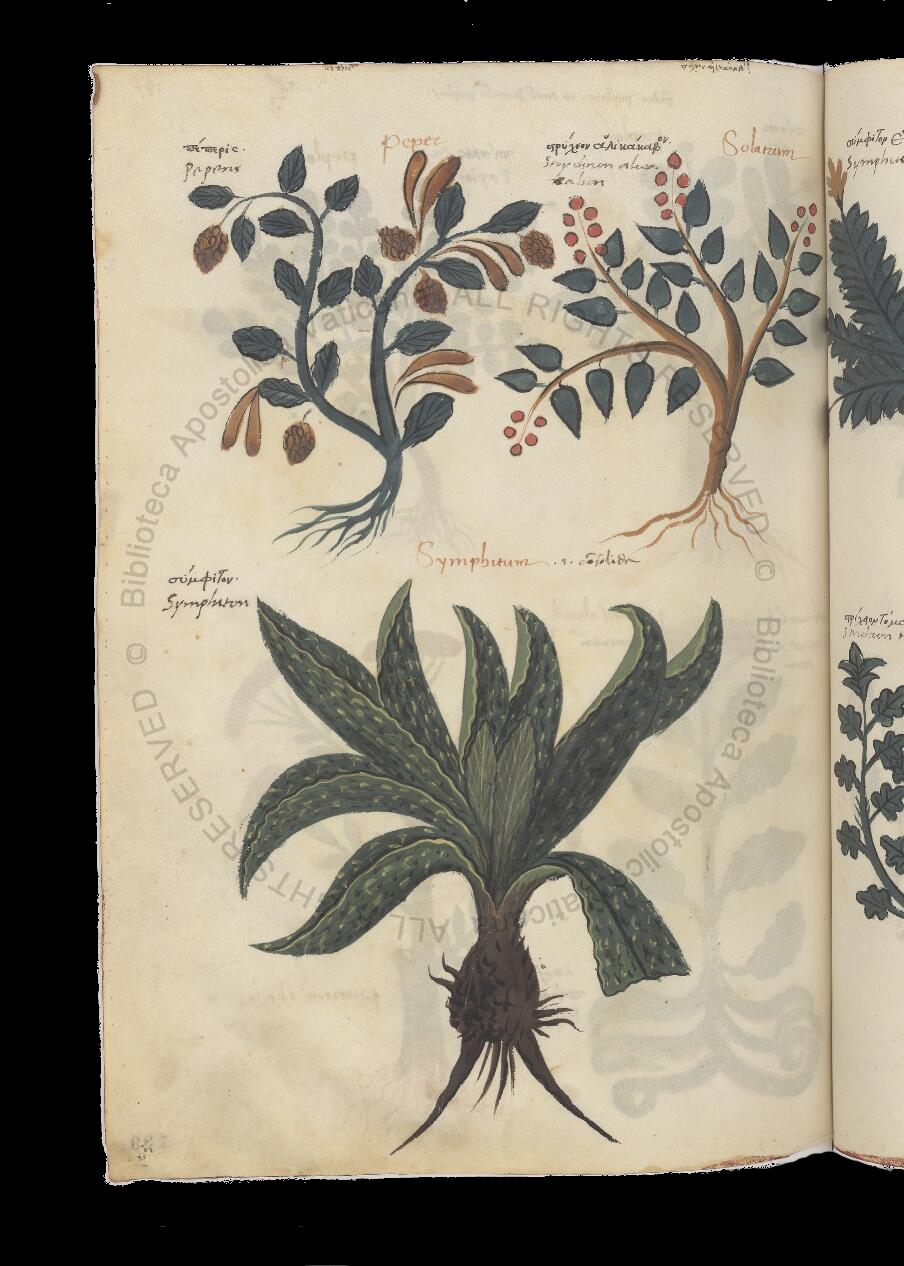
In the iconographic body, a new phytonym appeared (e.g. the manuscripts Naples f. 148r and Padua f. 169r): φυσαλλίς, which replaced the name of the στρύχνον not better identified than by ἕτερον στρύχνον [4]. This term is not used in De materia medica and must be considered as heterogeneous. As it will be seen below, it probably originates from a botanical characteristic of the plant that unmistakably distinguishes it and is especially visually translated in the iconography.
Galen lists the plants in the alphabetical order of ir most common name, which does not provide any information about botanical taxonomy. He nevertheless used some taxonomical criterion, which resulted here in a simple dichotomy edible/non-edible illustrated by στρύχνον κηπαῖον-struchnon kēpaion [54.1] vs. ἁλικάκκαβον-alikakkabon [9.1]. The difference between the two species is already present in Dioscorides, without being a taxonomical criterion, however. The chapter of De materia medica on ἁλικάκκαβον-alikakkabon follows indeed that on στρύχνον κηπαῖον-struchnon kēpaion. It specifies that ἁλικάκκαβον-alikakkabon has “the same indications as the previous one” [= στρύχνον κηπαῖον] except that it is not eaten”. In Galen, the opposition is not just about these two taxa, however. About ἁλικάκκαβον-alikakkabon, Galen specifies that it is “among those species of στρύχνον-struchnon that are not edible”, which is more general. Only the species κηπαῖον- kēpaion is explicitly said to be edible. Its name in both Dioscorides [3.1] and Galen [54.1] clearly indicates that it is a garden/cultivated plant. Galen is more explicit, writing that “it grows in gardens and all know it” [54.1]. But this might be again an addition to Galen’s original text. Returning to the dichotomy edible/non-edible, it was not necessarily translated into alimentary usages with their consequences, as we shall see.
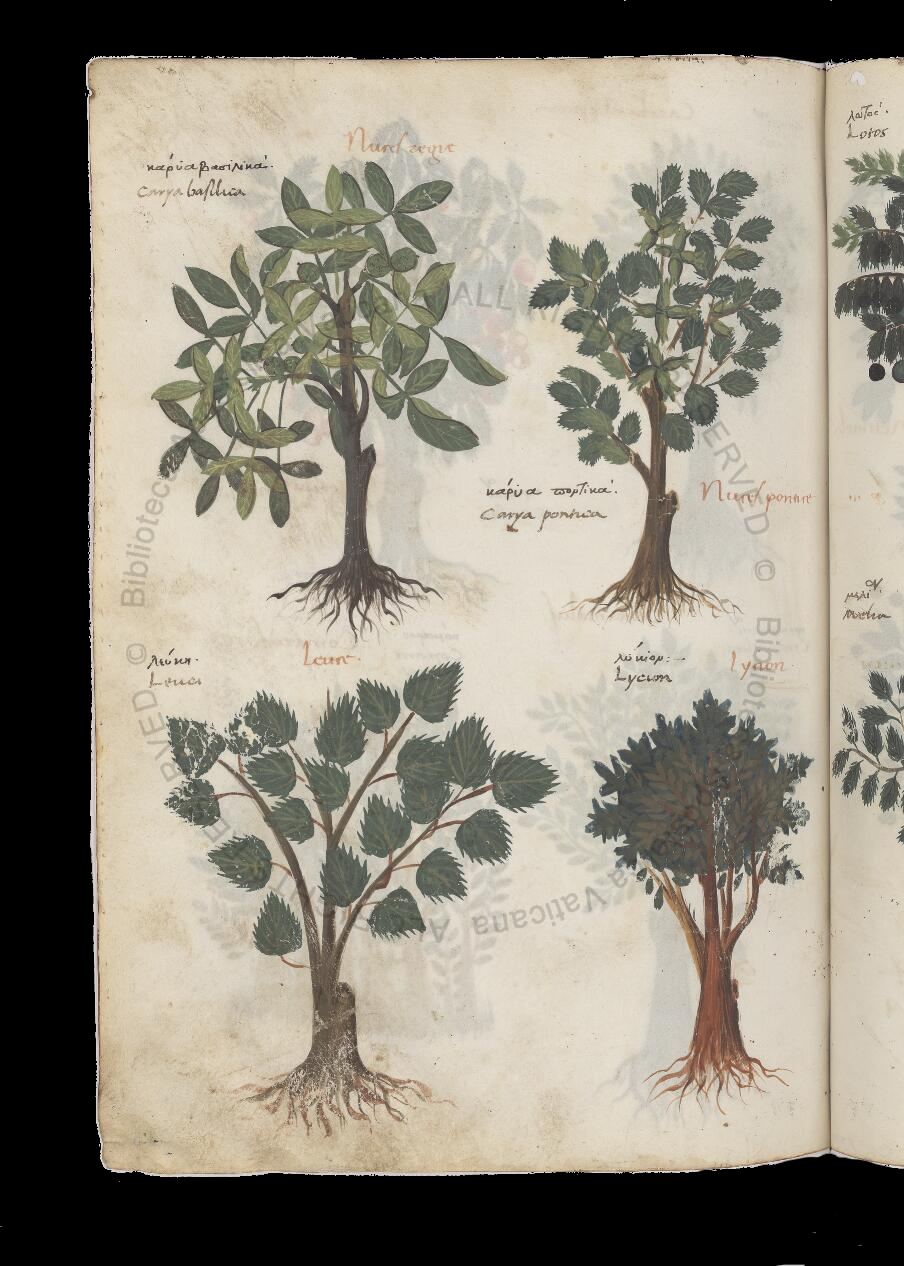
In terms of taxonomy, Dioscorides proceeded differently in De materia medica: he grouped the plants in coherent clusters (the exact nature of which might not be pharmaco-chemical as often stated) and ordered the resulting clusters on a scala naturae from iris to soot. In this system, all the taxa of the Solanaceae family studied here are grouped in book 4 except one: [1] λύκιον, which appears in the part of book 1 devoted to trees. This results from the arborescent nature of the plant, identified in the very first word of the chapter devoted to it: δένδρον ἐστὶν [1.2]. Its representation in the MS New York, f. 255v, and its copy MS Vatican, f. 215v, although generic, visualizes this structure. Though unrelated in botanical taxonomy, λύκιον-lukion nevertheless bears some therapeutic similarity with the other Solanaceae (below). Its position among the tress results from a classification system that combines botanical structures (tree in the present case) and as much as possible pharmacotherapeutic properties, though without exclusivity for the latter.
All the other Solanaceae species identified (recognized?) in De materia medica form a group in book 4 ( chapters 70-75), although they correspond to no less than six different species in modern Linnean taxonomy. Confirming this taxonomical proximity, three species are designated in the way of the Aristotelian taxonomical system of γένος and εἶδος), with a γένος name (στρύχνον) that identifies the genus, and epithets that distinguish a εἶδος; these epithets refer to descriptive factors different in nature: horticultural (κηπαῖον [3]), pharmacotherapeutic (ὑπνωτικόν [5]), or toxicologic (μανικόν [6]).
The coherence of the groups is indirectly confirmed in the substitution list attributed to, but not by Galen. As its pseudo-autobiographical introduction suggests, substitution was invented as an emergency measure in a case of unavailability of a drug. A closer examination contradicts this story and reveals that substitution is a mere pharmacotherapeutic device that expands the range of substances to be possibly applied in a treatment, being understood that substitutes have the same or similar therapeutic properties as the substituted drug. According to De succedaneis, substitutions can be made between genera of Solanaceae genera and species:
| substituted drug | subtituting drug | |
| ἁλικάκκαβον | δορυκνίου ἢ στρύχνου σπέρμα [15.1] | |
| μαδραγόρου | χυλός δορύκνιον [27.2] |
The unity of the group is further reinforced by its position within book 4 of De materia medica. A substantial part of this book is devoted to plants considered toxic as per ancient criteria. The group of the Solanaceae is framed by ψύλλιον-psullion (4.69) and ἀκόνιτον-akoniton (4.76), both of which were credited with a toxic action in the ancient toxicological literature. Whereas ψύλλιον-psullion provokes a sharp loss of bodily temperature followed by narcosis and insensivity, ἀκόνιτον-akoniton provokes an immediate loss of consciousness, and oppression on the chest and the abdomen (gastro-intestinal system) leading to death. Between these two toxic activities—defined in Antiquity by coldness for ψύλλιον-psullion and mind and chest disturbance for ἀκόνιτον-akoniton—the Solanaceae under consideration here present a rather unitary action on the human body. Galen defines it at length and repeatedly in the theoretical books of De simplicibus and returns to it on several occasions throughout his production, in treatises related to materia medica and pharmacotherapeutics, and not only.
Returning to substitutions, they are not always about related taxa as above, but can also be between unrelated taxa, be it for the subtituted or the substituting drug, as in the following cases (alphabetical order of Greek names of substituted plants; names of Solanaceae taxa in bold):
| substituted drug | subtituting drug | |
| ἀλόη Ἰνδική | ... λύκιον ... [20] | |
| δορύκνιον | ὑοσκυάμου ἢ ἐλελισαφάκου σπέρμα [18] | |
| κυνόσβατος | ἁλικακάβου σπέρμα [15.2] | |
| μανδραγόρας | ἐλαίας δάκρυον [27.1] |
Whereas the substituted or substitute plants in all the cases above are not credited with a potent physiological action, in one case, instead, one of the substitutes (ὑοσκυάμου ... σπέρμα) [18] is a powerful drug (a species of the Hyoscyamus genus). This is also the case in the following substitution where a Solanaceae substitutes opium poppy:
| substituted drug | subtituting drug | |
| μήκων | μανδραγόρου χυλός [27.3] |
In a slightly different way, Galen groups some Solanaceae (δορύκνιον and μανδραγόρας) with potent plants that include opium poppy (μήκων-mēkōn) in one case [16]; hemlock (κώνειον-kōneion) and the less active Plantago spp. (ψύλλιον-psullion) in another [23]; opium poppy and henbane (ύοσκύαμος-uoskuamos) in a third [24]; and also, opium poppy and hemlock in a last one [26]:
δορύκνιον, μήκων, μανδραγόρας [16]
μανδραγόρας, κώνειον, ψύλλιον [23]
μήκων, ύοσκύαμος, μαδραγόρας [24]
μήκων, μανδραγόρας, κώνειον [26]
In a similar way, Dioscorides compares the action of στρύχνον ὑπνωτικόν-struchnon upnōtikon to that of μήκων-mēkōn (opium poppy) [5.4].
The connection of ἁλικάκκαβον-alikakkabon, δορύκνιον-doruknion and μανδραγόρας-mandragoras with such plants as κώνειον-kōneion (hemlock), μήκων-mēkōn (opium poppy), and ύοσκύαμος-uoskuamos (henbane) indicates that the three Solanaceae here have an action similar to that of the other three plants, which were identified as toxic. In fact, στρύχνον μανικόν-struchnon manikon [6bis.3] and δορύκνιον-doruknion [7.4] are considered lethal in De materia medica, but only if consumed at higher doses. The common point between the Solanaceae and the other lethal agents here is their cooling nature (actually deadly), repeatedly affirmed by Galen (below) and best illustrated by hemlock. This explains why the group of Solanaceae appears among the toxic drugs in De materia medica, even though none of them is explicitly defined as toxic.
Whereas Dioscorides provides a morphological description of the taxa under study here in the chapter devoted to each of them, Galen does not do so, as he is less interested in botany than in pharmacotherapeutics.
In his descriptions, Dioscorides proceeds in a typical, though unsystematic way, with both a general description (structure) and an analytical one (the parts) and, for the latter, from root to top. In the description of the parts, he considers their shape, number and dimension, appearance and consistency/texture, colour with possible differences according to the annual life cycle, organoleptic qualities in some cases, and any other element that might be distinctive.
All descriptive characters presented by Dioscorides for the taxa studied here are tabulated in English in two tables: Table 1 about all the taxa except mandrake, and Table 2 for mandrake only.
Table 1
Botany — All taxa except Mandragoras
| Shape | Root | Stems | Leaves | Flower | Fruit | |
|---|---|---|---|---|---|---|
| Alikakkabon [4.2] | folding downward when grown |
|
| |||
| Doruknion [7.1] |
| less than 1 cubit |
| white |
| |
| Struchnon kēpaion [3.2] |
| abundant |
|
| ||
| Struchnon manikon [6.2] |
|
| white |
| ||
| Struchnon manikon [6bis.1] |
|
| ||||
| Struchnon upnōtikon [5.2] | bush |
|
|
|
|
|
Table 2
Botany — Mandragoras
| Female [8.2/1] | Male [8.2/2] | Mōrion [8bis.1] | |
|---|---|---|---|
| Colour | black | white | |
| Leaves |
|
|
|
| Fruit |
|
| |
| Root |
|
|
|
| Stem | none | none |
This tabular presentation, comparative in nature, evidences significant features that the textual presentation, sequential in nature and, consequently, fragmented, does not allow. The most salient characteristic revealed by this tabular presentation is the focus on the fruit, the description of which is present for all taxa, contrary to what happens for the other structural elements of the plants, which are treated in a non-systematic way. Description of the fruits refers in an almost systematic way to the following parameters:
structure
shape
colour, with possible evolution over time
dimensions
numbers when applicable
organoleptic qualities (touch)
comparison with well-known plants, including difference(s)
Comparison is frequently used to distinguish the two species (female and male, in this order) of μανδραγόρας-mandragoras [8], and also μώριον-mōrion [8bis] (Table 2). In other cases, Dioscorides compares parts of the taxa here to those of others, for example the leaves of λύκιον-lukion to those of Boxwood and its fruit to Pepper [1.2]. Also, when describing στρύχνον ὑπνωτικόν-struchnon upnōtikon, he compares its leaves to those of Quince tree [5.2] and, in describing the fruit of στρύχνον μανικόν-struchnon manikon, he compares it to grape [6bis.1]. In typically Aristotelian method, in several of the comparisons, he includes both a common element and a difference. If he compares the leaves of στρύχνον κηπαῖον-struchnon kēpaion to those of Basil, he immediately adds that they are longer and larger [3.2]. He does the same for the leaves of ἁλικάκκαβον-alikakkabon, comparing its leaves to those of the previous plant (στρύχνον ηπαῖον- struchnon kēpaion), mentioning, however, that they are larger [4.2]. Other such cases are those of στρύχνον μανικόν-struchnon manikon the leaves of which recall those of Rocket although they are smaller [6.2], and its fruit, which is like the olive, but hairy (below) [6.2]. The leaves of the Olive tree are used to describe those of δορύκνιον-doruknion, wich are smaller, however [7.2].
This focus on the fruit and the lack of systematicity about the other parts of the plants reveal the exact nature of plant descriptions in Dioscorides: they are not aimed at offering a full botanical description but concentrate on the characteristic(s) that allows for correct identification in a functional way. As a consequence, the lexicon of the different parts of these descriptions is differentiated: whereas it is generic and non-specific for all the parts that are not the fruit, with the possible exception of the general shape (tree, bush, low plant), which refers to the Theophrastean quadripartite division of the whole plant world, for the fruit, instead, it is precise and descriptive, with a selected lexicon (especially for the shapes), with a higher number of comparisons that connects specific plants to more familiar and well-known species.
This diagnostic function of the plant description is reflected in the representations that accompany the text in several manuscripts. The clearest—but not unique—case is that of ἁλικάκκαβον-alikakkabon: its fruit is described as a round capsule similar to bladder that contains a yellow/orange fruit, round, light, and like grape, which is represented in a vivid color in the manuscripts, and in a persistent way from the most ancient to the most recent (below). Such focus on meaningful diagnostic characters might have contributed in some cases and manuscripts to give a non-natural appearance to plant representations.
Dioscorides provides some information about the habitat of the taxa. Στρύχνον ὑπνωτικόν-struchnon ὑπνωτικόν grows in rocky places [5.3] while στρύχνον μανικόν-struchnon manikon in mountainous and windy ονεσ, as well as in areas planted with Plane trees [6bis.2]. Δορύκνιον-doruknion grows in rocky places close to the sea [7.3], and μώριον-mōrion in shady areas and in the proximity of caves [8bis.1].
Information on distribution is almost absent. Only for λύκιον-lukion does Dioscorides specifies the region from which it comes from: Cappadocia and Lycia—the latter as an etymology—and in numerous other places not otherwise identified [1.3]. A similar distribution in Cappadocia and Lycia is found in Galen [19.5].
Considering the characteristics of each taxon provided in De materia medica and focusing on the fruit as a uniquely distinctive diagnostic device as did Dioscorides (see Tables 1 and 2), while consulting at the same time the representations of the plants in the manuscripts (see the list by plant in Appendix II and their reproduction at the end of this study), identifications at the level of genus and species can be proposed for the ancient phytonyms studied here. Identifications below (reflecting updated taxonomy) include the plant diagnostic characteristic(s) that allows for the identifications with a brief discussion based on modern floras (alphabetical order of Greek names).
 |  |
| μανδραγόρας | Mandragora officinarum Bertol .(.) | |
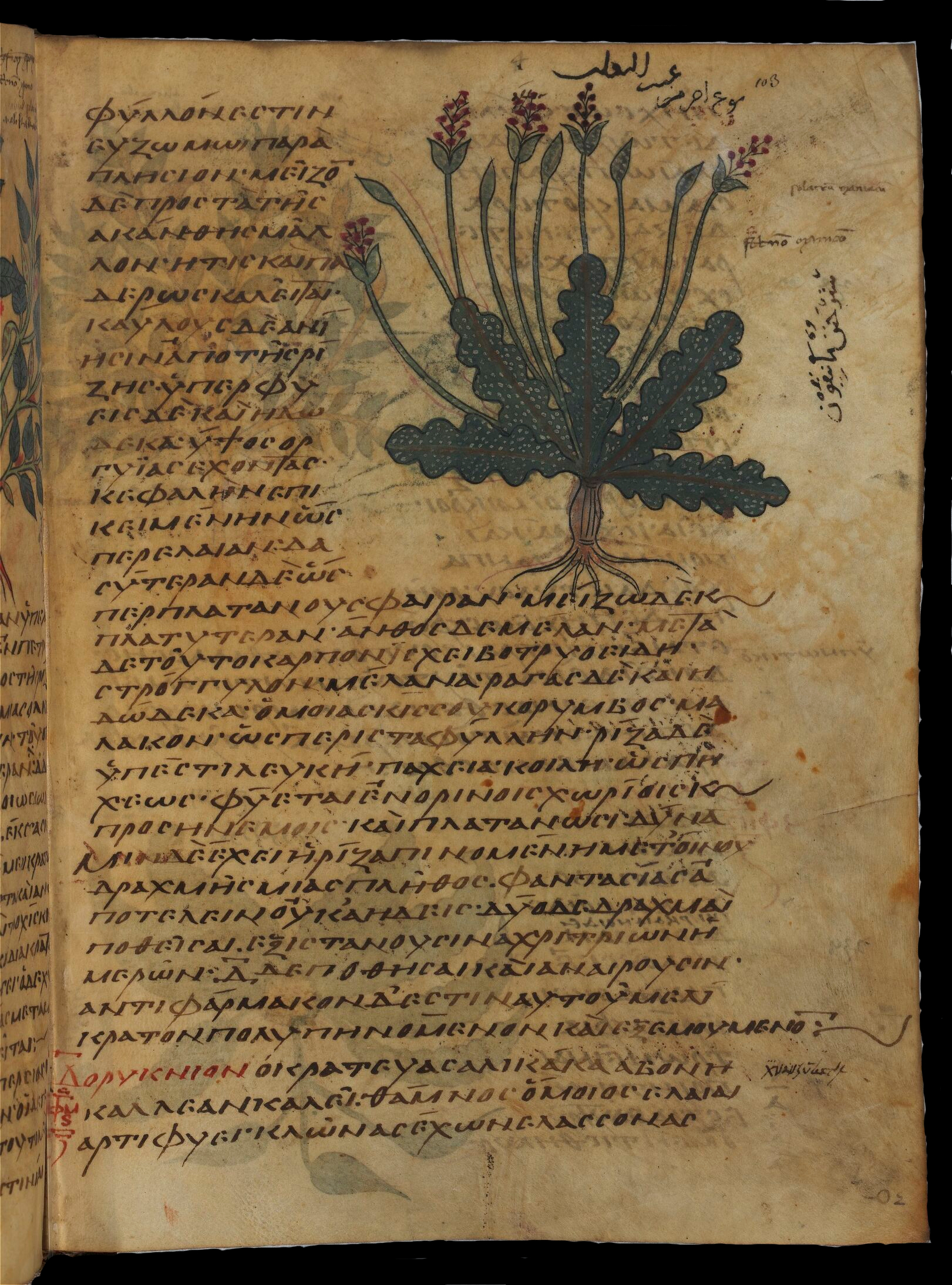
| Both the male and female species correspond to Mandragora officinarum L. = M. autumnalis Bertol., the flowers of which can be whitish or purplish. This colour difference probably justifies the distinction of a female and a male species of the ancient texts. The dark colour of the female species (to be understood as referring to a darker/deeper, not black strictly speaking, and probably referring to individuals with purplish flowers), which apparently contradicts the gendering of colour in the ancient Greek world (dark = male vs. light = female), might refer to a meaning of dark as a negatively connotated colour. The colour of the fruit of each species, instead, reflects the ancient gender distinction, with the greenish fruit of the female species and the saffron-like of the make species. In addition to colour, size and smell oppose the two species: the female species is smaller, has leaves with a fetid and heavy smell, and a fruit with a pleasant smell instead, whereas the male species has long and large leaves without the fetid odour of the female species, and the same pleasant odour of the fruit, but stronger and heavier. The representations in manuscripts accentuate this dichotomy of the two species, particularly the smaller size of the female species (from left to right: MS Paris f. 103v; MS New York f. 104v; MS Padua f. 190v) opposed to that larger and stronger of the male one (MS Paris f. 104r; MS New York f. 103v; MS Padua f. 190r). |
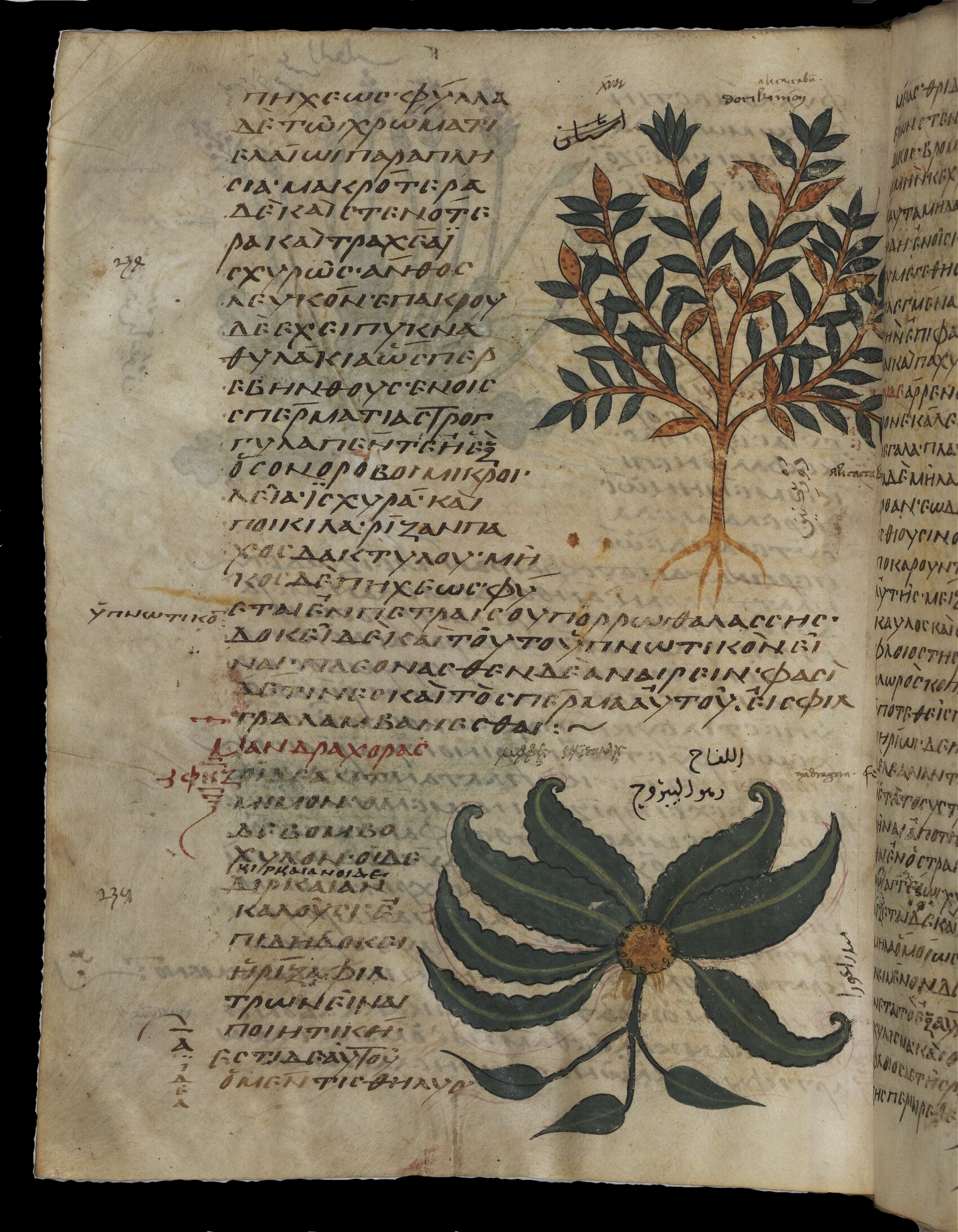 | 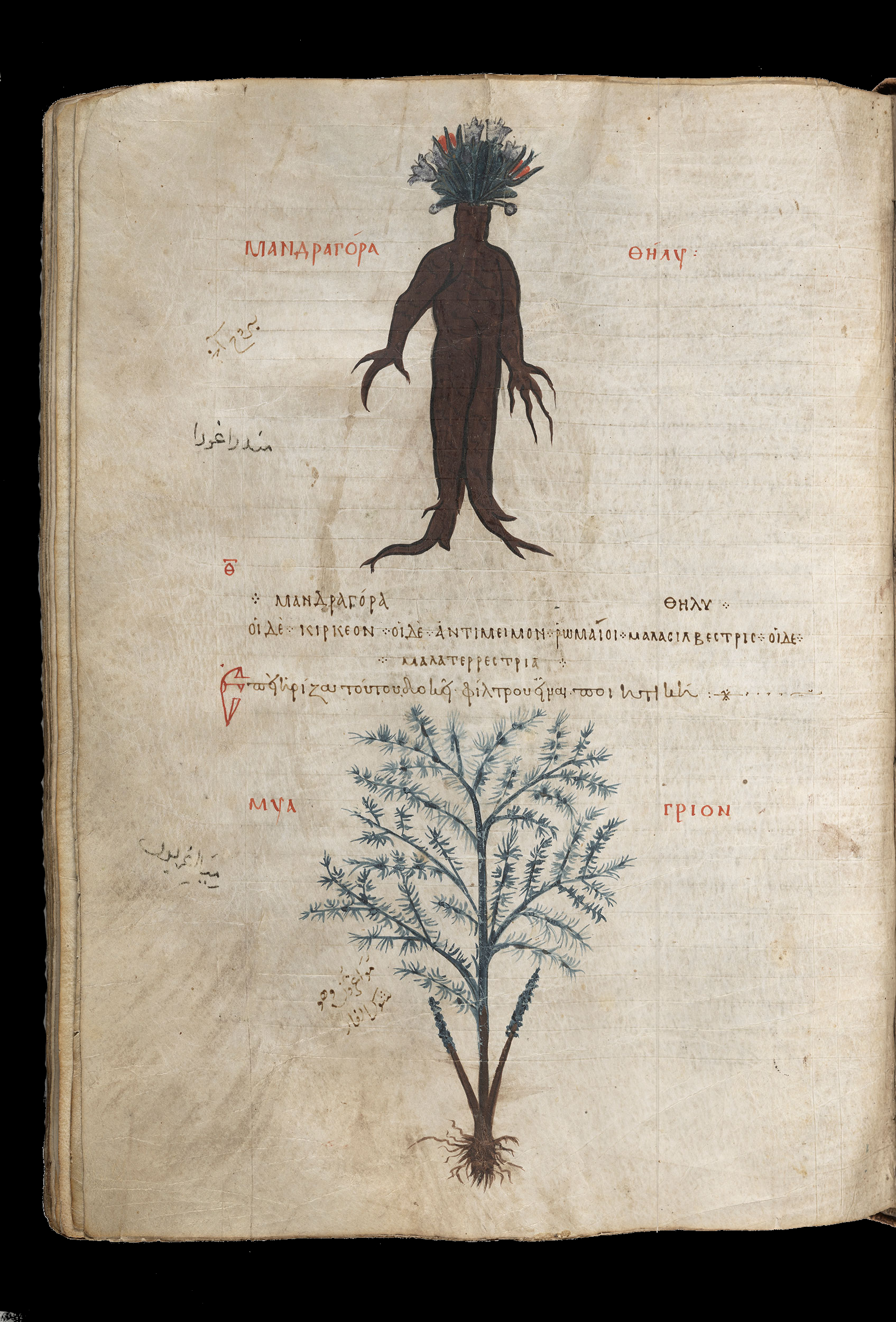 | 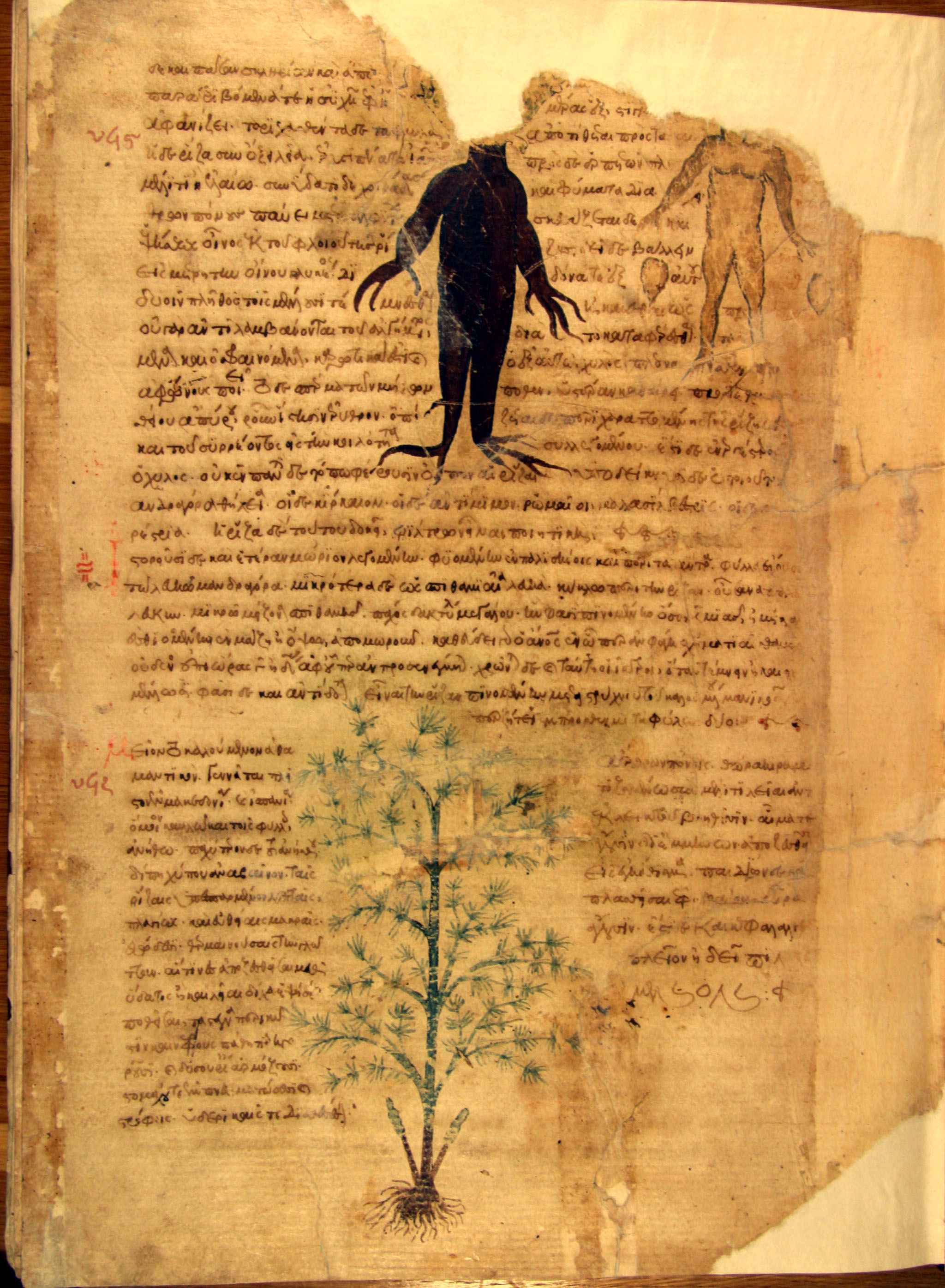 |
Female mandrake
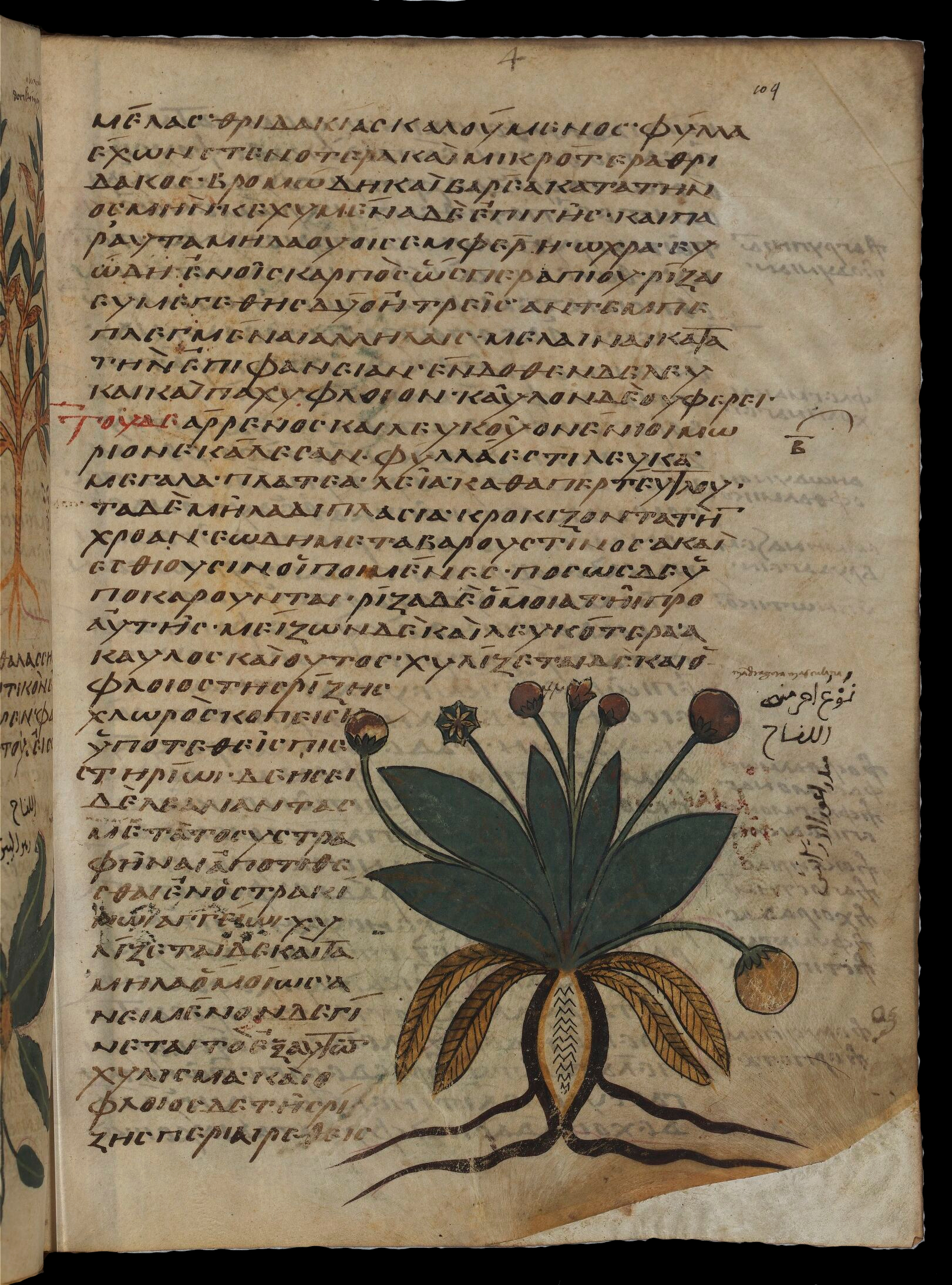 | 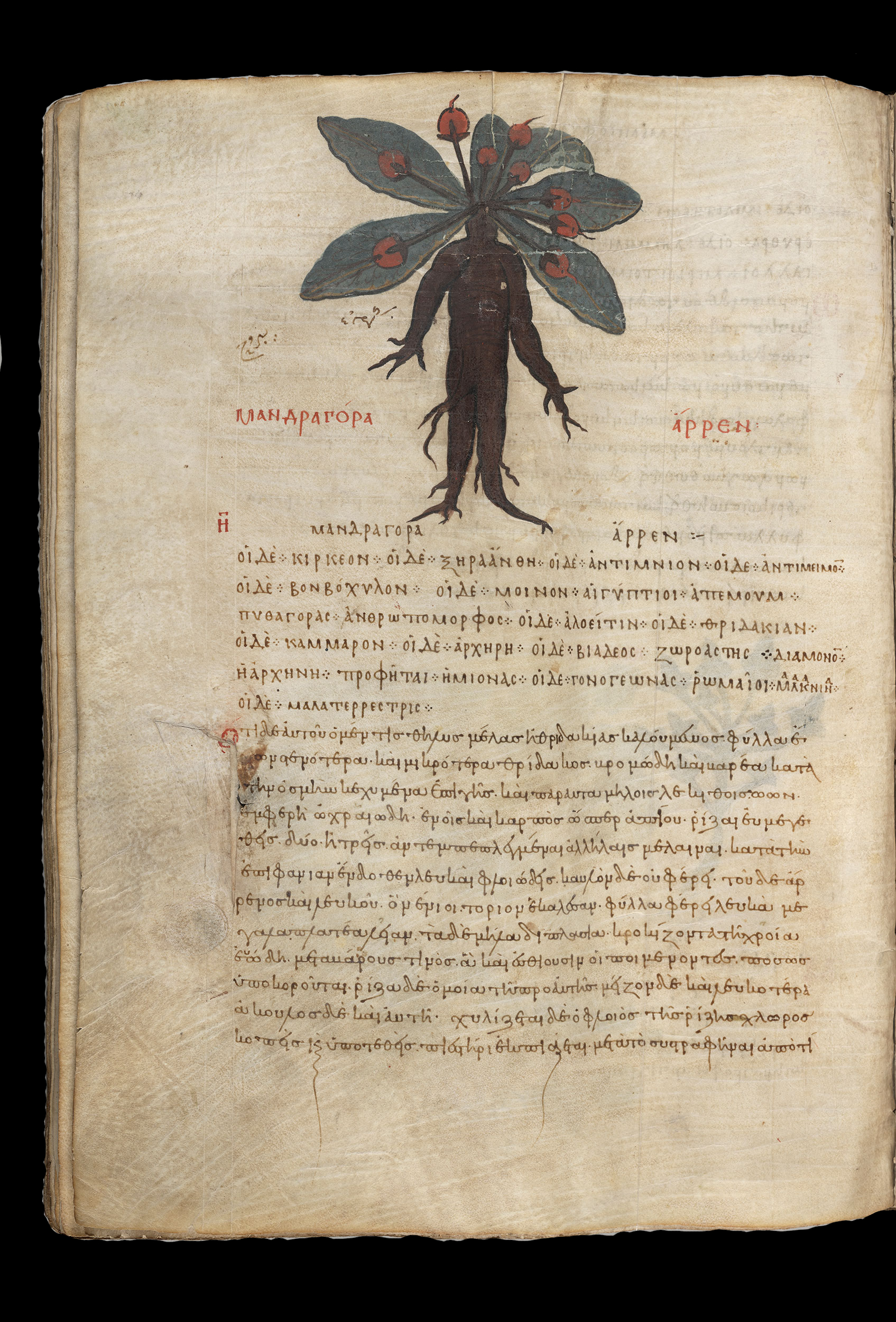 | 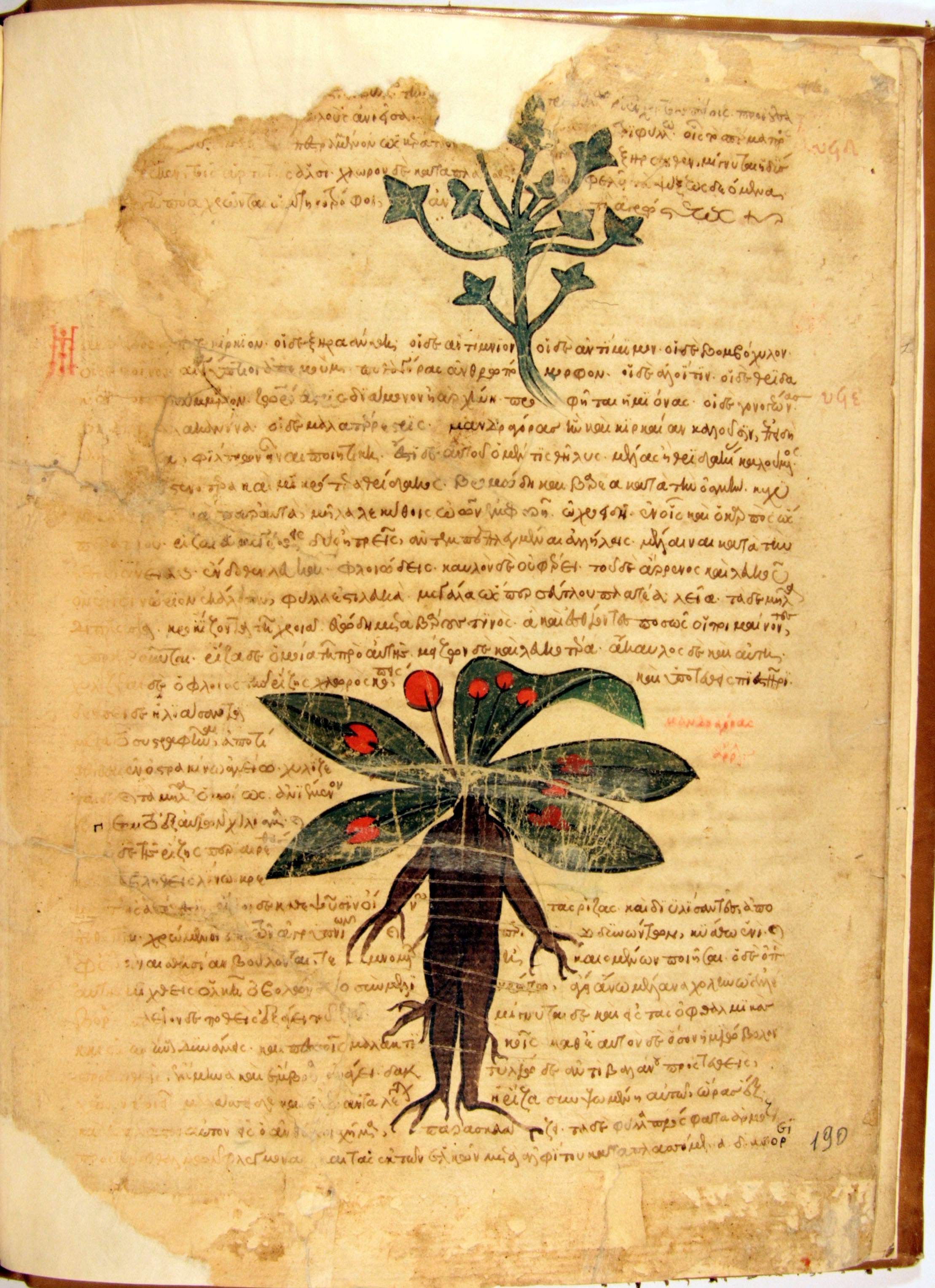 |
Male mandrake
| στρύχνον κηπαῖον | Solanum nigrum L. | |
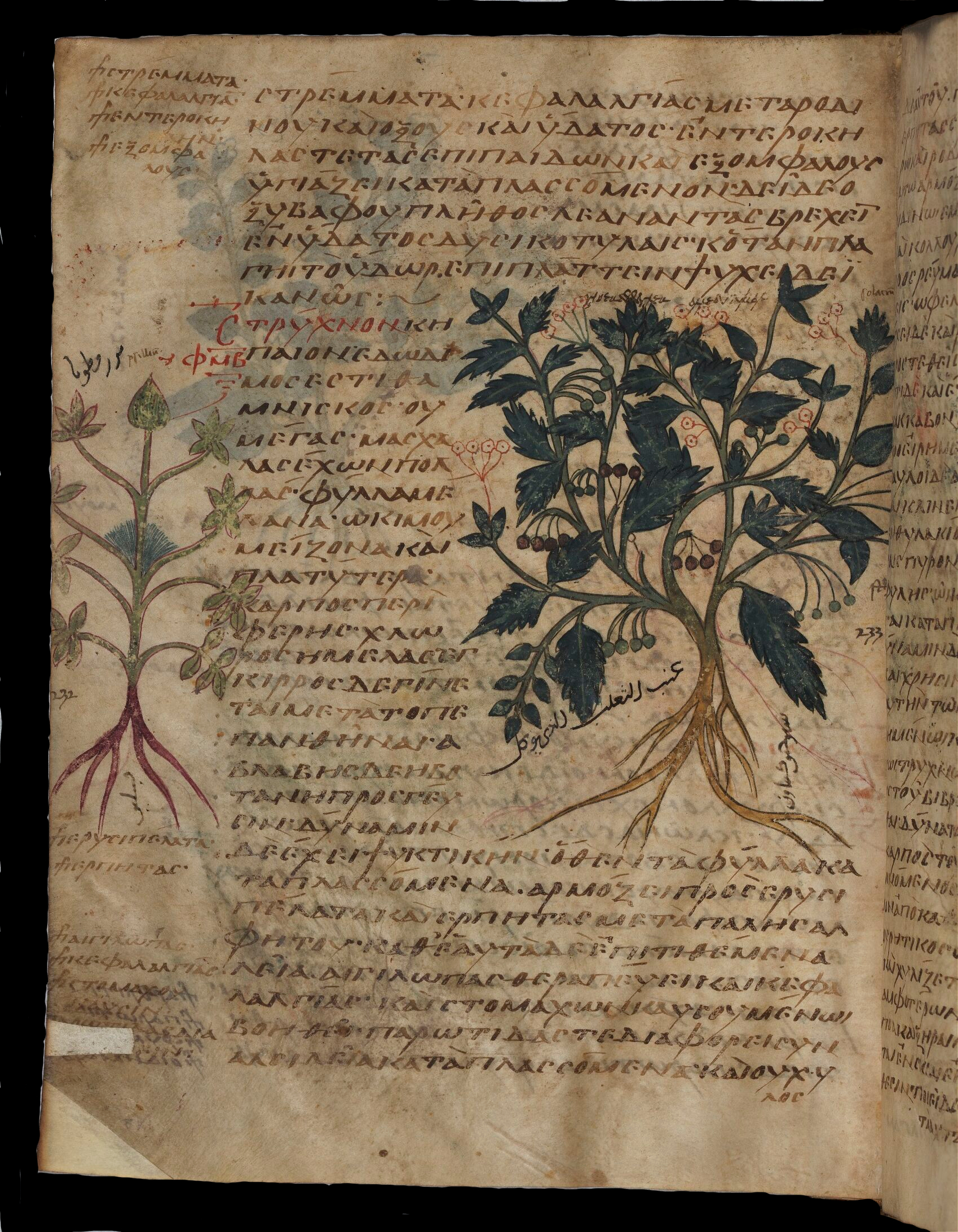
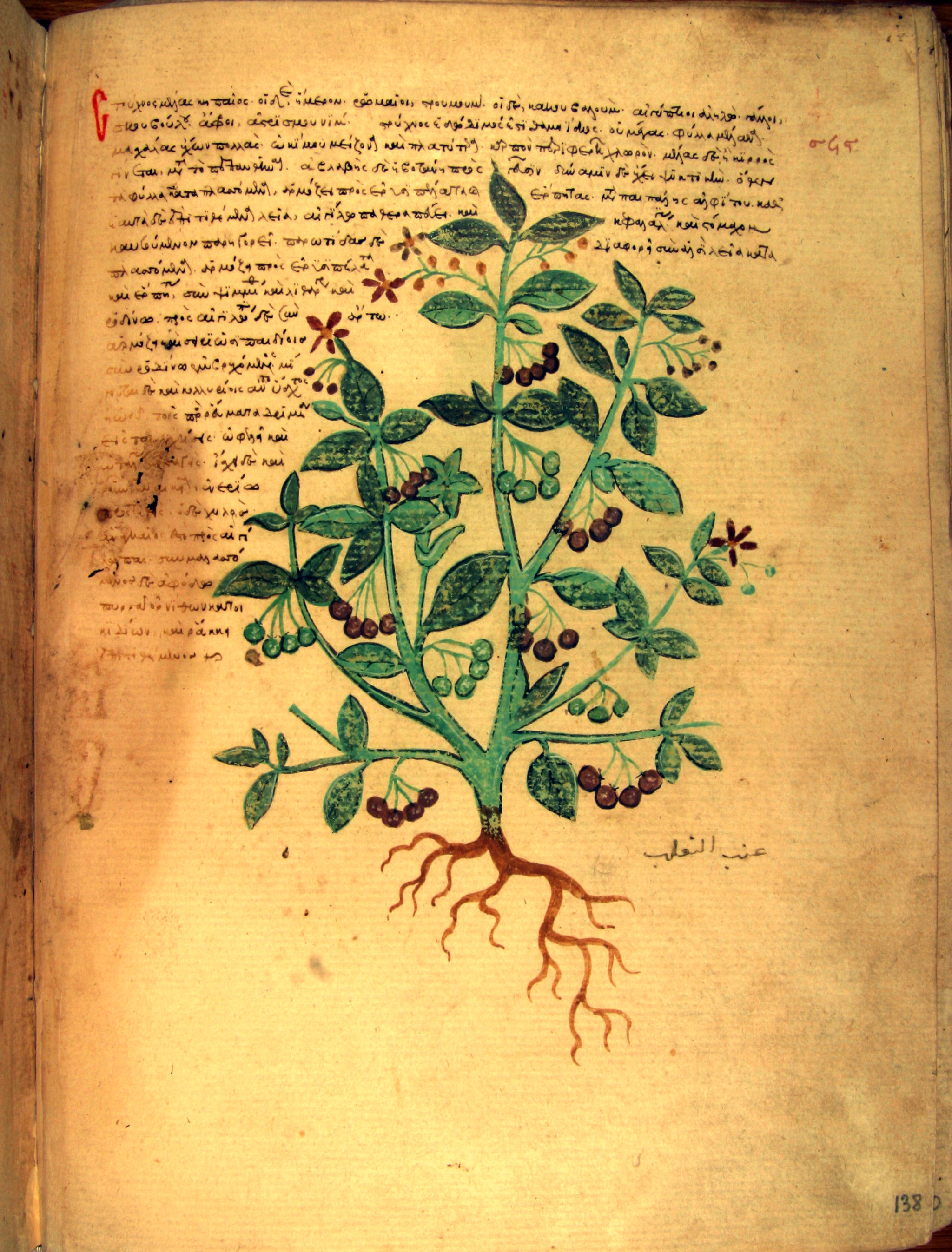
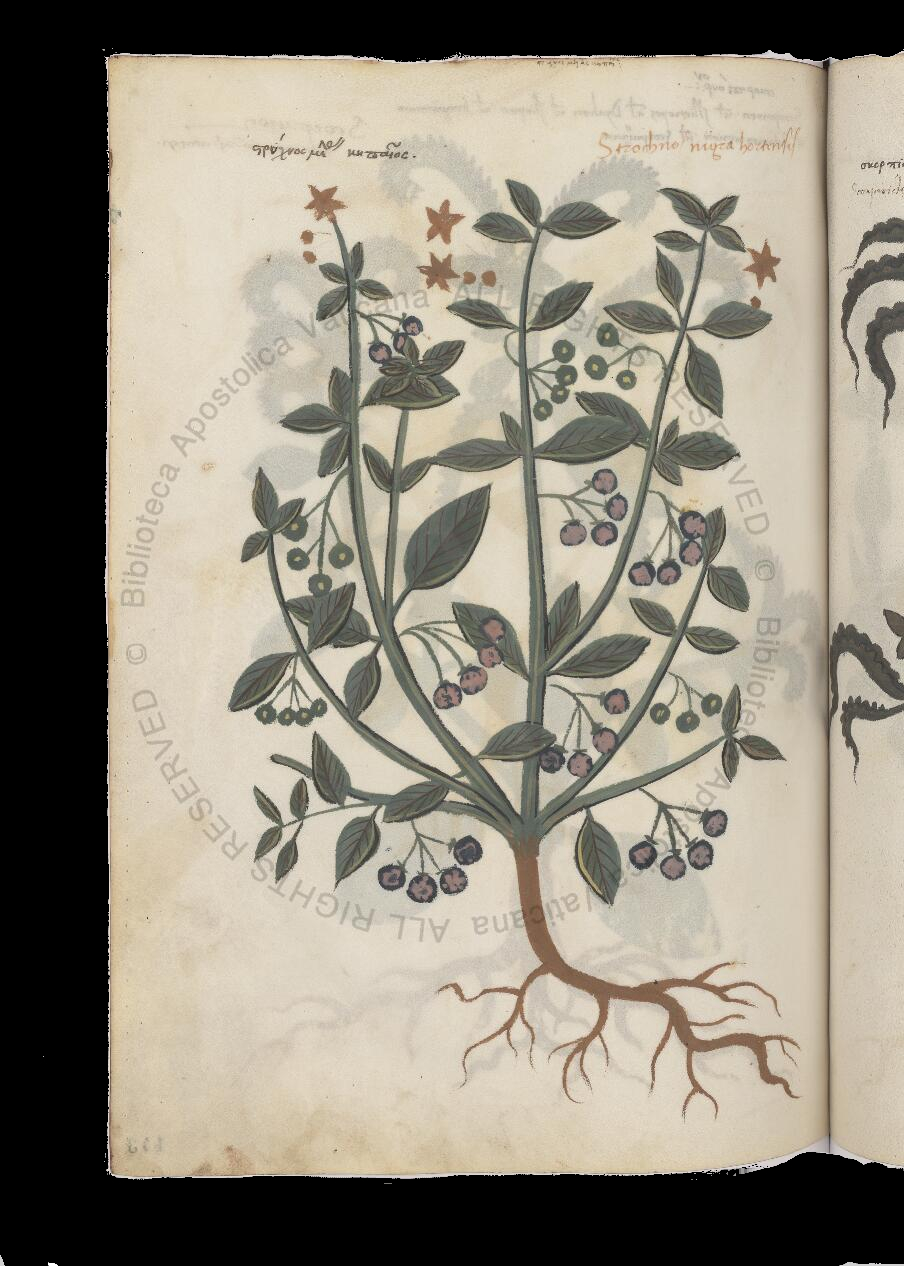
| The general shape of the plant, the shape and dark colour of the leaves, and the round fruit, green or black and yellowish when ripe, well represented in the manuscripts although the colour of the fruit is exclusively dark (from left to right: MS Paris, f. 101v; MS Padua f. 138r; MS Vatican f. 143v), all allow for an identification as Solanum nigrum L. |
 |  |  |
| στρύχνον ὑπνωτικόν | Withania somnifera (L.) Dunal (= Physalis somnifera L.) | |
| Diagnostic elements in Dioscorides’ description of this taxon are contradictory. Whereas the general description (shape, stems, leaves) fits well Withania somnifera (L.) Dunal to which this Greek phytonym is usually identified, neither the color of the flower nor the structure of its fruit correspond. Its flower is white/yellow instead of red as per Dioscorides. Its fruit forms a cluster unlike the solitary berry implicitly mentioned in Dioscorides’ text and represented in a manuscript (MS Paris f. 102v). |
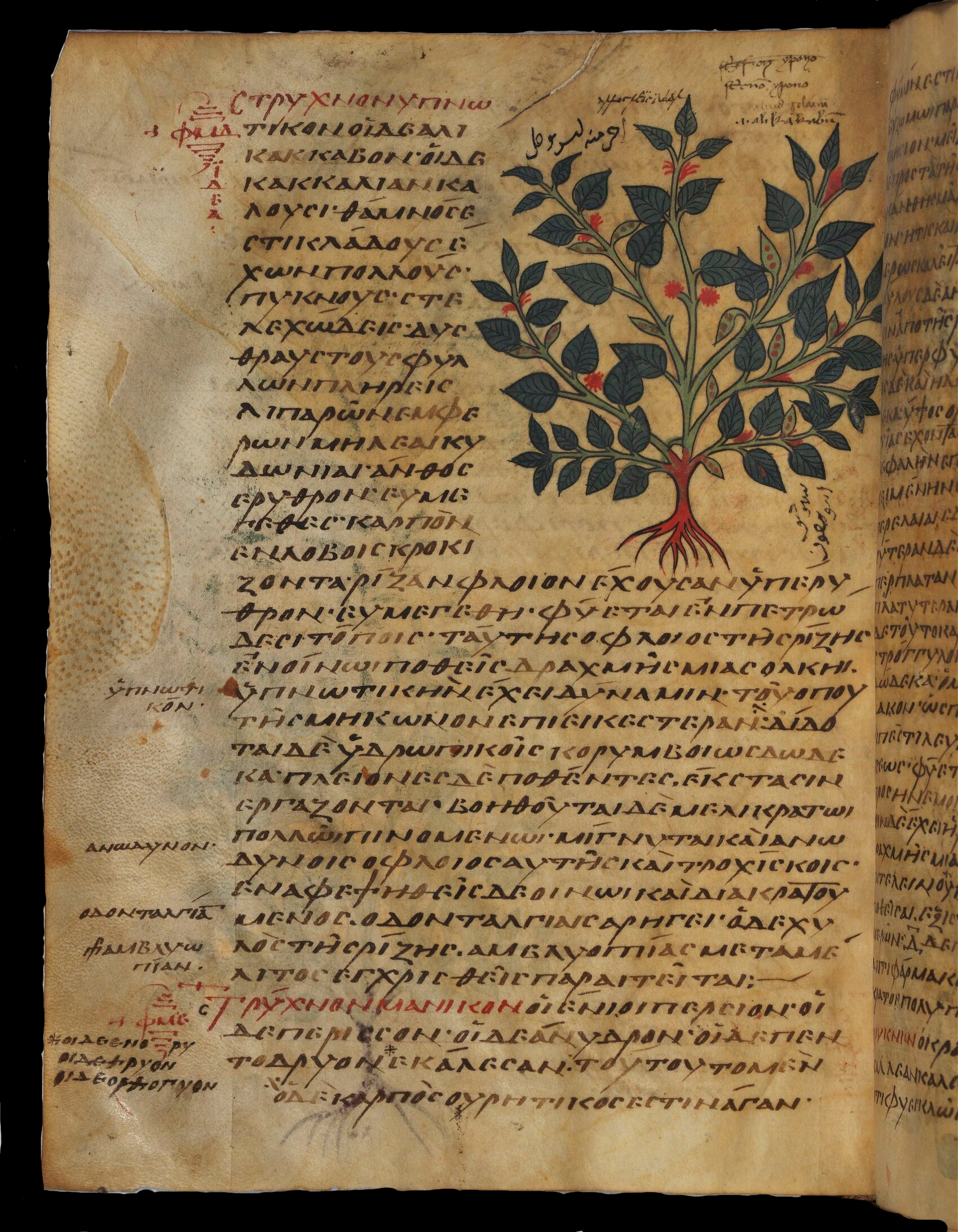
| The part of the plant to be used as identified in the list of its therapeutic indications provides an important key: it is designated as a corymb in both Dioscorides [5.6] and Galen [55]. Although the term is not correct from a strict botanical viewpoint, it may have been applied to describe the cluster of fruits of Withania somnifera. In addition to the shape and color of the fruit, correctly identified as a berry of a saffron-like color by Dioscorides and represented as such in the manuscript, this designation of the fruit supports the identification above. All these elements are distinctive characteristics of this taxon and distinguish it from Solanum nigrum L., for example. |
The case of στρύχνον μανικόν-struchnon manikon and δορύκνιον-doruknion, with two identifications each, requires further explanation.
| στρύχνον μανικόν | Datura stramonium L. and Atropa bella-donna L. | |
Strangely enough, the text offers the description of two fruits with very distinctive characteristics defined as follows in Dioscorides’ text [6.2] and [6bis.1]:
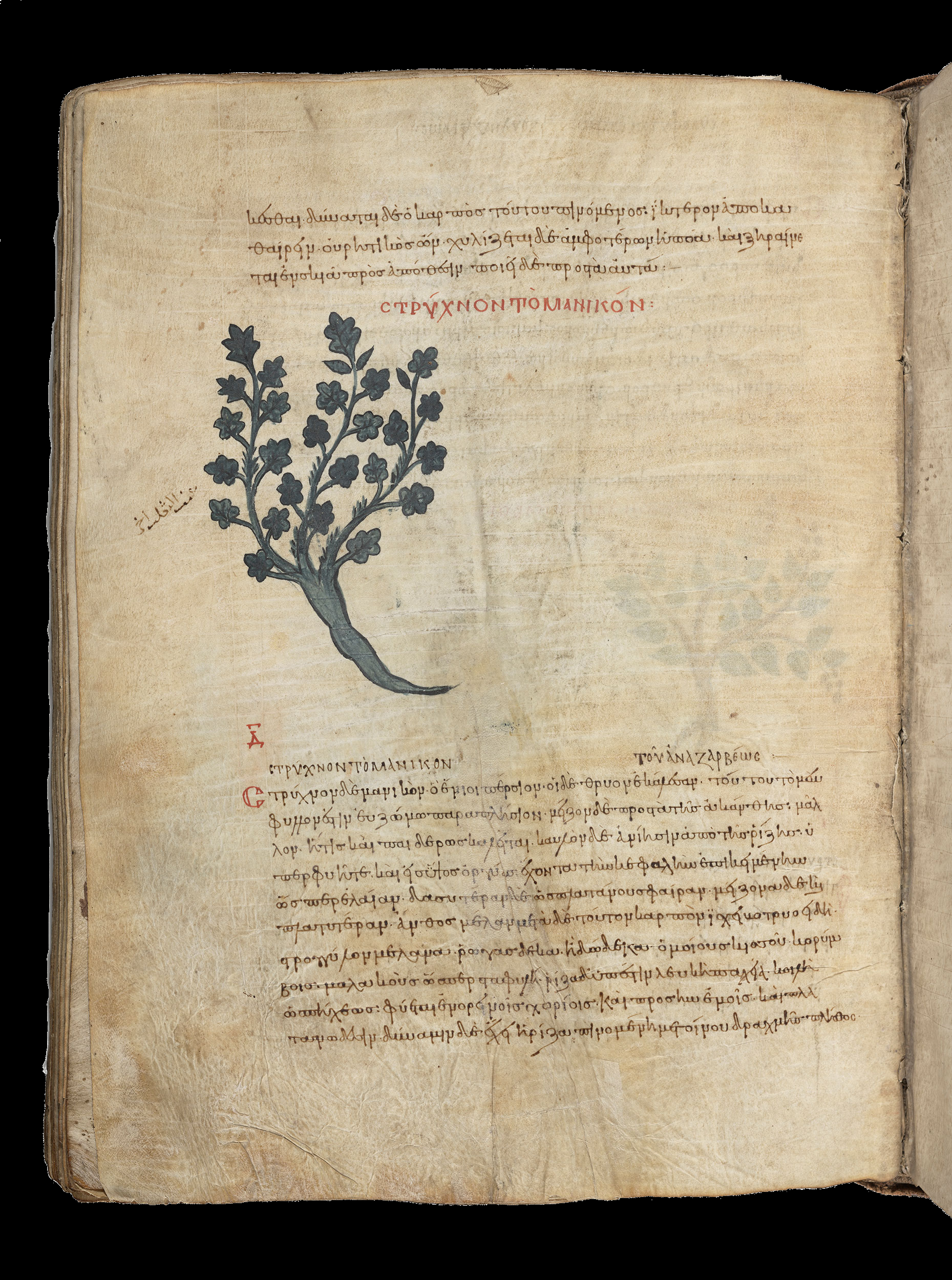
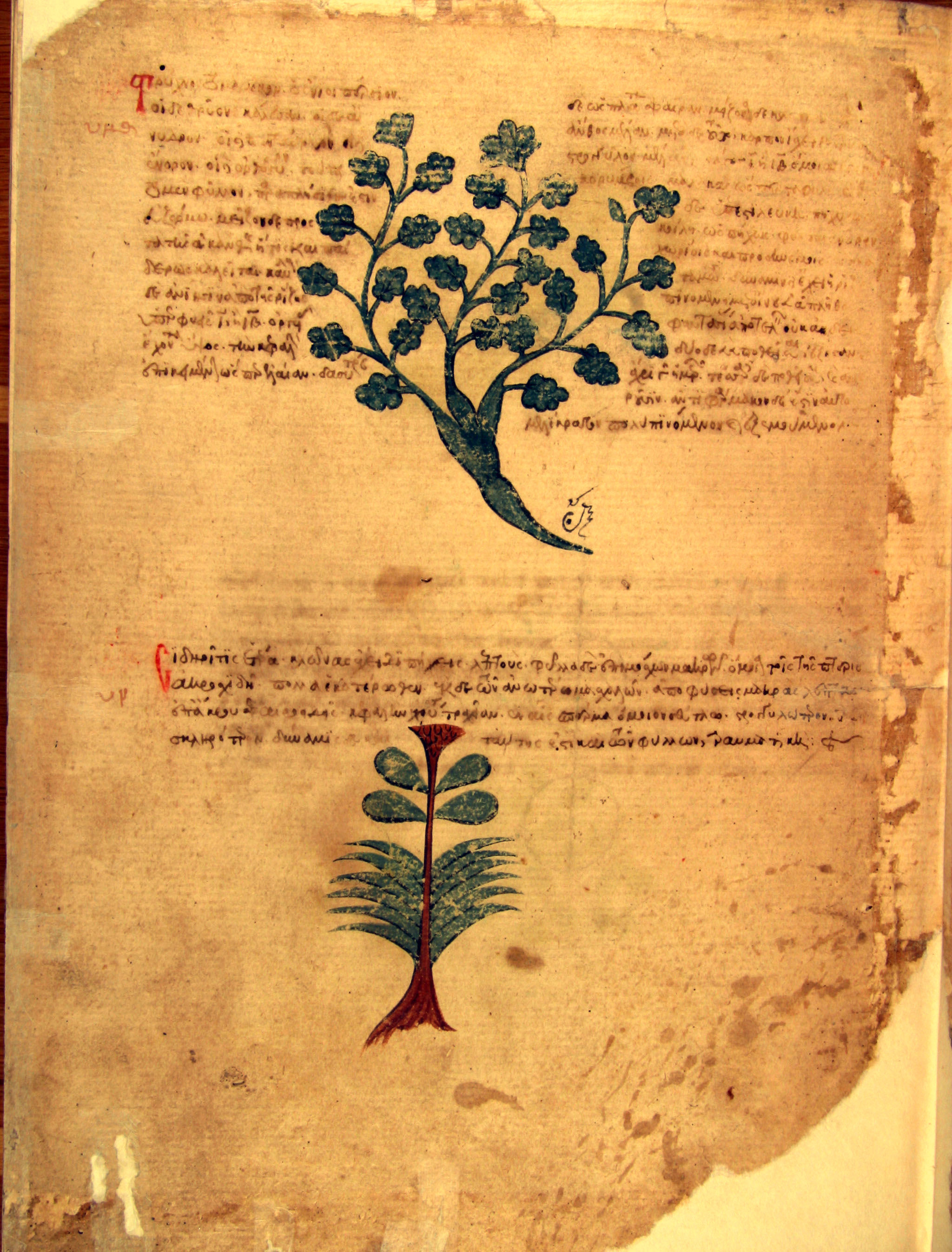
These characteristics are incompatible. Interestingly, the second set of characteristics is introduced by the expression “afterwards”, which should notbe referred to a chronological evolution of the fruit through the annual life cycle and maturation process, but rather to the physical organization of the page of a book, meaning that there is one description followed by the other. This “afterwards” most probably indicated that some folios or parts of text had been lost . As a result, the first description of a fruit is immediately followed by another one in a sequence that did not correspond to the usual structure of Dioscorides’ chapters. In this view, the first fruit is unmistakably that of Datura stramonium L. with its typical prickly capsule. The representations in the manuscript are not about this fruit, but about the second above, as a grape. This identification contradicts the native distribution of the Datura genus traditionally considered to be typical of the New World and introduced to the Old World in the Renaissance. However, textual evidence here supports its presence in the ancient Mediterranean World. The second fruit seems to evoke Solanum nigrum L. especially because of its corymb structure compared to that of Ivy fruit, its color, and number. While some manuscripts offer images of an unspecific plant (from left to right, MS New York f. 146v; Padua f. 197v, 1st plant; MS Vatican f. 200r, lower right), another represents a plant with pods containing a certain number of seeds instead of a corymb as described in the text (MS Paris f. 103r). The effects of the plant as described in the text [6bis.3] favor identification of this second fruit as that of Atropa bella-donna L. |
 |  |  |
| δορύκνιον | according to Kratevas: Physalis officinarum Moench (= P. alkekengi L.) | |
| and | ||
| [?] Withania * * somnifera * **(L.) Dunal (= Physalis somnifera L.) | ||
| The case of δορύκνιον-doruknion is different. Dioscorides opens the chapter stating that the root-cutter (drug-provider) Kratevas (1st cent. B.C.) calls it ἁλικάκκαβον/καλλέα-alikakkabon/kallea, the former of which recalls a species of struchnon [4]. He then provides the description, which does not correspond to that of ἁλικάκκαβον-alikakkabon. According to this description, δορύκνιον-doruknion is a plant like a young olive tree, with leaves like those of the olive tree, but longer and narrower, rough, a white flower, and a fruit in pods, like chickpea, with 5-6 small round seeds like Bitter vetch, soft on the external side, but hard and of different colours. The representations in manuscripts partially correspond to such a description (on the left, MS New York f. 41v. 2nd plant; on the right, MS Padua f. 185v, 1st plant), with a trunk and branches with leaves similar to those of the olive tree. They correspond in both manuscripts (the Paduan is a copy of the New York one) and are clearly a creation that visualizes some elements of the description in the text. |
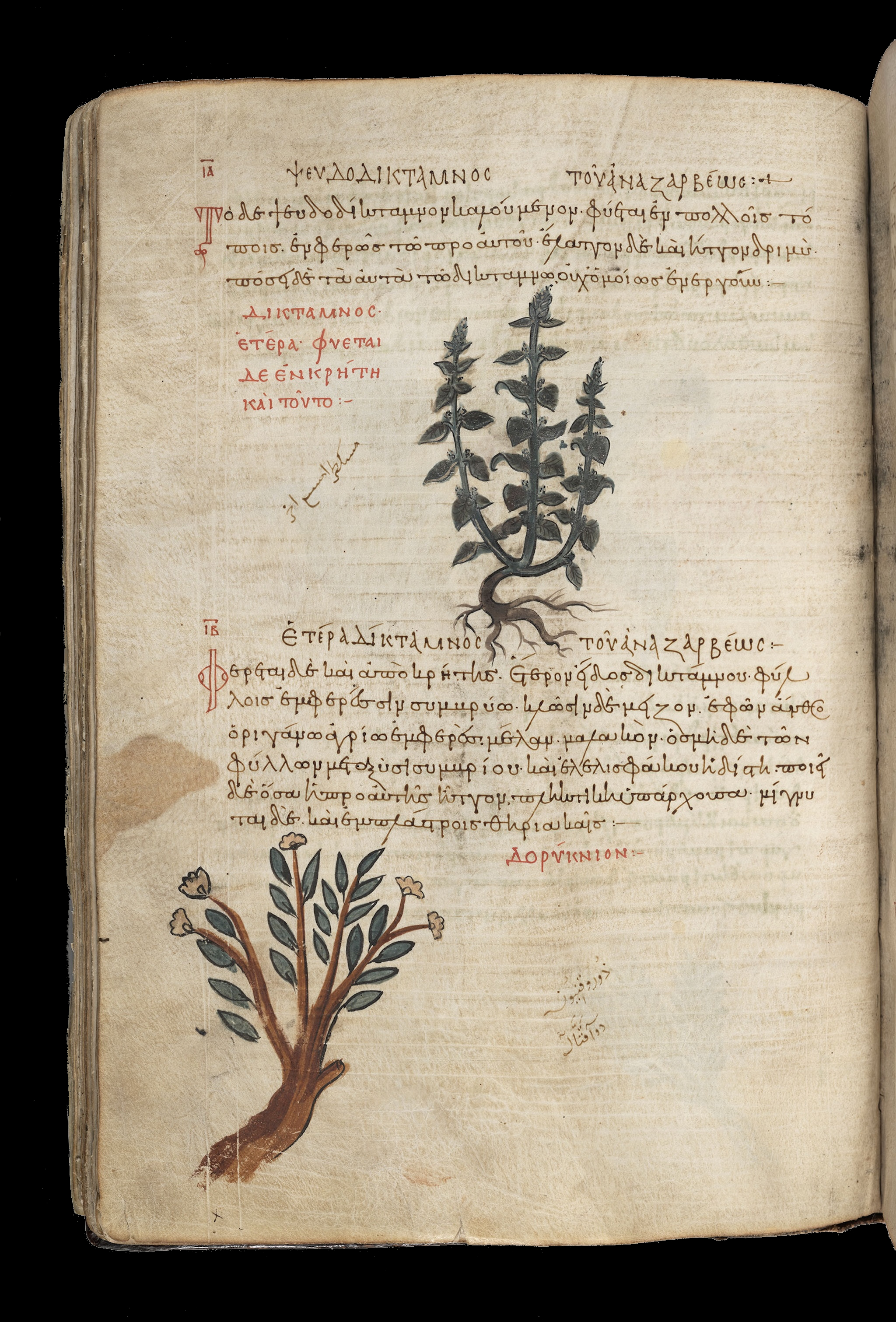 | 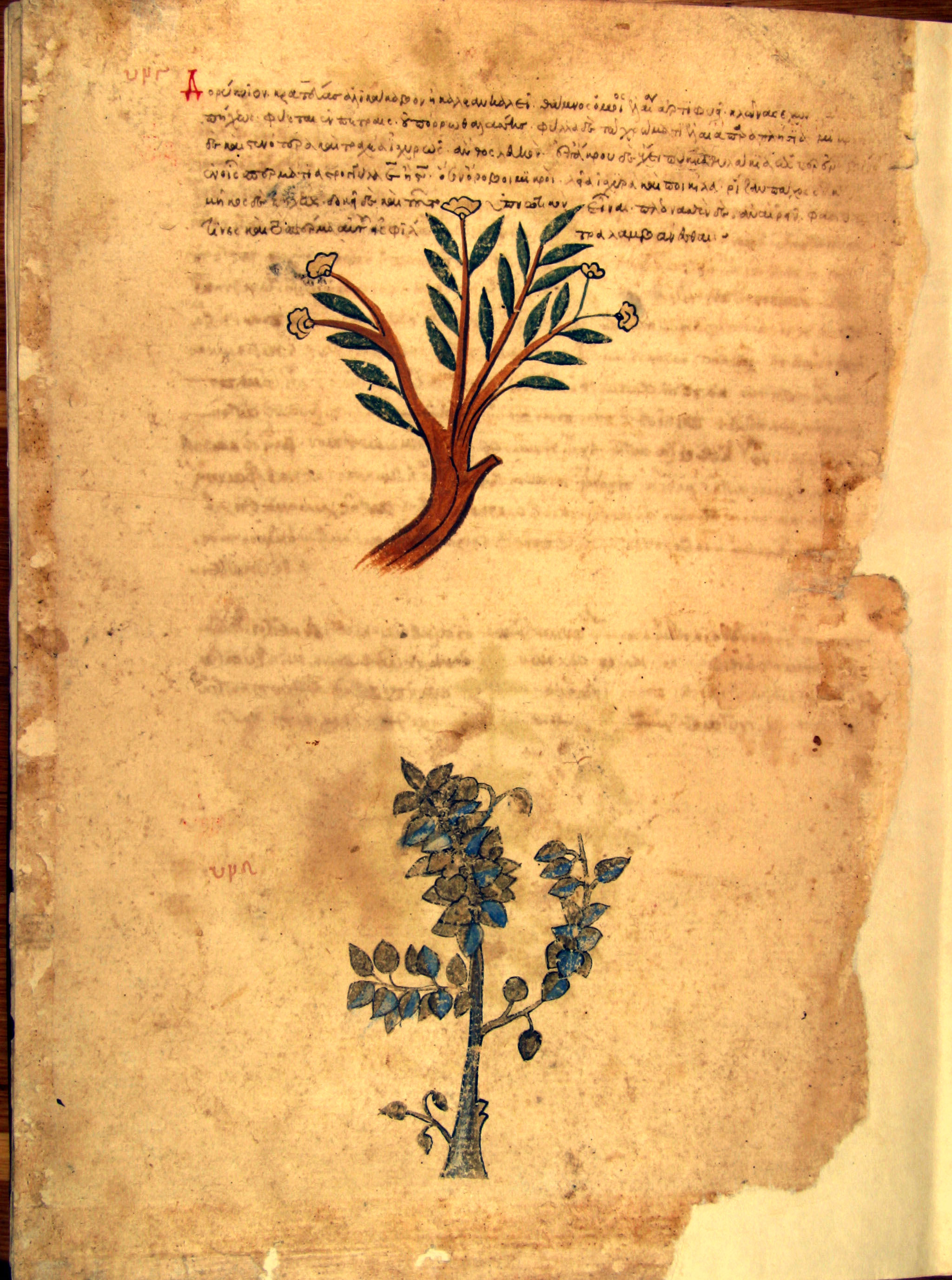 |
| The general description might favor an identification as Withania somnifera (L.) Dunal (= Physalis somnifera L.), the twigs and pods of which are villous (recalling the adjective rough used by Dioscorides about the leaves), the inflated calyx (a pod like that villous of Chickpea), and the seeds. The sleep-inducing property of the plant and its toxic effect at higher dose reinforce this identification. |
The plant μώριον-mōrion is not considered here [8bis]. In the description of μανδραγόρας ἄρρην-mandragoras arrēn (male mandrake), Dioscorides mentions that it is sometimes called μώριον-mōrion, suggesting that this phyonym is just a synonym of μανδραγόρας ἄρρην-mandragoras arrēn. Nevertheless, he treats it in the following chapter as a species of its own. Even though he reports popular sayings, he includes a description [8bis.1]. Whereas its leaves recall those of the male species of mandrake, its root is simple, intead of intertwined, with the distinctive shape of that of mandrake [8.2/1]. No fruit is mentioned. The representations in the manuscripts visualize such characteristics in a rather schematic shape that shows insufficient knowledge of the plant (on the left, MS Paris f. 105r; on the right, MS New York f. 107r).
 | 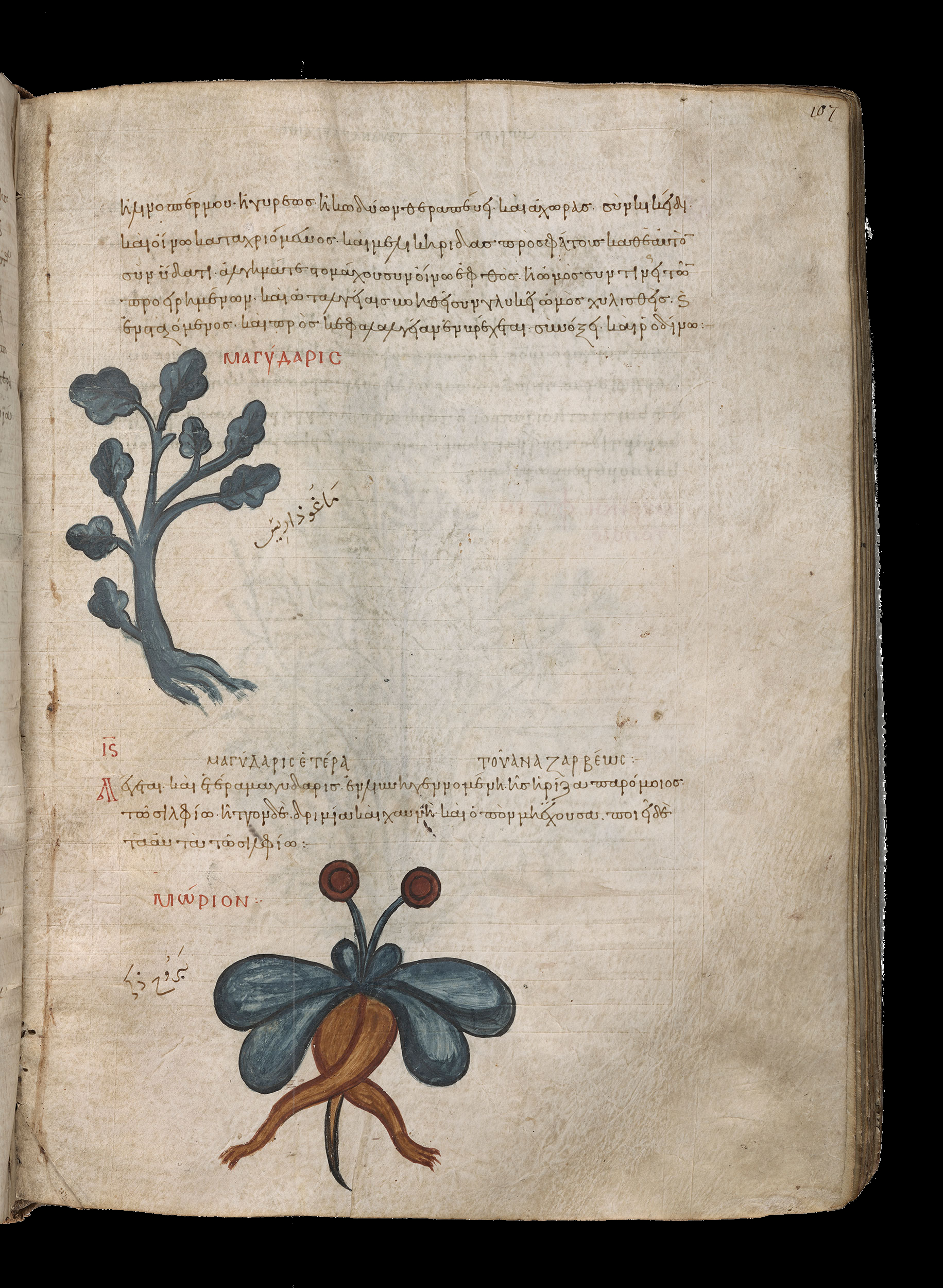 |
According to popular beliefs, consumption of a drachma of the plant has a singular effect: “the man sleeps in the position he had when he ate it, without perceiving anything for three or four hours from the moment he took it”. To this, Dioscorides adds, nevertheless, that the plant is used by surgeons as an anesthetic and that it is believed, in a further popular tradition, to be an antidote to the intoxication by στρύχνον μανικνόν-struchnon manikon [8bis 2-4].
Textual information has been transformed in data (in English) parsed in a table created to account as precisely as possible of the information contained in the texts, express in the most accurate way their content and, at the same time, to make renewed study possible. The table contains the following fields:
- medical conditions with
- body part
- condition
- plant (Solanaceae taxa)
- text with
- reference to the texts in appendix (number from [1] to [57])
- plant (drug)
- part of the plant
- form
- co-ingredients
- pharmaceutical form
- expected results
The field “Medical condition” is divided into two parts. The first lists the body parts are expressed as per the ancient texts, by specific bodily parts, major physiological systems, interpretative physiological systems (the four humors), pathological conditions, or any other categorization explicit or not in the texts. The second part of the field records the medical conditions mentioned in the texts. These conditions are taken at face value. They are symptological and not etiological, even though Galen refers to hypothetical etiological mechanisms to explain the action of the Solanaceae in some cases (below), exactly as he does for other taxa. None of these mechanisms have been taken into consideration here. The field “Plant” that follows, lists the phytonyms of the Solanaceae considerred here according to a transcription of their Greek name into Latin alphabet. This next field (“Text”) refers the text from which information has been collected. In its first sub-field, it contains the numbers from [1] to [57] attributed to the texts collected for this study and reeproduced in Appendix I. Its second sub-field mentions the name of Dioscorides (abbreviated Diosc.) and Galen in order to perceive the possible differences between the two. The fields “Plant” is not a repetition of the field with the same title, but is about the materia medica obtain from the plants. It is divided into two sub-fields: “Part” is about the parts of the plants that were used, and “Form” about the form under which these parts were used medicinally. The field “Co-ingredient” mentions the possible other substances used with the plants in order to pepare medicines, and the next, “Pharmaceutical form” indicates the kind of medicines that were prepared. The field “Expected results” translates the verbs used in the description to express the efficacy of the medicines. These verbs are translated into English as “heals”, “alleviates”, “is indicated” or similar. This field also includes more general information such the mention of the property of a plant.
Pharmacotherapeutics—All taxa
Based on the textual corpus presented in Appendix I, Table 3 contains 207 items and 10 datapoints for each, resulting in a total of 2,070 datapoints, including a certain number of negative value meaning that no information is offered by the text. Of these 197 items, 117 come from Dioscorides, De materia medica (= 56 %), and 90 (= 43 %) from 8 treatises by Galen and 2 Pseudo-Galenic ones. The datapoints with negative value total 255, with 95 of them in uses from Dioscorides’ text (= 37 %) and 160 (= 62 %) from Galenic and Pseudo-Galenic texts.
On the basis of Table 3, a table has been created for each of the 7 plants studied here (Tables 4.1 to 4.8). Two tables have been generated for στρύχνον κηπαῖον-struchnon kēpaion (Tables 4.5 and 4.6). Galen used indeed the term τρύχνον-truchnon and στρύχνον-struchnon for the species named στρύχνον κηπαῖον-struchnon kēpaion by Dioscorides [53]. These tables are identified by the name of the taxon they are about (names in the form of the Latin transcription of their Greek names). They consist of the same fields as Table 3.
Alikakkabon
Doruknion
Lukion
Mandragoras
Struchnon kēpaion
Struchnos
Struchnon manikon
Struchnon upnōtikon
As the analysis and numbers that follow show, Dioscorides and Galen did not have the same approach in the pharmacotherapeutic analysis of the drugs under consideration here. This is nowhere clearer than in the comparison of the Tables 5 and 6 about στρύχνον κηπαῖον struchnon kēpaion and στρύχνον-struchnon, respectively. Table 5 contains only uses provided by Galen, whereas Table 6 contains only uses provided by Disocorides.
Dioscorides is systematic, providing information not only as abundant, but also as precise as possible, in a factual and descriptive way without investigating or speculating on the mechanisms of the medicinal uses he reports. Only in two cases does he introduce theoretical reasoning in listing the uses of a taxon. One is about στρύχνον κηπαῖον-struchnon kēpaion. Dioscorides states its general action (cooling [3.4]) and then presents its applications as resulting from that property in a deductive way [3.5]. The other case is about ἁλικάκκαβον-alikakkabon [4.5], where the reasoning is presented in the opposite way: not as a deduction going from the principle to the use, but as cause going from the use to the principle [4.4]. Galen, as for him, does not indicate the part of the plant to be used in 57 % of the cases and the form in which their parts should be used in 48 % of the cases (below). This should not be interpreted as a lack of accuracy or, even less, of interest. Galen’s focus is elsewhere: it is on identifying an overarching concept of the action of the plants. As the analysis of the therapeutic profile below makes it plain, Galen proceeded by induction from the analysis of the specific applications and then formulating a general concept in abstract terms that subsumes all applications. He proceeds as Dioscorides did for στρύχνον κηπαῖον-struchnon kēpaion, by formulating a general property and listing then applications as a deduction of that property (ἁλικάκκαβον-alikakkabon [9.4], λύκιον-lukion [19.4], μανδραγόρας-μανδραγορας [22.1]).
Apart from some cases studied below where the materia medica for the medicines is a product prepared from a plant, in all other cases the substance for the preparation of medicine is of plant origin.
Only in one case does Dioscoride mention that one species is of better quality (more potent): λύκιον-lukion [1.9]. He specifies the characteristics to recognize it, both chromatic (external and internal colour of the root) and organoleptic (smell and taste).
When dealing with that same drug, Dioscorides refers to adulterations and explains how they were made [1.9]. Contrary to what he usually does, he does not add here methods for detecting the adulteration. However, since the authentic product is odorless and the adulterations are made by adding substances with a characteristic smell, method of detection is implicit.
Whereas Dioscorides systematically identifies the part of the plants to be used—except in the case of δορύκνιον-doruknion [7]—Galen does not do so in 49 cases (= 62 % of his mentions of Solanaceae) (above).
The parts are the following, with the number of uses and the references to the texts (the number of uses is higher than the number of texts referred to as parts of plants in the same text may have several uses):
Whole plant
16 uses (14 in Dioscorides, 2 in Galen)
[3.6], [4.4], [4.5], [4.6], [6], [7.4], [35], [4.5]
Root
57 uses (50 in Dioscorides, 7 in Galen)
[1.10], [5.7], [6bis.3], [8.6], [8.7], [8.8], [8.11], [8bis.4], [13.1], [17], [24], [55]
Root epidermis (cork in Greek)
7 uses (5 in Dioscorides, 2 in Galen)
[5.4], [5.6], [8.12], [13.2], [25]
Twigs
6 uses (all in Galen)
[12]
Leafage
12 uses (all in Dioscorides)
[4.6]
Leaves
27 uses (all in Dioscorides)
[3.5], [4.4], [8.10]
Fruit
12 uses (7 Dioscorides, 5 Galen)
[4.5], [5.5], [5.6], [8.13], [10], [55], [56], [57]
Seed
3 uses (2 in Dioscorides, 1 in Galen)
[8.14], [55]
Splinter from the bark-like root epidermis
1 use (Galen)
[13.2]
Roots are the most used part, with 57 uses (entire, ground or as a source of juice) and 7 of the epidermis. Total number of 64 represents 32 % of all uses. Leaves (also entire, ground or as a source of juice) come second with 39 uses (leafage and leaves) corresponding to 15 %.
The form in which the plants were used (e.g. fresh vs. dry, entire vs. ground) clearly indicates that plants were mostly used fresh. They were either acquired from a provider or harvested from an orchard adjacent to the houses, possibly also with a part specifically devoted to growing medicinal plants. This possible difference in the sources for procurement might reflect a difference between urban and rural situations.
Dioscorides specifies the form in which parts of the plants must be used for thereapeutic applications. Contrary to his general use, he does not provide such information in 22 cases (= 18 % of his total number of uses of Solanaceae). These cases are either obvious ([4.5], [5.4], [5.5], [5.6], [6bis.3]) or related to a use reported as unsure [7.4]. Galen does not identify any form of the drugs in 60 cases ( 66 % of the uses he mentions).
Fresh
25 uses
leaves: 19 uses [3.5], [4.4], [8.10], [12]
twigs: 6 uses [12]
Fresh and ground
leaves: 8 uses [3.5], [4.4]
Dry
1 use (whole plant, fruit) [4.5]
Ground
root: 5 uses [8.11]
leaves: see above under fresh
fruit: 2 uses [10]
Juice (cold pressing)
total uses: 68
undetermined (whole plant?): 21 uses [3.6], [4.4], [19.3], [38], [39],[41], [42], [43], [44], [49], [50], [51], [52]
whole plant: 12 use [3.6], [4.4]
root: 23 uses [1.10], [5.7]
leafage/leaves: 12 uses [4.6]
Boiled
4 uses (root, root epidermis) [5.6], [8.6], [13.2]
in one case, boiling of the root epidermis is explicit avoided [8.12]
Cleaned
splinter cleaned in vinegar for use as a toothpick [13.2]
Pickled
8 uses (leaves) [8.10]
Only for some of the species studied here does Dioscorides characterize their therapeutic action in general terms with the following:
- astringent (λύκιον-lukion) [1.10]
- cooling, refreshing or, probably better, heat-lowering (στρύχνον κηπαῖον-struchnon kēpaion [3.4] and ἁλικακκαβον-alikakkabon [4.4])
- sleep-inducing (upnōtikos) (στρύχνον ὑπνωτικόν-struchnon upnōtikon), resulting in almost a tautology [5.4].
Galen delves much more into the general typification of the action of the Solanaceae species with different approaches that might sometimes lead to divergent statements.
For λύκιον-lukion, he does not only identify its action in general terms as desiccative, but he explains it in function of his system of material analysis of its substance which, in this specific case, is finely-particled, diaphoretic and hot, and at the same time, earthy, cold and styptic [19.4].
For στρύχνον-struchnon approached as a genus without identification of a species, he repeatedly specifies that it is cooling [30] and [31] as Dioscoride about στρύχνον κηπαῖον-struchnon kēpaion [3.4], and, in one case, he recommends a list of plants that includes στρύχνον-struchnon and the more general class of the cooling substances [39]. This cooling property is combined with astringency in two passages [33] and [54.2], and this combination is said to be obtained also from opium poppy and mandrake in addition to στρύχνον-struchnon [36] and δορύκνιον-doruknion [16]. In another case, this cooling activity goes with moistening [34] and in still another with desiccation [53].
Στρύχνον ὑπνωτικόν-struchnon upnōtikon, specifically, is highly cooling [55] but less than opium poppy. Its seed is diuretic [55] as is also the leaf of ἁλικακκαβον-alikakkabon, which has the same general property as στρύχνον κηπαῖον-struchnon kēpaion [9.4].
The action of mandragora, indistinctive of the species female or male, is defined in a similar way as cooling [21], with the same property and some moisture in both the whole plant [26] and its fruit [22.1] in a combination that is also present in opium poppy and hemlock [26]. In one passage, the plant is characterized as cooling and desiccative [22.2].
This general characterization of the action of the plants accounts for their use in the treatment of some medical conditions. In the case of στρύχνον κηπαῖον-struchnon kēpaion, Dioscorides makes an explicit connection between its cooling property and its use in the treatment of skin pathologies, cephalgia and burning stomach [3.4]. A similar relationship from property to use is stated by Galen about the diuretic action of ἁλικακκαβον-alikakkabon, which justifies the use of the plant in many compound medicines without any further explanation [9.4].
Toxicity is stated about some plants, mostly because of excessive dose (below). In one case, however, it is attributed to the whole substance of the plant, without any influence of dosage; even a minimal dose provoked total damage, as Galen puts it [57].
In some cases, the intensity of the property of a plant is measured in imprecise terms, on a degree-scale or in comparative terms. Although this is the backbone of Galen’s analysis of materia medica—particularly the objective measuring on a four-degree scale with interemediary degrees—it already appears in Dioscorides though in a less systematic and less formal way. Dioscorides considers στρύχνον μανικον-struchnon manikon as very diuretic [5.5] and moderatley sleep-inducing compared to opium poppy [5.4]. As per his own system, Galen is more precise on this. If he proceeds by comparison in some case [16], in another he combines both comparison and exact degree on his four-degree scale [55], and in still two others he precisely measures the property on the scale, with an exact degree [53] [54].
According to the number of uses for each plant, μανδραγόρας, with 45 uses (= 22.8 %), closely followed by στρύχνον κηπαῖον-struchnon kēpaion and its equivalent στρύχνος-struchnos in Galen with 44 uses (= 22.3 % of the total number or uses). They are followed by, λύκιον-lukion with 29 uses (14 %), and ἁλικάκκαβον with 28 uses (= 14 %). The much lower numbers of uses of all other three species results from different factors: στρύχνον ὑπνωτικόν-struchnon upnōtikon (7 uses), though being indicated to treat odontalgy [5.6], amblyopia [5.7], dysuria [5.5] [55] and dropsy [5.6], as well as general pain [5.6], was also sleep-inducing [5.4] [55] and potentially toxic (mental disturbance) if taken in doses higher than therapeutic [55]. The case of δορύκνιον-doruknion is similar (6 uses): whereas Galen uses it to treat major conditions as well as articulartions and gout [17], Dioscorides reports, instead, that it seems to induce sleep and even lead to death if taken abundantly [7.4]. Assuming that the δορυκνίδιον-doruknidion mentioned by Galen (6 uses) is the same as δορύκιον-doruknion, the same lethal property is reported when the plant is taken in excessive dose [16].The στρύχνον μανικόν-struchnon manikon (5 uses) is credited with only one therapeutic properties [8bis.4], and mostly with mental disturbance by Galen [55] [56] [57], and by loss of consciousness and death by Dioscorides [6bis.3]. The difference between the two groups reveals a clear knowledge of the risks presented by some species (below).
Considering the body parts for the treatment of which Solanaceae were used, Table 3 highlights three major fields of use listed below by number of uses and fraction of the total number of uses (percentage): skin (40 uses = 20 % of the total number of uses), eyes and sight (31 uses = 15 %), head (18 uses = 9 %), with a total of 41 % of all uses.
However, a cross-reading of the table beyond bodily parts brings to light actions with equally significant numbers and percentages of uses: anti-inflammatory action from abcesses to gangrenous wounds, with 26 uses (= 14 %), and catharsis from evacuation of bile and phlegm to gout, with 17 uses (= 9.5 %).
A comparison of the uses of each plant indicates some common effects as table 5 clearly shows, with 39 uses for skin affections (= 19 %), 31 for the eyes (= 15 %) and 17 for the head (= 8 %). All these are for external use in a significant way, and total 87 (= 44 %).
Table 5
Comparisons of taxa
Taxa | Bodily parts/actions | |||||||
Skin | Eyes | Head | Digestive system | Psyche | Gynecology | Urinary tract | Lethal | |
Alikakkabon | 11 | 6 | 4 | 3 | - | - | - | - |
Doruknion | - | - | - | - | 1 | - | - | 1 |
Lukion | 9 | 6 | - | 9 | - | 2 | - | - |
Mandragoras | 12 | 5 | 1 | - | - | 5 | - | 1 |
Struchnon kepaion | 4 | 6 | 3 | 1 | - | - | - | |
Struchnos | 3 | 7 | 9 | 2 | - | - | 1 | - |
Struchnon manikon | - | - | - | - | 4 | - | - | 1 |
Struchnon upnotikon | - | 1 | - | - | - | - | 3 | - |
Total | 39 | 31 | 17 | 14 | 5 | 7 | 4 | 3 |
As indicated above, three species were known for their toxic action: στρύχνον ὑπνωτικόν-struchnon upnōtikon, στρύχνον μανικόν-struchnon manikon, and δορύκνιον-doruknion to which μανδραγόρας/ μώριον-mandragoras/mōrion should be added.
For the first three, doses higher than therapeutic are responsible for the iatrogenic effects. For στρύχνον ὑπνωτικόν-struchnon upnōtikon, a dose in excess of 12 corymbs provokes great excitement, probably agitation and mentally unsound behavior in a way that is reversible, however if properly treated [5.6]. The species στρύχνον μανικόν-struchnon manikon, also, is credited with psychoactive properties that were differentiated and increased according to the doses: whereas one drachm is described as provoking llustions that are not unpleasant, two drachms disturb the mind for up to three days and four can even lead to death [6bis.3]. The case of δορύκνιον-doruknion, which Dioscorides reports with caution, is similar as it can be sleep-inducing and lethal in higher dosage, without an exact definition of the sub-lethal/lethal dosage [7.4]. The latter two are not reported as reversible.
Μανδραγόρας-mandragoras and μώριον-mōrion (which might refer to the same plant) are a case of its own. Eating or smelling its fruit or consuming its juice induces sleep and provoke aphonia when taken in excess [8.13]. Whereas two obols of the juice from the root eliminates phlegm and bile, a higher quantity leads to death [8.7]. Shepherds are said to consume the fruit of male μανδραγόρας-mandragoras, which provokes a certain stupefaction [8.2/2].
For μώριον-mōrion, which might be a species of mandrake if not mandrake itself, Dioscorides reports an extraordinary action that he does not endorse, however, saying that it is popular narrative and belief: it instantly provokes a loss of consciousness, leaving those who drink or eat it either in a maza or as a foodstuff in the exact position they had when they took it, without feeling anything for three or four hours from the moment they absorbed it [8bis.2].
The sleep-inducing inducing of μανδραγόρας/ μώριον-mandragoras/mōrion benefited surgery (cutting and burning) thanks to the anesthesia (in the etymological meaning of the word, lack of sensivity as per Dioscorides’ explicit wording [8.6]) [8.6], [8.12] [8bis.3].
Pharmaceutical activity about the Solanaceae consisted in preparing two major types of products: drugs for the preparation of medicines and the medicines themselves.
1. Preparation of drugs for medicine-making
Dioscorides describes the preparation of some materia medica that are stored in appropriate containers for later use.
For one of the Solanaceae—μανδραγόρας-mandragoras—Dioscorides describes a process to collect in the field what he identifies as a liquid. It consisted of digging around the root and collecting the liquid flowing from the root. We must assume that an incision in the root was necessary for this liquid to exude. As Dioscorides adds, roots did not produce such liquid in all places, something that could be learned by experience. In any case, this liquid was less active than the juice obtained from the root [8.15]. Considering the whole set of popular beliefs that accompanied mandrake, this might be an addition, so more so because it appears at the end of the chapter on μανδραγόρας-mandragoras. The detail about experience coming at the very end of the phrase contributes to doubting the authenticity of this whole segment.
Other parts of the μανδραγόρας-mandragoras required specific treatment. The epidermis of the root was cut when still green and pressed. The juice was exposed to the sun to be reduced and then conserved in a clay recipitent [8.3]. The epidermis could also be hung on a thread and kept for further use [8.8], exactly as was the case for the root of iris, which was cut in slices that were hang on thread and dried in a shady, ventilaed place. The root itself can also be boiled in wine, reduced to a third, filtered and kept for a future use [8.6]. The leaves can be pickled and preserved [8.10] and the fruit can be processed as the root epidermis, that is, pressed to obtain a juice that is then exposed to the sun and reduced to be further preserved [8.4].
For λύκιον-lukion [1.5], [1.7], [1.8]), the drug is not the plant itself, but a derivative obtained from either its root and leafage or its fruit. Root and leafage are cut and kept moist for a sufficient number of days, then boiled and reduced until the liquid reached the consistency of honey [1.5]. Aduteration takes place during this boiling process, by pouring into it amurca, wormwood juice, or ox-bile [1.6]. It is detected by its odour. The foam floating on the boiling solution is collected and used as a drug in itself [1.7]. A similar process is used for the juice of the fruit, which is not boiled, but reduced by exposition to the sun [1.8].
Another drug can be prepared and stored for later use: the juice obtained from στρύχνον κηπαῖον-struchnon kēpaion [4.5] and from ἁλικακκαβον-alikakkabon [4.5] that is condensated in the shade and kept for storage.
2. Ingredients used in the preparation of medicines
Besides the Solanceae that constitute the main ingredient of medicines—be it in the form of a fresh plant or a prepared drugs made with one of them and preserved for later use—, medicines include other substances, with both excipients and substances that can be identified as co-ingredients, although the difference might not be always as clearcut as this binary opposition suggests. Such other substances are mentioned in 75 cases (ca. 40 % of the whole uses).
In external use, excipients can be bread [3.6], [4.4]; goose fat [10], [48], honey [5.7], [50] or oil [8.11]. In internal use they can be Barley groat [3.6], [4.4], [8.10], [8.11], [35], water [1.10] [8.11], and wine [5.4], [5.6], [6bis3], [8.6], [55].
The list of these ingredients—be they excipients or co-ingredients—follows:
Barley groat [3.6], [4.4], [8.10], [8.11], [35]
Bread [3.6], [4.4]
Crocus [44]
Egg [3.6], [4.4]
Galbanum [42]
Goose fat [48], [10] Galen
Henbane [25]
Honey [50], [5.7]
Illekebra moss [42]
Libanos [42]
Lithargyrum [3.6], [4.4], [44]
Melikraton [5.6], [8.7]
Muron [48], [10] Galen
Native sulphur [8.14], [44]
Oil [8.11]
Psimithium [3.6], [4.4], [44]
Rose oil [3.6], [4.4], [38]
Salt [3.5], [4.4]
Vinegar [8.11], [13.2], [14], [39]
Vinegar [47]
Kedria [47]
Propolis [47]
Vinegar [13.1]
Oak gall [13.1]
Water [1.10], [3.6], [4.4], [8.11]
Wine [5.4], [5.6], [6bis.3], [8.6], [8.12], [55]
In De materia medica, Dioscorides does not systematically describe preparations of medicines, which is understandable as the work is about materia medica and not pharmacopoiesis. If he sometimes mentions medicines, he mostly lists the main ingredients and the possible excipient or co-ingredients without any other information and without systematic indication of dosage of the ingredients. In some cases, however, he provides a more detailed description as for an anesthesiant wine for surgery [8.12], which is made of the epidermis of the root of μανδραγρόρας-mandragoras (3 man) infused in a proportional quantity of wine, without boiling as explicitly specified.
As can be expected, Galen is specific in his pharmaceutical treatises, the tey organized by types of medicines or by the bodily parts for which medicines were prescribed (De compositione medicamentorum per genera and De compositione medicamentorum secundum locos, respectively). In the former, he lists the ingredients with the quantity of each [44], [45] to form trochiscs to be stored for use when necessary. In the latter, he proceeds in the same way in one case, without specifying, however whether this is a medicine for immediate consumption or for storage [25]. In the other case, he reproduces a formula of Asclepiades, which he modifies. The formula includes instructions for the preparation. After the list of the ingredients with their respective quantities, it prescribes to boil the juice of two ingredients and a gum; when the gum has melted, another gum should be added. Whereas the original formula prescribes mastic, Galen substitutes it with galbanum probably in the same quantity as mastic [42].
The Pseudo-Galenic treatise De remediis parabilibus procceds in a similar way with ingredients and quantities for two medicines prepared for immediate administration [50], [51], and in a slightly imprecise way for two others: one which is simple [49] and another made of three ingredients, two of must be in a quantity that is not exactly defined, but must be equal for both [48].
The pharmaceutical form and road of administration is often, but not always indicated. It is explicitly present in over 100 cases (= 56 % of all uses). In many cases, it can be deduced from the imperatif form of the verb meaning “taking”, which refers here to an oral administration in the form of a potion.
Pharmaceutical forms are varied. Not only do they distinguish external and internal administration, but they also identify special forms of administration. For external use, they can be applications, an aspersion, bandages, cataplasms, frictions, ointments, and tampons. For internal use, they can be colliria, gargling, infusions, instillations, potions, clysters, and suppositories. Some forms are not identified as pharmaceutical forms stricly speaking but as classes of medicines (e.g. antalgics), which may be assumed to have been of a certain pharmaceutical form. Each form was determined in function of the condition to be treated.
Their list follows with the total number of each when higher than two, and in all cases the references to the texts (numbers between brackets in bold).
Antalgics [5.6]
Applying
16 uses
[4.4], [3.5], 1.10], [4.5], [8.14], [12], [8.10], [12], [45], [49]
Aspersion [3.6], [4.4]
Bandages (made of wool) [49]
Breathing [8.13]
Cataplasm
13 uses
[11], [30.2], [30.3], [4], [3.6], [8.10], [4.4], [3.5]
Collirium [3.6], [4.4]
Compound drug [42]
Eating [8.13]
Friction
8 uses
[8.10], [8.11]
Gargling [47], [13.1]
Infusion [13.2]
Instillation [41], [3.6]
Liquid medicine (undetermined)
15 uses
[19.3], [19.4]
Ointment
8 uses
[1.10], [48], [5.7], [38], [48]
Pessary or potion 2 uses [8.7]
Potion
24 uses
[51], [4.5], [55], [56], [8.14], [1.10], [50], [5.6], [8.6], [8.7], [6bis.3], [5.4], [1.10]
Clyster [1.10]
Sponges [39]
Suppository [8.8], [10]
Tampon (possibly applied with wool)
3 uses
[3.6], [4.4], [49]
Trochisc for both external and internal administration
5 uses
[5.6], [14], [25], [44], [45]
5. Place and material for the preparation of drugs and medicines
The place for the preparation of drugs and medicine is not explicitly stated. It can be deduced to have consisted of at least three places: a closed one, with a source of heat; a covered, shady and ventilated one; and an open one, exposed to the sun.
The material to be used to prepare both drugs and medicines is not identified except in two cases: a press [8.3] and a ceramic container for a drug prepared for later [8.3]. On the other hand, the description of a preparation requires use of a strainer [8.6]. The indications provided in the preface of De materia medica —though possibly inauthentic—and logical deductions from the uses made of the plants allow to draw up the following list of instruments to be used whether the plant material was used fresh or not: a press to obtain juice of roots, leafage and fruits, a grater/shreeder to grind roots and fruits, and all the small utensils that could usually be found in a kitchen for the preparation of food with operations like cutting and boiling, from pots of all capacity and size according to the needs to colanders and strainers, as well as small utensils like knives, laddles, skimmers, spoons and others.
Dosage of the medicines to be administred is often absent, except for the lethal threshold of plants credited with toxic properties. Nevertheless, exact quantities are indicated in seven prescriptions:
- στρύχνον ὑπνωτικόν-struchnon upnōtikon administered in a dose of 1 drachm induces sleep [5.4];
- juice from the root of μανδραγόρας-mandragoras without any co-ingredient applied on the cervix in a quantity of half an obol treats amenorrhea and provokes abortion [8.8];
- the same quantity introduced into the anus in the form of a suppository induces sleep [8.8];
- 3 cyaths of anesthesiant wine made of the root of μανδραγόρας-mandragoras should be administered to patients of surgical interventions [8.12];
- a quarter of a choinix of δορύκινον-doruknion should be applied externally to patients suffering of gout, articulations pain, and major conditions [17];
- trochiscs of 1 obol have to be administered internally to patiens suffering of hemoptysis, internal pus, and fluxes [25].
Lethal doses are as follows:
- whereas 12 corymbs of στρύχνον ὑπνωτικόν-struchnon upnōtikon treat hydropic patients, a higher quantity provokes mental disturbance [5.6], [55];
- 2 obols of juice from the root of μανδραγόρας-mandragoras taken orally eliminate phlegm and bile orally, and a higher dose is lethal [8.7];
- στρύχνον μανικόν acts differently according to dosage [6bis.3]:
- 1 drachm provokes not-unpleasant illustions;
- 2 drachms generate a state of agitation thant can last up to three days;
- 3 drachms are lethal.
In the case of δορύκνιον-doruknion, the lethal dose is not exactly quantified. According to Dioscorides, the plant seems to induce sleep and, if taken more abundantly, to provoke death [7.4]. Galen offers the same information, without mentioning it as did Dioscorides, but as a fact [16].
The instant sleep-inducing if not lethargic action of μώριον-morion reported above is said to result from a dose as loow as 1 drachm [8bis.2].
The texts include some information about the result to be expected from the medicines for 96 uses (= 54 % of the total numbere of uses). This information is not explicitly stated as such but expressed through 20 different verbs ranging from “treating” to “being indicated”. These verbs vary in function of the medical conditions the plants are used for: dissolves for the treatment of abcesses, cleans for wounds and eliminates for excessive liquids in the body, for example. The term property is used here when the action of the plant is mentioned in abstract without necessarily referring to a medical condition.
These verbs are subjective and may not exactly indicate the degree of efficacy of any use. However, they do not only result for a century-long experience of the plants used medicinally, but also they were used in a persistent and consitent way through the subsequent centuries, a fact that validates them and gives them some objective value, all the more because the texts here have repeatedly been worked on, revised, and commented on, sometimes with substantial textual transformations, both at their macro- and microscopic level (the general structure of the texts and its exact wording).
These verbs (in English translation) are the following with the number of occurrences of each (when higher than 1) and the references to the texts (numbers between brackets from [1] to [57]):
Active on
10 uses
[8.11], [4.5], [4], [3.6], [4.4]
Alleviates [5.7]
Cleans [8.14]
Cures
4 uses
[1.10], [1.11]
Dissolves
11 uses
[8.11], [8.10]
Efficacious
4 uses
[1.10]
Eliminates [1.10]
Evacuates
2 uses
[8.7]
Heals
7 uses
[40], [1.10], [4.4], [3.5]
Helps
5 uses
[4.4], [3.5], [5.6]
Is indicated
12 uses
[9.4], [4.4], [3.6], [4], [8.10], [1.10]
Is useful
2 uses
[4.4], [3.6]
Makes
2 uses
[41]
Property
18 uses
[57], [7.4], [8.13], [5.5], [55], [8.6], [8.12], [8.13], [56], [8.7], [6bis.3], [5.4]
Provokes
2 uses
[8.8]
Reduces
5 uses
[4.4], [3.5], [8.11], [8.10]
Seems to provoke [7.4]
Smothes [8.7]
Stops
5 uses
[8.11], [1.10], [8.14], [4.4], [3.6]
Treats [1.10]
Some non-medical uses of the Solanceae are attested in the textual body examinated here. They are the following:
- alimentary
apart from στρύχνον κηπαῖον-struchnon kēpaion, which was domesticated as its very name indicates and was used alimentary, probably as a leafy vegetable [3.1], [54.1], the fruits of the male species of μανδραγόρας-mandragoras are reported to have been consumed by shepherds, although they provoke a certain stupefaction [8.2/2].
- cosmetic
Λύκιον-lukion was used to make hair blond [1.11].
- decorative
ἁλικάκκαβον-alikakkabon was used in intertwining crowns [4.3] [9.3].
- arts and crafts
According to Dioscorides, ivory boiled with the root of μανδραγόρας-mandragoras for six hours became malleable and could be shaped in any desired form [8.9].
- magics
Dioscorides reports the popular use of δορύκνιον-doruknion in love charms [7.5].
Although written traces of the use of taxa from the Solanaceae family in ancient Greek medicine do not antedate Hippocratic medicine (5th cent. BCE), the substantial body of literature from the Hippocratics onwards doubtlessly attest to precise knowledge and use. The potent effects of some taxa have contributed to creating an aura of mystery and magic around them, mostly attested in non-scientific literature. Nevertheless, these potent effects are referenced in the botanico-medical literature examined here, sometimes with caution as these effects are reported as popular beliefs not necessarily endorsed by the authors whose works have been studied here.
The present preliminary study has focused on Dioscorides, De materia medica, and selected relevant passages from the many treatises by Galen, particularly his major analysis and compendium of materia medica, De simplicibus, and his two major pharmaceutical works on the composition of medicines by affected bodily organs or functions and by pharmaceutical type. Research has identified a more substantial body of material, however, from the Hippocratics to the Early-Byzantine encyclopedists from Oribasius (3rd cent. CE) to the last Alexandrian Paul of Aegina (7th cent. CE).
In this textual body, taxa now identified as members of genera in the Solanaceae family were recognized. They are not explicitly identified as forming a unitary group, even though most of them were grouped in the taxonomy of Dioscorides, De materia medica. Their respective actions indicate both perception of similarity and differentiation.
Whereas Dioscorides in De materia medica provides descriptions of the plants, Galen does not, either in his major work on materia medica (De simplicibus) or in his many other relevant treatises. This is understandable bearing in mind the different focus of these works.
Dioscorides describes the plants in a systematic way from root to top, with a particular focus on the fruit as the comparative analysis through tabulation of textual data has shown. Distinction of the genera and species was made by means of a precise description of the major characteristics of the fruit, using a specific botanical lexicon.
These major characteristics are translated into graphic components in the botanical tables that accompany the text in some manuscripts. Although not all such manuscripts render these characters with the same degree of botanical precision, they somewhat maintain these characters through the centuries.
Combination of textual descriptions and their graphic rendering in botanical tables allows for identification of most of the taxa discussed here according to the binomial Linnean taxonomy. Some taxa cannot be exactly identified, however, for different reasons. Some plants of non-mediterranean origin were unknown contrary to the drugs derived from them. Others were known on the basis of popular beliefs. And still others were identified by names attributed to more than one genus or species.
A remarkable case is the identification of a species from a genus that is traditionally considered as native to the New World: Datura. Philological analysis makes it clear that the chapter in which the plant appears suffered of some loss of text resulting in the fusion of two chapters and the assimilation of two different taxa. Characterization of the two plants brought together in this unitary chapter is clear enough to guarantee identification of the two plants. The fruit of one of them clearly presents the characteristics of the Datura genus. Textual evidence here is strong and provides a further element to the current revision of the sharp divide traditionally made in botanical literature about the distribution of plants between Old and New World.
As for the uses of these taxa, knowledge of their potentially strong psycho-activity is clear, with exact dosage, ensuing gradual differentiation of the effects, and lethality. Knowledge did not necessarily translate into avoidance. Low intensity effects are noted as enjoyable and alimentary consumption with ensuing effect is recorded as a practice of shepherds, possibly as food while in the field. High, but nevertheless sub-lethal consumption was treated appropriately.
Therapeutic uses were principally external, with a prevalence for the treatment of skin and eye affections. Some internal uses are listed, however, including alimentary consumption of the leaves of a taxon. The uses recorded in the texts under analysis here—totaling around 200—form a substantial and differentiated body of data that was continuously and persistently transmitted through the centuries in a way that suggests efficacy.
From a methodological perspective, this preliminary study aimed to bring texts to light and to make them available to non-specialists through textual comprehensiveness, philological accuracy and scientific appropriateness. In addition to laying down the basis for an expanded study of the Solanaceae based on the whole available textual corpus and provided with all the traditional scientific apparatus, it seeks to open the way for a renewed approach to the ancient Greek medico-therapeutic literature and for possible re-examination of its therapeutic arsenal through cross-disciplinary research.
[1] λύκιον Dioscorides, De materia medica, 1.100
Ed. Wellmann 1906-1914: 1.91-92
[1.1.] λύκιον, ὃ ἔνιοι πυξάκανθαν καλοῦσι,
[1.2] δένδρον ἐστὶν ἀκανθῶδες, ῥάβδους ἔχον τριπήχεις ἢ καὶ μείζονας, περὶ ἃς τὰ φύλλα πύξῳ ὅμοια, πυκνά. καρπὸν δὲ ἔχει ὡς πέπερι, μέλανα, πυκνόν, πικρὸν λίαν, καὶ τὸν φλοιὸν δὲ ὠχρόν, ὅμοιον τῷ διεθέντι λυκίῳ, ῥίζας δὲ πολλάς, πλατείας, ξυλώδεις.
[1.3] φύεται δὲ πλεῖστον ἐν καππαδοκίᾳ καὶ λυκίᾳ, καὶ ἐν ἄλλοις δὲ τόποις πολλοῖς ·
[1.4] τραχέα δὲ φιλεῖ χωρία.
[1.5] χυλίζεται δὲ τῶν ῥιζῶν σὺν τοῖς θάμνοις θλασθέντων καὶ βραχέντων ἐφ’ ἱκανὰς ἡμέρας, εἶθ’ ἑψομένων, καὶ τῶν μὲν ξύλων ῥιπτομένων, τοῦ δὲ ὑγροῦ πάλιν ἑψομένου μέχρι μελιτώδους συστάσεως.
[1.6] δολοῦται δὲ ἀμόργης ἅμα τῇ ἑψήσει [vol. 1, p. 92] μειγνυμένης ἢ ἀψινθίου χυλίσματος ἢ βοείας χολῆς.
[1.7] καὶ τὸ μὲν ἐπινηχόμενον ἀφρῶδες ἐν τῇ ἑψήσει ἀφελὼν ἀπόθου εἰς τὰ ὀφθαλμικά, τῷ δὲ λοιπῷ εἰς τὰ ἄλλα χρῶ.
[1.8] γίνεται δὲ καὶ ἐκ τοῦ καρποῦ ὁμοίως χύλισμα ἐκπιεζομένου καὶ ἡλιαζομένου.
[1.9] ἔστι δὲ κάλλιστον τὸ καιόμενον λύκιον καὶ κατὰ τὴν σβέσιν τὸν ἀφρὸν ἐνερευθῆ ἔχον, ἔξωθεν μέλαν, διαιρεθὲν δὲ κιρρόν, ἄβρωμον, στῦφον μετὰ πικρίας, χρώματι κροκῶδες, οἷόν ἐστι τὸ ἰνδικόν, διαφέρον τοῦ λοιποῦ καὶ δυναμικώτερον.
[1.10] δύναμιν δὲ ἔχει στυπτικὴν καὶ τὰ ἐπισκοτοῦντα ταῖς κόραις καθαίρει, ψωριάσεις τε τὰς ἐπὶ τῶν βλεφάρων καὶ κνησμοὺς καὶ τὰ παλαιὰ ῥεύματα θεραπεύει. ποιεῖ καὶ πρὸς ὦτα πυορροοῦντα, παρίσθμια, οὖλά τε εἱλκωμένα καὶ διερρωγότα χείλη, ῥαγάδας ἐν δακτυλίῳ, παρατρίμματα περιχριόμενον · ἁρμόζει καὶ κοιλιακοῖς καὶ δυσεντερικοῖς πινόμενον καὶ ἐγκλυζόμενον. δίδοται δὲ καὶ αἱμοπτυικοῖς καὶ βήττουσι σὺν ὕδατι, καὶ τοῖς ὑπὸ λυσσῶντος κυνὸς δηχθεῖσιν ἐν καταποτίῳ ἢ σὺν ὕδατι ποτόν. ξανθίζει δὲ καὶ τρίχας, παρωνυχίας τε καὶ ἕρπητας καὶ σηπεδόνας ἰᾶται · ἵστησι δὲ καὶ ῥοῦν γυναικεῖον προστιθέμενον.
[2] λύκιον ἰνδικὸν Dioscorides, De materia medica, 1.100
Ed. Wellmann 1906-1914: 1.92
[2.1] λέγεται δὲ τὸ ἰνδικὸν λύκιον γίνεσθαι ἐκ θάμνου, τῆς λεγομένης λογχίτιδος.
[2.2] ἔστι δὲ εἶδος ἀκάνθης, ῥάβδους ἔχον ὀρθάς, τριπήχεις ἢ καὶ μείζους, πολλὰς ἀπὸ τοῦ πυθμένος, παχυτέρας βάτου, φλοιὸς ῥαγεὶς ἐνερευθής, τὰ δὲ φύλλα ὅμοια ἐλαίας,
[2.3] ἧς ἡ πόα ἐν ὄξει ἑψηθεῖσα καὶ ποτιζομένη ἱστορεῖται φλεγμονὰς σπληνὸς καὶ ἴκτερον θεραπεύειν καὶ καθάρσεις γυναικῶν ἄγειν · καὶ ὠμὴ δὲ λεία ποθεῖσα τὰ αὐτὰ ποιεῖν παραδίδοται, τοῦ δὲ σπέρματος μύστρα δύο ποθέντα ὑδατῶδες καθαίρειν καὶ θανασίμοις βοηθεῖν.
[3] στρύχνον κηπαῖον Dioscorides, De materia medica, 4. 70
Ed. Wellmann 1906-1914: 2.228-229
[3.1] στρύχνον κηπαῖον · ἐδώδιμόν ἐστι.
[3.2] θαμνίσκος οὐ μέγας, μασχάλας ἔχων πολλάς, φύλλα μέλανα, ὠκίμου μείζονα [vol. 2, p. 229] καὶ πλατύτερα, καρπὸς περιφερής, χλωρὸς ἢ μέλας · ἔγκιρρος δὲ γίνεται μετὰ δὲ πεπανθῆναι ·
[3.3] ἀβλαβὴς δὲ ἡ βοτάνη πρὸς γεῦσιν.
[3.4] δύναμιν δὲ ἔχει ψυκτικήν,
[3.5] ὅθεν τὰ φύλλα καταπλασσόμενα ἁρμόζει πρὸς ἐρυσιπέλατα καὶ ἕρπητας μετὰ πάλης ἀλφίτου, καθ’ ἑαυτὰ δὲ ἐπιτιθέμενα λεῖα αἰγίλωπας θεραπεύει καὶ κεφαλαλγίας καὶ στομάχῳ καυσουμένῳ βοηθεῖ, παρωτίδας τε διαφορεῖ σὺν ἁλσὶ λεῖα καταπλασσόμενα.
[3.6] καὶ ὁ χυλὸς δὲ αὐτοῦ ποιεῖ πρὸς ἐρυσιπέλατα καὶ ἕρπητας σὺν ψιμυθίῳ καὶ λιθαργύρῳ καὶ ῥοδίνῳ, πρὸς αἰγιλώπια δὲ σὺν ἄρτῳ · ἁρμόζει καὶ σειριῶσι παιδίοις σὺν ῥοδίνῳ ἐμβρεχόμενος. μείγνυται δὲ καὶ κολλυρίοις ἀντὶ ὕδατος ἢ ᾠοῦ τοῖς πρὸς ῥεύματα δριμέα εἰς τὰς ἐγχρίσεις, ὠφελεῖ καὶ ὠταλγίας ἐνσταγείς · ἴσχει δὲ καὶ ῥοῦν γυναικεῖον ἐν ἐρίῳ προστεθείς.
[4] στρύχνον ἕτερον/ἁλικάκκαβον Dioscorides, De materia medica, 4. 71
Ed. Wellmann 1906-1914: 2.229-230
[4.1] ἔστι δὲ καὶ ἕτερον στρύχνον, ὃ ἰδίως ἁλικάκκαβον καλοῦσι,
[4.2] φύλλοις ὅμοιον τῷ προειρημένῳ, πλατύτερον μέντοι · [vol. 2, p. 230 ] οἱ καυλοὶ δὲ αὐτοῦ μετὰ τὸ αὐξηθῆναι χαμαικλινεῖς γίνονται. καρπὸν δ’ ἔχει ἐν θυλακίοις περιφερέσιν, ὁμοίοις φύσαις, πυρρόν, περιφερῆ, λεῖον, ὡς ῥᾶγα σταφυλῆς,
[4.3] ᾧ καὶ οἱ στεφανοπλόκοι χρῶνται καταπλέκοντες τοῖς στεφάνοις.
[4.4] δύναμιν δὲ ἔχει καὶ χρῆσιν τὴν αὐτὴν τῷ προειρημένῳ κηπευτῷ στρύχνῳ χωρὶς τοῦ βιβρώσκεσθαι.
[4.5] δύναται δὲ ὁ καρπὸς τούτου πινόμενος ἴκτερον ἀποκαθαίρειν οὐρητικὸς ὤν ·
[4.6] καὶ χυλίζεται δὲ ἀμφοτέρων ἡ πόα καὶ ξηραίνεται ἐν σκιᾷ εἰς ἀπόθεσιν · ποιεῖ δὲ πρὸς τὰ αὐτά.
[5] στρύχνον ὑπνωτικόν Dioscorides, De materia medica, 4. 72
Ed. Wellmann 1906-1914: 2.230-231
[5.1] στρύχνον ὑπνωτικόν, οἱ δὲ ἁλικάκκαβον, οἱ δὲ κακκαλίαν καλοῦσι ·
[5.2] θάμνος ἐστὶ κλάδους ἔχων πολλούς, πυκνούς, στελεχώδεις, δυσθραύστους, φύλλων πλήρεις λιπαρῶν, ἐμφερῶν μηλέᾳ κυδωνίᾳ, ἄνθος ἐρυθρόν, εὐμέγεθες, καρπὸν ἐν λοβοῖς [vol. 2, p. 231] κροκίζοντα, ῥίζαν φλοιὸν ἔχουσαν ὑπέρυθρον, εὐμέγεθη ·
[5.3] φύεται ἐν πετρώδεσι τόποις.
[5.4] ταύτης ὁ φλοιὸς τῆς ῥίζης ἐν οἴνῳ ποθεὶς δραχμῆς μιᾶς ὁλκὴ ὑπνωτικὴν ἔχει δύναμιν τοῦ ὀποῦ τῆς μήκωνος ἐπιεικεστέραν,
[5.5] ὁ δὲ καρπὸς οὐρητικός ἐστιν ἄγαν ·
[5.6] δίδονται δὲ ὑδρωπικοῖς κόρυμβοι ὡς δώδεκα, πλείονες δὲ ποθέντες ἔκστασιν ἐργάζονται · βοηθοῦνται δὲ μελικράτῳ πολλῷ πινομένῳ. μείγνυται καὶ ἀνωδύνοις ὁ φλοιὸς αὐτῆς καὶ τροχίσκοις, ἐναφεψηθεὶς δὲ οἴνῳ καὶ διακρατούμενος ὀδονταλγίας ἀρήγει.
[5.7] ὁ δὲ χυλὸς τῆς ῥίζης ἀμβλυωπίας μετὰ μέλιτος ἐγχρισθεὶς παραιτεῖται.
[6] στρύχνον μανικόν Dioscorides, De materia medica, 4. 73
Ed. Wellmann 1906-1914: 2.231-232
[6.1] στρύχνον μανικόν, ὃ ἔνιοι πέρσειον, οἱ δὲ [232] περισσόν, οἱ δὲ ἄνυδρον, οἱ δὲ πεντόδρυον, οἱ δὲ ἔνορυ, οἱ δὲ θρύον, οἱ δὲ ὀρθόγυιον ἐκάλεσαν ·
[6.2] τούτου τὸ μὲν φύλλον ἐστὶν εὐζώμῳ παραπλήσιον, μεῖζον δὲ πρὸς τὸ τῆς ἀκάνθης μᾶλλον, ἥτις καὶ παιδέρως καλεῖται · καυλοὺς δὲ ἀνίησιν ἀπὸ τῆς ‹αὐτῆς› ῥίζης ὑπερφυεῖς, δέκα ἢ δώδεκα, ὕψος ὀργυιᾶς ἔχοντας, κεφαλὴν ἐπικειμένην ὥσπερ ἐλαίαν, δασυτέραν δὲ ὥσπερ πλατάνου σφαῖραν, μείζω δὲ καὶ πλατυτέραν, ἄνθος δὲ μέλαν ·
[6bis] στρύχνον μανικόν Dioscorides, De materia medica, 4. 73
Ed. Wellmann 1906-1914: 2.231-232
[6bis.1] μετὰ δὲ τοῦτο καρπὸν ἴσχει βοτρυοειδῆ, στρογγύλον, μέλανα—ῥᾶγας ‹δὲ› δέκα ἢ δώδεκα ὁμοίας κισσοῦ κορύμβοις—μαλακὸν ὡσπερεὶ σταφυλήν · ῥίζα δ’ ὕπεστι λευκή, παχεῖα, κοίλη, ὡς πήχεως·
[6bis.2] φύεται ἐν ὀρεινοῖς χωρίοις καὶ προσηνέμοις καὶ πλατανῶσι.
[6bis. 3] δύναμιν δὲ ἔχει ἡ ῥίζα πινομένη μετ’ οἴνου δραχμῆς μιᾶς πλῆθος φαντασίας ἀποτελεῖν οὐκ ἀηδεῖς, δύο δὲ δραχμαὶ ποθεῖσαι ἐξιστάνουσιν ἄχρι τριῶν ἡμερῶν, τέσσαρας δὲ ποθεῖσαι καὶ ἀναιροῦσιν· ἀντιφάρμακον δ’ ἐστὶν αὐτοῦ μελίκρατον πολὺ πινόμενον καὶ ἐξεμούμενον.
[7] δορύκνιον Dioscorides, De materia medica, 4. 74
Ed. Wellmann 1906-1914: 2.233
[7.1] δορύκνιον, ὃ κρατεύας ἁλικάκκαβον ἢ καλλέαν καλεῖ.
[7.2] θάμνος ὅμοιος ἐλαίᾳ ἀρτιφυεῖ, κλῶνας ἔχων ἐλάσσονας πήχεως, φύλλα δὲ τῷ χρώματι ἐλαίᾳ παραπλήσια, μικρότερα δὲ καὶ στενότερα καὶ τραχέα ἰσχυρῶς, ἄνθος λευκόν · ἐπ’ ἄκρου δὲ ἔχει πυκνὰ θυλάκια ὥσπερ ἐρεβίνθου, ἐν οἷς σπερμάτια στρογγύλα, πέντε ἢ ἕξ, ὅσον ὄροβοι μικροί, λεῖα, ἰσχυρὰ καὶ ποικίλα, ῥίζαν πάχος δακτύλου, μῆκος δὲ πήχεως ·
[7.3] φύεται ἐν πέτραις οὐ πόρρω θαλάσσης.
[7.4] δοκεῖ δὲ καὶ τοῦτο ὑπνωτικὸν εἶναι, πλεονασθὲν δὲ ἀναιρεῖν.
[7.5] φασὶ δέ τινες καὶ τὸ σπέρμα αὐτοῦ εἰς φίλτρα λαμβάνεσθαι.
[8] μανδραγόρας Dioscorides, De materia medica, 4. 75
Ed. Wellmann 1906-1914: 2.233-237
[8.1] μανδραγόρας · οἱ δὲ ἀντίμιμον, οἱ δὲ βομβόχυλον, οἱ δὲ κιρκαίαν [, οἱ δὲ διρκαίαν] καλοῦσιν, ἐπειδὴ δοκεῖ ἡ ῥίζα φίλτρων εἶναι ποιητική.
[8.2/1] ἔστι δ’ αὐτοῦ ὁ μέν τις θῆλυς, ὁ μέλας, θριδάκιας καλούμενος, φύλλα ἔχων στενότερα καὶ μικρότερα θρίδακος, βρωμώδη καὶ βαρέα κατὰ τὴν ὀσμήν, κεχυμένα δὲ ἐπι γῆς, καὶ παρ’ αὐτὰ μῆλα οὔοις ἐμφερῆ, ὠχρά, εὐώδη, [vol. 2, p. 234] ἐν οἷς καρπὸς ὥσπερ ἀπίου · ῥίζαι εὐμεγέθεις, δύο ἢ τρεῖς, ἀντεμπεπλεγμέναι ἀλλήλαις, μέλαιναι κατὰ τὴν ἐπιφάνειαν, ἔνδοθεν δὲ λευκαὶ καὶ παχύφλοιοι · καυλὸν δὲ οὐ φέρει.
[8.2/2] τοῦ δὲ ἄρρενος καὶ λευκοῦ, ὃν ἔνιοι μώριον ἐκάλεσαν, φύλλα ἐστὶ λευκά, μεγάλα, πλατέα, λεῖα, καθάπερ τεύτλου · τὰ δὲ μῆλα διπλάσια, κροκίζοντα τὴν χρόαν, εὐώδη μετὰ βάρους τινός, ἃ καὶ ἐσθίουσιν οἱ ποιμένες, ποσῶς δὲ ὑποκαροῦνται · ῥίζα δὲ ὁμοία τῇ πρὸ αὐτῆς, μείζων δὲ καὶ λευκοτέρα · ἄκαυλος δὲ καὶ οὗτος.
[vol. 2, p. 235]
[8.3] χυλίζεται δὲ ὁ φλοιὸς τῆς ῥίζης χλωρὸς κοπεὶς καὶ ὑποτεθεὶς πιεστηρίῳ · δεήσει δὲ ἡλιάσαντας μετὰ τὸ συστραφῆναι ἀποτίθεσθαι ἐν ὀστρακίνῳ ἀγγείῳ.
[8.4] χυλίζεται δὲ καὶ τὰ μῆλα ὁμοίως, ἀνειμένον δὲ γίνεται τὸ ἐξ αὐτῶν χύλισμα ·
[8.5] καὶ ὁ φλοιὸς δὲ τῆς ῥίζης περιαιρεθεὶς καὶ διαβληθεὶς λίνῳ κρέμαται εἰς ἀπόθεσιν.
[8.6] ἔνιοι δὲ καθέψουσιν οἴνῳ τὰς ῥίζας ἄχρι τρίτου καὶ διυλίσαντες ἀποτίθενται, χρώμενοι ἐπὶ τῶν ἀγρυπνούντων καὶ περιοδυνώντων κυάθῳ ἑνὶ καὶ ἐφ’ ὧν βούλονται ἀναισθησίαν τεμνομένων ἢ καιομένων ποιῆσαι.
[8.7] ὁ δὲ ὀπὸς ποθεὶς ὀβολῶν δυεῖν ὁλκῆς πλῆθος σὺν μελικράτῳ ἄγει ἄνω φλέγμα καὶ χολὴν ὡς ἐλλέβορος, πλείων δὲ ποθεὶς ἐξάγει τοῦ ζῆν. μείγνυται καὶ εἰς τὰς ὀφθαλμικὰς καὶ ἀνωδύνους δυνάμεις καὶ πεσσοῖς μαλακτικοῖς ·
[8.8] καθ’ ἑαυτὸν δὲ ὅσον ἡμιώβολον προστεθεὶς ἔμμηνα καὶ ἔμβρυα ἄγει, δακτυλίῳ τε ἀντὶ βαλανίου προστεθεὶς ὕπνον ποιεῖ.
[8.9] μαλάσσειν δὲ καὶ ἐλέφαντα λέγεται ἡ ῥίζα συνεψομένη αὐτῷ ἐπὶ ὥρας ἓξ καὶ εὔπλαστον αὐτὸν εἰς ὃ ἄν τις βουληθῇ σχῆμα παρασκευάζειν.
[236]
[8.10] τὰ δὲ φύλλα πρόσφατα ἁρμόζει πρός τε ὀφθαλμῶν φλεγμονὰς καὶ τὰς ἐπὶ τῶν ἑλκῶν μετ’ ἀλφίτου καταπλασσόμενα · διαφορεῖ δὲ καὶ πᾶσαν σκληρίαν καὶ ἀποστήματα, χοιράδας, φύματα, κατατριβόμενά τε ἡσυχῆ ἐπὶ ἡμέρας πέντε ἢ ἓξ στίγματα ἄνευ ἕλκους ἀφανίζει · καὶ ταριχευόμενα δὲ τὰ φύλλα ἀποτίθεται πρὸς τὰς αὐτὰς χρείας.
[8.11] ἡ δὲ ῥίζα λεία σὺν ὄξει ἐρυσιπέλατα ἰᾶται, πρὸς δὲ ἑρπετῶν πληγὰς σὺν μέλιτι ἢ ἐλαίῳ ‹ποιεῖ›, σὺν ὕδατι δὲ χοιράδας καὶ φύματα διαχεῖ καὶ ἄρθρων πόνους παύει μετ’ ἀλφίτων.
[8.12] σκευάζεται δὲ καὶ δίχα ἑψήσεως οἶνος ἐκ τοῦ φλοιοῦ τῆς ῥίζης · δεῖ δὲ ἐμβάλλειν μνᾶς τρεῖς εἰς μετρητὴν οἴνου γλυκέος διδόναι τε ἐξ αὐτοῦ κυάθους τρεῖς τοῖς μέλλουσι τέμνεσθαι ἢ καίεσθαι, ὡς προείρηται · οὐ γὰρ ἀντιλαμβάνονται τοῦ ἀλγήματος διὰ τὸ καταφέρεσθαι.
[8.13] τὰ δὲ μῆλα ἐσθιόμενα καὶ ὀσφραινόμενα καρωτικὰ καὶ ὁ ἐξ αὐτῶν χυλός · πλεονασθέντα δὲ καὶ ἀφώνους ποιεῖ.
[8.14] τὸ δὲ σπέρμα τῶν μήλων ποθὲν ὑστέραν καθαίρει, προστεθὲν δὲ μετὰ θείου ἀπύρου ῥοῦν ἵστησιν ἐρυθρόν.
[8.15] ὀπίζεται δὲ περιχαρασσομένης τῆς ῥίζης θολοειδῶς καὶ τοῦ συρρεόντος εἰς τὴν κοιλότητα συλλεγομένου · ἔστι δὲ ἐνεργέστερος τοῦ ὀποῦ ὁ χυλός. οὐκ ἐν παντὶ δὲ τόπῳ φέρουσιν ὀπὸν αἱ ῥίζαι · ὑποδείκνυσι δὲ τὸ τοιοῦτον ἡ πεῖρα.
[8bis] μώριον Dioscorides, De materia medica, 4. 75
Ed. Wellmann 1906-1914: 2.233-237
[8bis.1] ἱστοροῦσι δέ τινες καὶ ἑτέραν μώριον φυομένην ἐν [237] παλισκίοις καὶ περὶ τὰ ἄντρα, φύλλα ἔχουσαν ὅμοια τῷ λευκῷ μανδραγόρᾳ, μικρότερα δὲ ὡς σπιθαμιαῖα, λευκά, κύκλῳ περὶ τὴν ῥίζαν, οὖσαν ἁπαλὴν καὶ λευκήν, μικρῷ μείζονα σπιθαμῆς, πάχος δακτύλου μεγάλου,
[8bis.2] ἥν φασι πινομένην ὅσον δραχμὴν μίαν ἢ μετ’ ἀλφίτου ἐσθιομένην ἐν μάζῃ ἢ ὄψῳ ἀπομωροῦν · καθεύδει γὰρ ὁ ἄνθρωπος ἐν ᾧπερ ἂν φάγῃ σχήματι αἰσθανόμενος οὐδενὸς ἐπὶ ὥρας τρεῖς ἢ τέσσαρας, ἀφ’ οὗ ἂν προσενέγκηται.
[8bis.3] χρῶνται δὲ καὶ ταύτῃ οἱ ἰατροί, ὅταν τέμνειν ἢ καίειν μέλλωσι ·
[8bis.4] φασὶ δὲ καὶ ἀντίδοτον εἶναι τὴν ῥίζαν πινομένην μετὰ στρύχνου τοῦ καλουμένου μανικοῦ.
[9] ἁλικάκκαβον Galenus, De simplicibus 8.τ.15
Ed.: Kühn 12 (1826): 145
[9.1] [Περὶ τρύχνου ἢ στρύχνου] ... τῶν δ’ ἄλλων τῶν οὐκ ἐδωδίμων τὸ μὲν ἁλικάκκαβον ὀνομάζεται ...
[9.2] πυῤῥὸν ἔχον τὸν καρπὸν ἐοικότα ῥαγὶ σταφυλῆς κατὰ τὸ σχῆμα καὶ τὸ μέγεθος ...
[9.3] ... ᾧ καὶ πρὸς τοὺς στεφάνους χρῶνται ...
[9.4] τὸ μὲν οὖν ἁλικάκκαβον ἐν τῇ τῶν φύλλων δυνάμει παραπλήσιον ὑπάρχει τῷ κηπευομένῳ τρύχνῳ, τὸν καρπὸν οὐρητικὸν ἔχον. διὸ καὶ πολλαῖς τῶν συνθέτων δυνάμεων, ὅσαι πρὸς ἧπαρ ἢ κύστιν ἢ νεφροὺς ἁρμόττουσι, μίγνυται.
[10] ἁλικάκκαβον Galenus, *De compositione medicamentorum secundum locos *2.1
Ed.: Kühn 12 (1826): 529
[... Ἀπολλωνίου ... πρὸς τὰς τῶν κροτάφων ἀλγηδόνας καὶ τὰς ὅλης κεφαλῆς τὰς χωρὶς φανερᾶς αἰτίας γεγενημένας] ... ἄλλο · ἁλικακάβου καρπὸν τρίψας μετὰ στέατος χηνείου ἢ μύρου βαλανίνου χρῶ.
[11] ἁλικάκκαβον Galenus, De compositione medicamentorum secundum locos 4.8
Ed.: Kühn 12 (1826): 793
[Πρὸς θερμὸν ῥεῦμα] ... ἢ καὶ ἁλικάκαβον λείαν κατάπλασσε ...
[12] ἁλικάκκαβον Galenus, *De compositione medicamentorum secundum locos *5.3 (12.836.15K)
Ed.: Kühn 12 (1826): 836.15
[Περὶ ἰόνθων, συκωδῶν ὄγκῶν, λειχηνωδῶν καὶ ἐξανθημάτων καὶ δοθιηνῶν] ... [Σωκρατίωνος ἑφθή] ... ἁλικακάβου δέσμιον χειροπληθὲς τῶν ἀκρεμόνων χλωρῶν συντίθει.
[13] ἁλικάκκαβον Galenus, De compositione medicamentorum secundum locos 5.5
Ed.: Kühn 12 (1826): 855.11 & 857.1
[Τὰ ὑπ’ Ἀρχιγένους γεγραμμένα πρὸς ἀλγοῦντας ὀδόντας]
[13.1] Ἀλγοῦντας δὲ ὀδόντας διακλυζέσθωσαν ὄξει θερμῷ δριμεῖ ... ἢ ἁλικακάβου ῥίζῃ μετ’ ὄξους καὶ κηκίδος ...
[13.2] ... ἢ ἁλικακάβου φλοιοῦ καὶ δᾳδίου ἐναπεσβεσμένου ὄξει διακλύζου, ἐπιπολὺ ἑψηθείσης ἀφεψήματι ...
[14] ἁλικάκκαβον Galenus, De compositione medicamentorum per genera 2.11
Ed.: Kühn 13 (1827): 829
[Περὶ στροχίσκων Ἀσκληπιάδου] [Τροχίσκοι κιῤῤοὶ Ἱέρακος Θηβαίου, ἡ διὰ τῶν ἁλικακάβων] Ποιεῖ πρὸς ψύδρακας, ἐπινυκτίδας, τὰ ἐν μυκτῆρσιν ἕλκη. ποιεῖ πρὸς ῥαγάδας καὶ ὅσα βούλει χωρὶς ὀδύνης ἐπουλῶσαι ... ἁλικακάβου φλοιοῦ ... ὄξει ἀναλάμβανε.
[15] ἁλικάκκαβον Galenus (Pseudo-), De succedaneis
Ed.: Kühn 19 (1830): 724 & 733
ἀντὶ ἁλικακάβου, δορυκνίου ἢ στρύχνου σπέρμα
ἀντὶ κυνοσβάτου, ἁλικακάβου σπέρμα
[16] δορυκνίδιον Galenus, De simplicibus 6.δ.8
Ed.: Kühn 11 (1826): 864.
[Περὶ δορυκνιδίου.] Δορυκνίδιον ὅμοιον τῇ κράσει μήκωνι καὶ μανδραγόρᾳ καὶ τοῖς οὕτω ψυκτικοῖς ἐστιν, ἐπικρατούμενον, ὑδατώδει ψυχρότητι πάνυ δραστηρίῳ. καροῖ μὲν γὰρ ὀλίγον, ἀναιρεῖ δὲ πλέον συλληφθέν.
[17] μανδραγόρας, δορυκνίον Galenus, De compositione medicamentorum secundum locos 10.3
Ed.: Kühn 13 (1827): 356
[Ἐπίθεμα ποδαγρικῶν, ἀρθριτικῶν, ποιεῖ πρὸς τὰς μεγίστας διαθέσεις, ᾧ ἐχρήσατο Ἐρασίστρατος ὁ Σικυώνιος.] ... μανδραγόρου ῥίζης χοῖνιξ α ˊ. στρύχνου, οἱ δὲ δορυκνίου ῥίζης χοίνικος τέταρτον ...
[18] δορυκνίον Galenus (Pseudo-), De succedaneis
Ed.: Kühn 19 (1830): 728
ἀντὶ δορυκνίου, ὑοσκυάμου ἢ ἐλελισαφάκου σπέρμα
[19] λύκιον Galenus, De simplicibus 7.λ.20
Ed.: Kühn 12 (1826): 63-64
[Περὶ λυκίου.] [19.1] Λύκιον ἢ πυξάκανθον [19.2] ἀκανθῶδες δένδρον, ἐξ οὗ τὸ καλούμενον γίγνεται λύκιον. [19.3] τοῦτο δὴ τὸ ὑγρὸν φάρμακον, ᾧ πρὸς ὑπώπιά τε χρῶνται καὶ πρὸς τὰς ἐν ἕδρᾳ καὶ στόματι φλεγμονὰς καὶ ἑλκώσεις, ἕρπητάς τε καὶ σηπεδόνας καὶ τὰ κακοήθη τῶν ἑλκῶν καὶ ὦτα πυοῤῥοοῦντα καὶ παρατρίμματα καὶ παρωνυχίας. [19.4] ἔστι γὰρ ξηραντικῆς δυνάμεως ἐξ ἑτερογενῶν οὐσιῶν συγκείμενον, τῆς μὲν [64] ἑτέρας λεπτομεροῦς τε καὶ διαφορητικῆς καὶ θερμῆς, τῆς δ’ ἑτέρας γεώδους ψυχρᾶς, ἐξ ἧς ἔχει τὴν στύψιν. ἀλλ’ αὐτὴ μὲν ἡ ποιότης ὀλίγη παντάπασιν ὑπάρχει τῷ φαρμάκῳ, τὸ διαφορεῖν δὲ καὶ ξηραίνειν οὐκ ὀλίγον, ἀλλὰ κατὰ τὴν δευτέραν ἀπόστασιν, ἐν θερμότητι δὲ περὶ τὰ μέσα πως τέτακται καὶ σύμμετρα. διὸ καὶ πρὸς διαφέροντα πάθη χρῶνται τῷ φαρμάκῳ, ὡς ῥυπτικῷ μὲν πρὸς τὰ ἐπισκοτοῦντα τῶν κορῶν, ὡς συνακτικῷ δὲ κοιλιακοῖς τε καὶ δυσεντερικοῖς καὶ ῥῷ γυναικείῳ προσφέροντες.[19.5] τοῦτο μὲν οὖν τὸ λύκιον ἐν Λυκίᾳ τε καὶ Καππαδοκίᾳ πλεῖστον γίγνεται. [19.6] τὸ δ’ ἕτερον, τὸ Ἰνδικὸν, ἰσχυρότερόν ἐστιν εἰς ἅπαν. [20] λύκιον Galenus (Pseudo-), De succedaneis Α (19.724.11-12K)
Greek text: Kühn 19 (1830): 724.11-12
ἀντὶ ἀλόης Ἰνδικῆς, ἀλόης χλωρᾶς φύλλα, γλαύκιον, λύκιον ἢ κενταύριον
[21] μανδραγόρας Galenus, De simplicibus 1.13
Ed.: Kühn 11 (1826): 404
... ἐπὶ τῶν ψυχρῶν ταῖς δυνάμεσιν ὡσαύτως ἔχει. μανδραγόρου γοῦν ῥίζης φλοιὸν, εἴ τις εἰς μεγάλα καταθραύσας ἐπιθείη κατὰ τοῦ δέρματος, ἢ καταπλάττοι ἢ καταπίοι παντελῶς, οὐδὲν ἀνύσει, λεπτουργηθεὶς δ᾿ ἱκανῶς ψύχειν πέφυκε.
[22] μανδραγόρας Galenus, De simplicibus 7.μ.4
Ed.: Kühn 12 (1826): 67
[Περὶ μανδραγόρας.] [22.1] Μανδραγόρας ἐπικρατοῦσαν μὲν ἔχει τὴν ψυκτικὴν δύναμιν, ὡς τῆς τρίτης εἶναι τῶν ψυχόντων τάξεως. οὐ μὴν ἀλλὰ καὶ θερμότητός τινος μετέχει καὶ κατά γε τὰ μῆλα καὶ ὑγρότητος, ὅθεν καὶ κωματώδη τὴν δύναμίν ἐστι ταῦτα. [22.2] τῆς ῥίζης δ’ ὁ φλοιὸς ἰσχυρότατος ὢν οὐ ψύχει μόνον, ἀλλὰ καὶ ξηραίνει, τὸ δ’ ἄλλο τὸ ἔνδον ἀσθενὲς ὑπάρχει.
[23] μανδραγόρας Galenus, Galenus, De temperamentis 3.4 (1.674.16 Κ)
Ed.: Kühn 1 (1821): 674.16
... ὡς γὰρ καὶ ἡ σαλαμάνδρα μέχρι μέν τινος ὑπὸ πυρὸς οὐδὲν πάσχει, κατακαίεται δ’, εἰ πλείονι χρόνῳ τῷ πυρὶ πλησιάσειεν, οὕτω καὶ ὁ μανδραγόρας, καὶ κώνειον, καὶ ψύλλιον, ἐπὶ βραχὺ μὲν ὁμιλήσαντα τῷ πυρὶ, τὴν οἰκείαν ἔτι διαφυλάττει κρᾶσιν, ἐπὶ
[675] πλέον δὲ θερμανθέντα, διαφθείρεται παραχρῆμα, καὶ δρᾷν οὐκέτι οὐδὲν ὧν πρότερον ἐπεφύκει δύναται.
[24] μανδραγόρας Galenus, De methodo medendi 12. 1
Ed.: Kühn 10 (1826): 816
... ἐν τοῖς καλουμένοις ἀνωδύνοις φαρμάκοις, ὅσα δι’ ὀποῦ μήκωνος, ἢ ὑοσκυάμου σπέρματος, ἢ μανδραγόρου ῥίζης ...
[25] μανδραγόρας Galenus, De compositione medicamentorum secundum locos 7.5
Ed.: Kühn 13 (1827): 100-101
[Ἀνώδυνοι τοῖς φθινώδεσιν ἁρμοττουσαι καὶ τοῖς ἀνάγουσιν αἷμα καὶ ἄλλοις τισὶν ἄνευ τῶν κωλικῶν] ... [Τροχίσκος ὁ διὰ τοῦ μανδραγόρου, ἐπιγράφεται σφραγίς. Ποιεῖ πρὸς αἱμοπτυϊκοὺς, ἐμπυϊκοὺς, ἔστι δὲ καὶ ἀναξηραντικὸς παντὸς ῥεύματος.] Μανδραγόρου ῥίζης φλοίου < δˊ, ὑοσκυάμου σπέρματος < δˊ λιβάνου ἄῤῥενος, ὀποῦ μήκωνος, κρόκου, σμύρνης < δˊ εˊ, λεῖα [101] ποιήσας, ποιεῖ τροχίσκους ὀβολιαίους καὶ δίδου καταλλήλως ταῖς διαθέσεσιν.
[26] μανδραγόρας Galenus, In Hippocratis De articulis 4.20 Ed.: Kühn 18A (1829): 693
... καὶ τὸ λοιπὸν γένος τῶν ψυχούντων ἀπὸ τούτων διώρισται, μήκωνος ὀπὸς καὶ μανδραγόρου χυλὸς καὶ κώνειον, ὅσα τ’ ἄλλα τὴν ψύξιν ἔχει σὺν ὑγρότητι ...
[27] μανδραγόρας Galenus (Pseudo-), De succedaneis Μ (19.736.1&2K)
Ed.: Kühn 19 (1830): 736.1 & 2; 736.8
[27.1] ἀντὶ μανδραγόρου, ἐλαίας δάκρυον
[27.2] ἀντὶ μαδραγόρου χυλοῦ, δορύκνιον
[27.3] ἀντὶ μήκωνος, μανδραγόρου χυλός
[28] στρύχνος Galenus, De simplicibus 1.27
Ed.: Kühn 11 (1826): 429
... μέχρι πόσου μὲν ψύλλιον ψύχει, μέχρι πόσου καὶ στρύχνος ἢ σκάνδυξ ἢ ψιμμύθιον ...
[29] στρύχνος Galenus, De simplicibus 3.16
Ed.: Kühn 11 (1826): 589
... εἰ γὰρ ἐπιτιθέντων ὁμοῦ στρύχνου τε καὶ ἀνθεμίδος, οὔθ᾿ οὕτως πυκνὸν καὶ σκληρὸν καὶ περιτεταμένον καὶ πελιδνὸν, ὡς εἰ καὶ στρύχνῳ μόνον ἐχρῆτό τις, οὔθ᾿ οὕτως ἀραιὸν καὶ μαλακὸν καὶ χαλαρὸν καὶ ἐρυθρὸν, ὡς εἰ καὶ χαμαιμήλῳ μόνον ἐχρῆτό τις, ἀλλὰ τὴν μέσην ἑκατέρων τῶν εἰρημένων διάθεσιν ὁρᾶται λαμβάνον τὸ μόριον, εὔλογόν ἐστιν ἀμφότερα τὰ φάρμακα κατὰ τὴν ἑαυτῶν ἐνεργῆσαι δύναμιν.
[30] στρύχνος Galenus, De simplicibus 3.16
Ed.: Kühn 11 (1826): 588
... εἰ γὰρ ἐπιθείης φλεγμαίνοντι μορίῳ στρύχνου χυλὸν, ὄψει πυκνούμενον αὐτὸ καὶ πιλούμενον καὶ τὰς διαπνοὰς ἐπεχομένας. ὥστ’ εἰ καὶ μέχρι πλείονος οὕτω ποιήσαις, οὐδ’ ἐρυθρὸν ἔτι φυλάξαις τὸ μόριον, ἀλλ’ ἤτοι πελιδνὸν ἢ μέλαν ἐργάσῃ, ὁποῖόν τι κᾀν τοῖς ἐρυσιπέλασι ποιοῦσι συνεχῶς οἱ πλεῖστοι τῶν ἰατρῶν. καὶ γὰρ καὶ ταῦτα μελαίνουσι καὶ σληρύνουσιν ἐν τῷ χρόνῳ, καταψύχοντες ἀμέτρως. εἰ τοίνυν μὴ στρύχνον, ἀλλ’ ἀνθεμίδα κατὰ τοῦ φλεγμαίνοντος ἐπιθείης μέρους, ὄψει πάντα τἀναντία πάσχον αὐτό. καὶ γὰρ ἀραιὸν καὶ κεχυμένον καὶ μαλακὸν καὶ χαλαρὸν ἔσται καὶ διαπνευθήσεται πολὺ τοῦ κατ’ αὐτὸ περιττοῦ καὶ πελιδνὸν καὶ μέλαν οὐδέποτ’ ἔσται, κᾂν πολλοῖς ἐφεξῆς ἡμέραις χρήσῃ τῷ χαμαιμήλῳ, χεῖν γὰρ τοῦτο πέφυκε καὶ διαφορεῖν, οὐ συνάγειν οὐδὲ πυκνοῦν οὐδ’ εἴργειν τὰς διαπνοάς. ὅτι μὲν οὖν ἐστιν ἐναντίας δυνάμεως τῷ στρύχνῳ τὸ χαμαίμηλον ἐκ τῶνδε δῆλον ·
[31] στρύχνος Galenus, De simplicibus 5.2 (11.709.4K)
Ed.: Kühn 11 (1826): 709.4
... στρύχνον ὅτι ἐμψύχει, καὶ τὸ μὲν ὕδωρ καὶ τοὔλαιον ὑγραίνει, τὸ δ᾿ ὄξος καὶ ἡ θάλαττα ξηραίνει, σχεδὸν ἅπασιν οὐχὶ ἰατροῖς μόνον, ἀλλὰ καὶ τοῖς ἰδιώταις ὁμολογεῖται ...
[32] στρύχνος Galenus, De simplicibus 5.10
Ed.: Kühn 11 (1826): 740
... περὶ δὲ τῶν σκληρυνόντων ἐφεξῆς δίειμι. χρὴ τοίνυν εἶναι ταῦτα ψυχρὰ καὶ ὑγρὰ, καθάπερ ἀείζωόν τέ ἐστι καὶ ἀνδράχνη καὶ ψύλλιον ὅ τ᾿ ἐπὶ τῶν τελμάτων φακὸς, ἢ τὸ στρύχνον ...
[33] στρύχνος Galenus, De alimentorum facultatibus 49
Ed.: Kühn 6 (1823): 635
[Περὶ στρύχνου.] Τῶν ἐσθιομένων λαχάνων οὐδὲν οἶδα τοσαύτην ἔχοντα στύψιν, ὅσην ὁ στρύχνος. εἰκότως οὖν ὡς τροφῇ μὲν αὐτῷ σπανιάκις, ὡς φαρμάκῳ δὲ συνεχῶς χρώμεθα. δραστήριον μὲν γάρ ἐστιν, εἰς ὅσα ψύξεως στυφούσης ἐστὶ χρεία, τροφὴν δ’ ἐλαχίστην ἔχει.
[34] στρύχνος Galenus, De methodo medendi libri 11.9
Ed.: Kühn 10 (1826): 705
[701] 9. Ἐφεξῆς δ’ ἂν εἴη σκέψασθαι περὶ τῶν ἔξωθεν ἐπιβαλλομένων φαρμάκων ὑγραινόντων τε καὶ ψυχόντων ...
[705] ἀγαθὸν φάρμακον εἰς τὰ τοιαῦτα καὶ ὁ τῶν ῥόδων χυλὸς ἅμα τοῖς ἀλφίτοις ψυχρός. ἀγαθὸν δὲ καὶ αὐτὰ λειωθέντα · καθάπερ οὖν καὶ αἱ λεῖαι βλάσται τῶν μετρίως στυφόντων φυτῶν, οὕτω δ’ ἔστιν ὅτε καὶ βοτάναις χρήσασθαι μετρίως στυφούσαις δυνατὸν, ὥσπερ τῷ στρύχνῳ.
[35] στρύχνος Galenus, De compositione medicamentorum secundum locos 2.1
Ed.: Kühn 12 (1826): 502
[Τὰ ὑπ’ Ἀπολλωνίου γεγραμμένα περὶ κεφαλαλγίας τῆς δι’ ἔγκαυσιν.] ... ἄλλο. στρύχνον καὶ καθ’ ἑαυτὸ καὶ μετὰ παιπάλης ἀλφίτων κατάπλασσε.
[36] στρύχνος Galenus, De compositione medicamentorum secundum locos 2.1
Ed.: Kühn 12 (1826): 508-509
[503] [Πρὸς κεφαλαλγίαν τὴν διὰ κατάψυξιν.] ... ἡ τοιαύτη βοήθεια κᾂν χυμῶν ἢ ἀτμῶν πλῆθος ἐπὶ τὴν κεφαλὴν ὁρμήσῃ, βοηθεῖ γενναίως. ἀποκρούεται γὰρ ταῦτα καὶ ὠθεῖ κάτω τοῦ σώματος, ὥστε ἐγὼ ἐπὶ μυρίων τούτῳ τῆς ἰάσεως τῷ τρόπῳ χρησάμενος οὐκ ἐδεήθην ἑτέρου ... τὸ ῥόδινον ... οὕτως ἐπεμβάλλειν αὐτῷ χυλὸν ... καί τι καὶ στρύχνου ποτὲ βραχὺ ... μήκωνος δὲ καὶ μανδραγόρου φυλάττεσθαι χυλὸν, οὐκ ἀβλαβῶς
[509] γὰρ ἐμψύχει. φυλάττεσθαι καὶ τὰ μετὰ τοῦ ψύχειν στύφοντα σαφῶς, ὥστε ἀνάγκης ποτὲ καταλαβούσης ὀλίγον αὐτῶν μιγνύναι χρὴ τοῖς ψύχουσι. διὰ τοῦτο καὶ στρύχνου χυλὸν ἢ οὐδ’ ὅλως μίγνυμεν ἢ βραχὺν παντάπασιν.
[37] στρύχνος Galenus, De compositione medicamentorum secundum locos 2.1 (12.532.5K)
Ed.: Kühn 12 (1826): 532 & 529
[... Ἀπολλωνίου ... πρὸς τὰς τῶν κροτάφων ἀλγηδόνας καὶ τὰς ὅλης τῆς κεφαλῆς τὰς χωρὶς φανερᾶς αἰτίας γεγενημένας.][37.1] ... πραϋντικὸν δ’ ὀδύνης οὐδ’ οὕτως ἔσται, καθάπερ οὐδὲ τὸ μετ’ αὐτὸ γεγραμμένον, ὃ διὰ τῆς κεραμικῆς γῆς καὶ στρύχνου συντίθησι.
[37.2] ... ἄλλο. στρύχνον καὶ γῆν κεραμικὴν τρίψας λείαν κατάπλασσε ...
[38] στρύχνος Galenus, De compositione medicamentorum secundum locos 2.1
Ed.: Kühn 12 (1826): 538
[Περὶ τῶν ἀπὸ στομάχου κεφαλαλγούντων] ... εἶτα κατάπλασσε τὸ μέτωπον ... ἢ στρύχνου χυλῷ μετὰ ῥοδίνου χρῖε.
[39] στρύχνος Galenus, De compositione medicamentorum secundum locos 2.1
Ed.: Kühn 12 (1826): 543
Ἀρχιγένους. θέρους δὲ ἢ καυσωδῶς διατεινομένων δι’ ὄξους καὶ ἐλαίου ἢ ὕδατος καὶ ῥοδίνου, ἔτι δὲ χυλοῦ πολυγόνου ἢ ἀνδράχνης ἢ στρύχνου, ἤ τινος τῶν ψυχόντων, σπόγγους τε ἐξ ὀξυκράτου τίθει τῇ κεφαλῇ.
[40] στρύχνος Galenus, De compositione medicamentorum secundum locos 4.8
Ed.: Kühn 12 (1826): 801
[Θεραπεία ἀμαυρώσεως καὶ ὑποχύσεως.] Ἀμαύρωσιν πᾶσαν ἢ ἀρχομένην ὑπόχυσιν θεραπεύει ... στρύχνῳ μέλανι ἔγχριε.
[41] στρύχνος Galenus, De compositione medicamentorum secundum locos 4.8
Ed.: Kühn 12 (1826): 802
[Πρὸς γλαυκοὺς καὶ νυκτάλωτας.] Πρὸς γλαυκοὺς στρύχνου χυλὸς ἐγχυματιζόμενος μέλανας ὀφθαλμοὺς ποιεῖ.
[42] στρύχνος Galenus, De compositione medicamentorum secundum locos 5.2
Ed.: Kühn 12 (1826): 822
[Τὰ ὑπ’ Ἀσκληπιάδου γεγραμμένα πρὸς αἰγίλωπας.] Ὁ δὲ Ἀσκληπιάδης ἐν τῷ πρώτῳ τῶν ἐκτός. ♃ ἰλλεκέβρας χυλοῦ λίτρας S". **στρύχνου **χυλοῦ λίτρας S". λιβάνου < η΄. μαστίχης < γ΄. χαλβάνης λίτρας S". ἕψε τοὺς χυλοὺς μετὰ τοῦ λιβάνου καὶ ὅταν διαλυθῇ, ἐπίβαλλε τὴν χαλβάνην, τὴν δὲ μαστίχην παραιτούμεθα.
[43] στρύχνος Galenus, De compositione medicamentorum secundum locos 8.2
Ed.: Kühn 13 (1827): 134
... ἐπὶ δὲ τῶν ἐν ὀφθαλμοῖς φλεγμονῶν χυλῷ ἡδυόσμου ἢ καλαμίνθης ἢ στρύχνου ἤ τινος τῶν ὁμοίων.
[44] στρύχνος Galenus, De compositione medicamentorum per genera 5.11
Ed.: Kühn 13 (1827): 830.10
[829] [Τροχίσκοι κιῤῥοὶ Ἱέρακος Θηβαίου, ἡ διὰ τῶν ἁλικακάβων.] Ποιεῖ πρὸς ψύδρακας, ἐπινυκτίδας, τὰ ἐν μυκτῆρσιν ἕλκη. ποιεῖ πρὸς ῥαγάδας καὶ ὅσα βούλει χωρὶς ὀδύνης ἐπουλῶσαι ... πρὸς ἐρυσιπέλατα τροχίσκος ...
[830] ... Ἀνδρομάχου κροκώδης, φάρμακον ἐπιτετευγμένον. ♃ λιθαργύρου δραχμὰς δ΄· τουτέστιν οὐγγίας S". ψιμυθίου οὐγγίας δ΄. θείου ἀπύρου οὐγγίαν α΄. κρόκου, ὀπίου ἀνὰ οὐγγίαν α΄. χυλῷ στρύχνου ἀναλάμβανε. ἐπὶ τῆς χρήσεως ἄνιε γλυκεῖ.
[45] στρύχνος Galenus, De compositione medicamentorum per genera 5.12 (13.832.17K)
Ed.: Kühn 13 (1827): 832.17
[Οἱ ὐπ’ Ἀνδρομάχου γεγραμμένοι τροχίσκοι ἐν τῷ τῶν ἐκτός.] ... πρὸς ἐρυσιπέλατα ἐκ τοῦ Ἀγαθοκλέους. ♃ ψιμυθίου < η΄. στυπτηρίας στρογγύλης < β΄. κροκομάγματος < β΄. θείου ἀπύρου < β΄. λείοις παραχεῖται στρύχνου χυλὸς καὶ ἀνάπλασσε [833] τροχίσκους ἐπὶ τῆς χρείας οἴνῳ αὐστηρῷ.
[46] στρύχνος Galenus (Pseudo-), De remediis parabilibus 1.5
Ed.: Kühn 14 (1827): 345
[Ἀρχιγένους ἐκλογαὶ ἐκ τῶν συνθέτων περὶ τῶν εἰς τοὺς ὀφθαλμοὺς ῥευμάτων.] ... καὶ καθόλου πᾶν τὸ τῶν στυφόντων γένος καὶ [345] ἀποκρουομένων ἐν ἀρχαῖς, ὅσα ἐστὶ κώνειόν τε καὶ ψύλλιον, σέλινον, στρύχνον ...
[47] στρύχνος Galenus (Pseudo-), De remediis parabilibus 1.7 (14.354.12-14K)
Ed.: Kühn 14 (1827): 354.12-14
[Πρὸς τὰ ἐν τοῖς ὀδοῦσι πάθη καὶ πρῶτον πρὸς ἀλγήματα.] Ἀλγοῦντες ὀδόντες διακλυζέσθωσαν ὄξει θερμῷ μετὰ κηκίδων, ἢ δαδίοις λιπαροῖς ἀνεζεσμένοις ἐν ὄξει, ἢ ὑοσκυάμου τῷ σπέρματι καὶ τοῖς φλοιοῖς σὺν ὄξει, ἢ κεδρείᾳ, ἢ προπόλει, ἢ στρύχνῳ ...
[48] στρύχνος Galenus (Pseudo-), De remediis parabilibus 2.5, 7 (14.417.15K)
Ed.: Kühn 14 (1827): 417.15
[ζ΄. Πρὸς τὰς ἐνδοτέρω φλεγμονάς.] Στέαρ χήνειον χυλῷ πράσου καὶ στρύχνου διεὶς ἴσον διάχριε τῆς ἡμέρας.
[49] στρύχνος Galenus (Pseudo-), De remediis parabilibus 2.5, 11
Ed.: Kühn 14 (1827): 419.1
[418] [ια΄. Πρὸς τὰς ἀκαταχέτους αἱμοῤῥαγίας καὶ μάλιστα ὅταν χρονίως πυρέξαντες αἱμοῤῥαγῶσιν.] ... ἄλλο. [419] πολυγόνου χυλῷ βρέχων ἔριον ἐπιτίθει· ἢ στρύχνου χυλῷ.
[50] στρύχνος Galenus (Pseudo-), De remediis parabilibus 2.22
Ed.: Kühn 14 (1827): 462-463
[Πρὸς ὑδρωπικοὺς πόμα ὥστε ἐξουρεῖν τὸ παρακείμενον ὑγρόν.] ... ἄλλο. Στρύχνου [463] χυλοῦ κυάθους δ΄. μέλιτος κυάθους ιστ΄. δὸς πιεῖν.
[51] στρύχνος Galenus (Pseudo-), De remediis parabilibus 2.24
Ed.: Kühn 1827: 468
[467] [Πρὸς διάῤῥοιαν γαστρός.] ... ἄλλο. λιβάνου χόνδρον κυαμιαῖον διεὶς οἴνῳ μέλανι κυάθον α΄. καὶ στρύχνου χυλοῦ κυάθους β΄. δίδου πιεῖν.
[52] στρύχνος Galenus (Pseudo-), De remediis parabilibus 2.28
Ed.: Kühn 14 (1827): 490.14
[Ὡς ἔχιδνα μὴ δήκῃ.] ... ἄλλο. χυλῷ στρύχνου χεῖρας κατάχριε.
[53] στρύχνος Galenus, De simplicibus 8.τ.15
Ed.: Kühn 112 (826): 145-146
[145] [Περὶ τρύχνου ἢ στρύχνου.] Τρύχνον, ἔνιοι δὲ μετὰ τοῦ στίγμα στρύχνον ὀνομάζουσι ... τὸ δ’ ὑπόλοιπον τῶν εἰρημένων τρύχνων ἄχρηστόν ἐστιν εἰς τὰς τῶν ἔνδον ἰάσεις. εἰ μὲν γὰρ τέτταρες δραχμαὶ ληφθεῖειν αὐτῶν, θάνατον ἐπιφέρουσιν, εἰ δ’ ἐλάττους, μανίαν. ἄλυπος δ’ ἡ μία, πλὴν οὐδ’ αὐτή τι χρηστὸν ἔχουσα. ἔξωθεν δὲ τοῦ σώματος ἐπιπλασσομένου ἕλκη κακοήθη καὶ νομώδη θεραπεύει. ἄριστος δ’ εἰς τοσοῦτον τῆς ῥίζης ὁ φλοιὸς, ξηραίνων μὲν κατὰ τὴν δευτέραν που τάξιν ἤδη συμπληρουμένην καὶ τρίτην ἀρχομένην, ψύχων δὲ κατὰ τὴν δευτέραν ἀρχομένην.
[54] στρύχνον ἐδώδιμον Galenus, De simplicibus 8.τ.15
Ed.: Kühn 12 (1826): 145
[Περὶ τρύχνου ἢ στρύχνου.] .... τὸ μὲν ἐδώδιμον ἐν τοῖς κήποις φυόμενον ἅπαντες γινώσκουσι καὶ χρῶνται πρὸς ὅσα ψῦξαί τε καὶ στῦψαι δέονται. δύναται γὰρ ἄμφω ταῦτα κατὰ τὴν δευτέραν τάξιν.
[55] στρύχνον ὑπνωτικὸν Galenus, De simplicibus 8.τ.15
Ed.: Kühn 12 (1826): 145-146
[145] [Περὶ τρύχνου ἢ στρύχνου.] ... τὸ δ’ ἕτερον τὸ θαμνῶδες τὸ ὑπνωτικὸν ... τοῦ δ’ ὑπνωτικοῦ στρύχνου τῆς ῥίζης ὁ φλοιὸς μετ’ οἴνου πινόμενος [146] ὑπνωτικὸς ὑπάρχει, δραχμῆς σταθμῷ λαμβανόμενος. ἔστι δὲ καὶ εἰς τὰ ἄλλα τῷ τοῦ μήκωνος ὀπῷ παραπλήσιος, ἀσθενέστερος δ’ εἰς τοσοῦτον ὡς τῆς τρίτης εἶναι τάξεως τῶν ψυχόντων, ἐκείνου κατὰ τὴν τετάρτην τεταγμένου. τὸ σπέρμα τούτου τοῦ τρύχνου δύναμιν οὐρητικὴν ἔχει. μανιῶδες δ’ ἐστὶ, πλέον τῶν δώδεκα κορύμβων πινόμενον.
[56] στρύχνον τὸ μανικὸν Galenus, De simplicibus 8.ς.15
Ed.: Kühn 12 (1826): 145
[Περὶ τρύχνου ἢ στρύχνου.] ... καὶ τρίτον ἐστὶν ἐπ’ αὐτοῖς τὸ μανικόν.
[57] στρύχνον τὸ μανικὸν Galenus, De simplicibus 5.19 (11.767.6K )
Ed.: Kühn 11 (1826): 767.6
.... ἔνια δὲ ὅλαις ταῖς οὐσίαις ἐστὶν ἡμῖν ἐναντία, καὶ διὰ τοῦτο, κᾂν ἐλάχιστα ληφθῇ, βλάπτει πάντως, οἷον ἥ τε δρυόπτερις καὶ ἡ πιτυοκάμπη καὶ ἡ θαψία καὶ τὸ στρύχνον τὸ μανικὸν …
Numbers between brackets refer to the Greek texts above
Texts by authors and works
Dioscorides, De materia medica
Ed. Wellmann 1906-1914
1.100 λύκιον [1]
Ed. Wellmann 1906-1914: 1.91-92
1.100 λύκιον ἰνδικὸν [2]
Ed. Wellmann 1906-1914: 1.92
4.70 στρύχνον κηπαῖον [3]
Ed. Wellmann 1906-1914: 2.228-229
4.71 στρύχνον ἕτερον/ἁλικάκκαβον [4]
Ed. Wellmann 1906-1914: 2.229-230
4.72 στρύχνον ὑπνωτικόν [5]
Ed. Wellmann 1906-1914: 2.230-231
4.73 στρύχνον μανικόν [6]
Ed. Wellmann 1906-1914: 2.231-232
4.73 στρύχνον μανικόν [6bis]
Ed. Wellmann 1906-1914: 2.231-232
4.74 δορύκνιον [7]
Ed. Wellmann 1906-1914: 2.233
4.75 μανδραγόρας [8]
Ed. Wellmann 1906-1914: 2.233-237
4.75 μώριον [8bis] Dioscorides
Ed. Wellmann 1906-1914: 2.233-237
Galen, De alimentorum facultatibus
Ed.: Kühn 6 (1823)
49 στρύχνος [33]
Ed.: Kühn 6 (1823): 635
Galen, De compositione medicamentorum per genera
Ed.: Kühn 13 (1827)
2.11 ἁλικάκκαβον [14]
Ed.: Kühn 13 (1827): 829
5.11 στρύχνος [44]
Ed.: Kühn 13 (1827): 830.10
5.12 στρύχνος [45]
Ed.: Kühn 13 (1827): 832.17
Galen, De compositione medicamentorum secundum locos
Ed.: Kühn 12-13 (1826-1827)
2.1 ἁλικάκκαβον [10]
Galenus, De compositione medicamentorum secundum locos 2.1
Ed.: Kühn 12 (1826): 529
2.1 στρύχνος [35]
Ed.: Kühn 12 (1826): 502
2.1 στρύχνος [36]
Ed.: Kühn 12 (1826): 508-509
2.1 στρύχνος [37]
Ed.: Kühn 12 (1826): 532 & 529
2.1 στρύχνος [38]
Ed.: Kühn 12 (1826): 538
2.1 στρύχνος [39]
Ed.: Kühn 12 (1826): 543
4.8 ἁλικάκκαβον [11]
Ed.: Kühn 12 (1826): 793
4.8 στρύχνος [40]
Ed.: Kühn 12 (1826): 801
4.8 στρύχνος [41]
Ed.: Kühn 12 (1826): 802
5.2 στρύχνος [42]
Ed.: Kühn 12 (1826): 822
5.3 ἁλικάκκαβον [12]
Ed.: Kühn 12 (1826): 836.15
5.5 ἁλικάκκαβον [13]
Ed.: Kühn 12 (1826): 855.11 & 857.1
7.5 μανδραγόρας [25]
Ed.: Kühn 13 (1827): 100-101
8.2 στρύχνος [43]
Ed.: Kühn 13 (1827): 134
10.3 μανδραγόρας, δορυκνίον [17]
Ed.: Kühn 13 (1827): 356
Galen, De temperamentis
Ed.: Kühn 1 (1821)
3.4 μανδραγόρας [23]
Ed.: Kühn 1 (1821): 674.16
Galen, De methodo medendi
Ed.: Kühn 10 (1826)
11.9 [34] στρύχνος [34]
Ed.: Kühn 10 (1826): 705
12.1 [24] μανδραγόρας [24]
Ed.: Kühn 10 (1826): 816
Galen, De simplicibus
Ed.: Kühn 11-12 (1826)
1.13 μανδραγόρας [21]
Ed.: Kühn 11 (1826): 404
1.27 στρύχνος [28]
Ed.: Kühn 11 (1826): 429
3.16 στρύχνος [29] [30]
Ed.: Kühn 11 (1826): 589 & 588, respectively
5.2 στρύχνος [31] Galenus, De simplicibus 5.2
Ed.: Kühn 11 (1826): 709.4
5.10 στρύχνος [32]
Ed.: Kühn 11 (1826): 740
5.19 στρύχνον τὸ μανικὸν [57]
Ed.: Kühn 11 (1826): 767.6
6.δ.8 δορυκνίδιον [16]
Ed.: Kühn 11 (1826): 864.
7.λ.20 λύκιον [19]
Ed.: Kühn 12 (1826): 63-64
7.μ.4 μανδραγόρας [22]
Ed.: Kühn 12 (1826): 67
8.ς.15 στρύχνον τὸ μανικὸν [9], [16], [53], [54], [55]
Ed.: Kühn 12 (1826): 145, 145, 145-146, 145, 145-146
Galen, In Hippocratis De articulis
Ed.: Kühn 18A (1829)
4.20 μανδραγόρας [26]
Ed.: Kühn 18A (1829): 693
Pseudo-Galen, De remediis parabilibus
Ed.: Kühn 14 (1827)
1.5 στρύχνος [46]
Ed.: Kühn 14 (1827): 345
1.7 στρύχνος [47]
Ed.: Kühn 14 (1827): 354.12-14
2.5, 7 στρύχνος [48]
Ed.: Kühn 14 (1827): 417.15
2.5, 11 στρύχνος [49]
Ed.: Kühn 14 (1827): 419.1
2.22 στρύχνος [50]
Ed.: Kühn 14 (1827): 462-463
2.24 στρύχνος [51]
Ed.: Kühn 1827: 468
2.28 στρύχνος [52]
Ed.: Kühn 14 (1827): 490.14
Pseudo-Galen, De succedaneis
Ed.: Kühn 19 (1830)
A λύκιον Galenus [20]
Greek text: Kühn 19 (1830): 724.11-12
A ἁλικάκκαβον [15]
Ed.: Kühn 19 (1830): 724 & 733
Δ δορυκνίον [18]
Ed.: Kühn 19 (1830): 728
K ἁλικάκκαβον [15]
Ed.: Kühn 19 (1830): 724 & 733
M μανδραγόρας [27]
Ed.: Kühn 19 (1830): 736.1 & 736.8
Numbers between brackets refer to the Greek texts above
ἁλικάκκαβον
[4] [9] [10] [11] [12] [13] [14] [15]
δορυκνίδιον
[16]
δορύκνιον
[7] [17] [18] [19]
λύκιον
[1] [2] [20]
μανδραγόρας
[8] [21] [22] [23] [24] [25] [26] [27]
μώριον
[8bis]
στρύχνον ἐδώδιμον
[54]
στρύχνον κηπαῖον
[3]
στρύχνον μανικόν
[6] [6bis] [56] [57]
στρύσνον ὑπνωτικόν
[5]
τρύχνον
[53] [54] [55] [56]
1. Representations by manuscripts
Chronological order of manuscripts
Naples, National Library, Ex Vindobonensis graecus 1, 7th century.
f. 148r (φυσαλλείς-fusallis)
Paris, Bibliothèque nationale de France, graecus 2179, 8th century (?)
f. 101v (στρύχνον κηπαῖον-struchnon kēpaion)
f. 102r (στρύχνον-ἁλικάκκαβον-struchnon alikakkabon)
f. 102v (στρύχνον ὑπνωτικόν-struchnon upnōtikon)
f. 103r (στρύχνον τὸ μανικόν-struchnon to manikon)
f. 103 v (δορύκνιον-doruknion)
f. 103v (μανδραγόρας θῆλυ-mandragora thelu)
f. 104r (μανδραγόρας ἄρρεν-mandragoras arren)
f. 105r (μώριον-mōrion)
New York, Pierpont Morgan Library M 652, 10th century
ff. 41v (δορύκνιον-doruknion)
f. 103v (μανδραγόρας ἄρρεν-mandragoras arren)
f. 104v (μανδραγόρας θῆλυ-mandragoras thelu)
f. 107r (μώριον-mōrion)
f. 146r (στρύχνον-ἁλικάκκαβον-struchnon alikakkabon)
f. 146v (στρύχνον τὸ μανικόν-struchnon to manikon)
f. 255v (λύκιον-lukion)
Padua, Biblioteca del Seminario Vescovile, 194, 14th century (2nd quarter)
f. 138r (στρύχνον κηπαῖον-struchnon kēpaion)
f. 169r (φυσαλλίς-fusallis)
f. 185v (δορύκνιον-doruknion)
f. 190r (μανδραγόρας-mandragoras)
f. 190v (μανδραγόρας-mandragoras)
f. 197r (στρύχνον-ἁλικάκκαβον-struchnon alikakkabon)
f. 197v (στρύχνον μανικόν-struchnon manikon)
Vatican, Biblioteca Apostolica Vaticana, Chigi F.VII.159, 15th century
f. 143v (στρύχνον κηπαῖον-struchnon kēpaion)
f. 199v (στρύχνον-ἁλικάκκαβον-struchnon alikakkabon)
f. 200r (στρύχνον τὸ μανικόν-struchnon to manikon)
f. 215v (λύκιον-lukion)
Alphabetical order of Greek names
δορύκνιον-doruknion
MS Paris f. 103v; MS New York f. 41v; MS Padua f. 185v
λύκιον-lukion
MS New York f. 255v; MS Vatican f. 215v
μανδραγόρας ἄρρεν-mandragora arren
MS Paris f. 104r; MS New York f. 103v; MS Padua f. 190r
μανδραγόρας θῆλυ-mandragoras thēlu
MS Paris f. 103v; MS New York f. 104v; MS Padua f. 190v
μώριον-mōrion
MS Paris f. 105r; MS New York f. 107r
στρύχνον ἕτερον-ἁλικάκκαβον-eteron struchnon alikakkabon
MS Paris f. 102r; MS New York f. 146r; MS Padua f. 197r; MS Vatican f. 199v
στρύχνον κηπαῖον-struchnon kēpaion
MS Paris, f. 101v; MS Padua f. 138r; MS Vatican f. 143v
στρύχνον μανικόν-struchnon manikon
MS Paris f. 103r; MS Padua f. 197v; MS Vatican f. 200r
στρύχνον ὑπνωτικόν-struchnon upnōtikon
MS Paris f. 102v
φυσαλλείς-fusallis
MS Naples f. 148r; MS Padua f. 169r
Amigues Suzanne 1995. Des plantes nommées moly. Journal des savants 1995, pp. 3–29.
Chen Xufei, Xufen Dai, Yinghai Liu, Yan Yang, Liban Yuan, Xirui He, and Gu Gong 2022. Solanum nigrum Linn.: An Insight into Current Research on Traditional Uses, Phytochemistry, and Pharmacology. Frontiers in Pharmacology 13 (August 2022), article 918071.
Chiarini Franco, Federico Sazatornil, and Gabriel Bernardello 2018. Data reassessment in a phylogenetic context gives insight into chromosome evolution in the giant genus Solanum (Solanaceae). Systematics and Biodiversity 16.4 (2018), pp. 397–416.
D’Arcy William G. 1979. The classification of the Solanaceae. In Hawkes, Lesner, and Skelding (eds) 1979, pp. 3–47.
Daunay Marie-Christine, and Jules Jannick 2007. Iconography of the Solanaceae from Antiquity to the XVIIth Century: a Rich Source of Information on Genetic Diversity and Uses. In Spooner et al. (eds) 2007, pp. 59–88.
Defelice Michael S. 2003. The Black Nightshades, Solanum nigrum L. et al. – Poison, Poultice, and Pie. Weed Technology 17(2) (2003), pp. 421–427.
Dimopoulos Panayotis, Thomas Raus, Erwin Bergmeier, Theophanis Constantinidis, Gregoris Iatrou, Stella Kokkini, Arne Strid and Dimitrios Tzanoudakis 2013. Vascular Plants of Greece. An annotated checklist (Englera 31. Serial publication of the Botanic Garden and Botanical Museum Berlin-Dahlem). Berlin: Botanic Garden and Botanical Museum Berlin-Dahlem, and Athens: Hellenic Botanical Society, 2013.
Dunal Michel Félix 1816. Solanorum generumque affinium Synopsis, seu Solanorum historiae. Editionis secundae ... Monspelii: Apud Renaud, 1816.
Dunal Michel Félix 1852. Prodromus Systematis Universalis Regni Vegetabilis. Ordo CXLII. Solanaceae. In Alphonse De Candolle (ed.), Prodromus Systematis Naturalis Regni Vegetabilis …, Pars decima tertia, Sectio prior Sistens Corollifloras supra omissas, nempe Solanaceas, Diapensieas et Plantaginaceas. Parisiis: Sumptibus Victoris Masson, 1852, pp. 1–690.
Edmonds Jennifer M., and James A. Chweya 1997. Black nightshades. Solanum nigrum L. and related species (Promoting the conservation and use of underutilized and neglected crops 15). Rome: Plant Genetic Resources Institute, 1997.
Fawzi Nael M., and Hafeez R. Habeeb 2016. Taxonomic study on the wild species of genus Solanum L. in Egypt. Annals of Agricultural Science 61 (2016), pp. 165–173.
Foucaud André, and Maryvonne Mahé 1974. Les “Strychnos” de Pline. Revue d'histoire de la pharmacie, 62(221) (1974), pp. 118–121.
Ganaie Masood Majaz, Vareem Raja, Zaffar Ahmad Reshi, and Vijeshwer Verma 2018. Family Solanaceae: Taxonomy and modern Trends. Annals of Plant Sciences 9.9 (2018), pp. 2403–2424.
Grégoire Pauline 2009. Entre alimentation, hygiène et médecine: le vocabulaire de l’administration des simples dans le livre IX des Recherches sur les plantes de Théophraste. BA thesis. Université de Liège, Faculté de Philosophie et Lettres, Département des Sciences de l’Antiquité, Academic year 2008-2009.
Hawkes John G., Richard N. Lesner, and A. Donald Skelding (eds) 1979. The Biology and Taxonomy of the Solanaceae (Linnean Society Symposium Series 7). London: Academic Press, 1979.
Hunziker Armando T. 2001. Genera Solanacearum: The Genera of Solanaceae Illustrated, Arranged According to a New System. Königstein: Koeltz Scientific Books, 2001.
Jackson Betty P., and Michael I. Berry 1979. Mandragora-taxonomy and chemistry of the European species. In Hawkes, Lesner, and Skelding (eds) 1979, pp. 505–512.
Janick Jules, Anna Whipkey, Marie-Christine Daunay, E. Jullian, and Hary S. Paris,
2007. Development of an Image Database of Solanaceae. In Spooner et al. (eds) 2007, pp. 507–510.
Khan Reayat 1979. Solanum melongena and its ancestral form. In Hawkes, Lesner, and Skelding (eds) 1979, pp. 629–636.
Madaus Gerhard 1938. Lehrbuch der biologischen Heilmittel, 3 vols. Leipzig: Georg Thieme, 1938.
Mehra K. L. 1979. Ethnobotany of Old-World Solanaceae. In Hawkes, Lesner, and Skelding (eds) 1979, pp. 161–170.
Meyer Ernst 1935. Pflanzliche Therapie. Eine Anleitung mit Beispielen zur Rezeptur. Leipzig: Georg Thieme, 1935.
Muer Thomas, Ralf Jahn, Herbert Sauerbier 2024. Flora Cretica – A complete handbook of all flowering plants, lycopods and ferns occurring on the island of Crete and surrounding islets. Karlsruhe: Kleinsteuber Books, 2024.
Olmstead Richard G., and Lynn Bohs 2007. A Summary of Molecular Systematic Research in Solanaceae: 1982-2007. In Spooner et al. (eds) 2007, pp. 255-268.
Poczai Péter, J. Taller, and I. Szabó 2008. Analysis of phylogenetic relationships in the genus Solanum (Solanaceae) as revealed by RAPD markers. Plant Systematics and Evolution. Supplement 275 (2008), pp. 59–67.
Poczai Péter, and Jaakko Hyvönen 2011. On the origin of Solanum nigrum: can networks help? Molecular Biology Reports 38 (2011), pp. 1171–1185.
Post George E. 1932. Flora of Syria, Palestine and Sinai: A Handbook of the Flowering Plants and Ferns, Native and Naturalized, from the Taurus to Ras Muhammad and from the Mediterranean Sea to the Syrian Desert. Second edition, extensively revised and enlarged by John Edward Dinsmore. (American University of Beirut: Publications of the Faculty of Arts and Sciences, Natural Science Series, No. 1.), vol. 2. Beirut: American Press; London: Oxford University Press, 1933.
Quattrocchi Umberto 2012. CRC World Dictionary of Medicinal and Poisonous Plants. Common Names, Scientific Names, Eponyms, Synonyms, and Etymology, 5 vols. Boca Raton, FL: CRC Press, 2012.
Rechinger Karl Heinz 1943. Flora Aegaea. Flora der Inseln und Halbinseln des Ägäischen Meeres (Akademie der Wissenschaften in Wien, Mathematisch-Naturwissenschaftliche Klasse, Denkschriften 105.1). Wien: Springer, 1943.
Reetu, and Shashank Tiwari 2023. Decoding the Healing Power of Solanum nigrum L.: A Review of Pharmacological Potential. International Journal of Medical Science 3(2) (2023), pp. 21–37.
Särkinen Tiina, Peter Poczai, Gloria E. Barboza, Gerard M. van der Weerden, Maria Baden, and Sandra Knapp 2018. A revision of the Old-World Black Nightshades (Morelloid clade of Solanum L., Solanaceae). Phytokeys 106 (2018), pp. 1–223.
Spooner David M., Lynn Bohs, James J. Giovannoni, Richard G. Olmstead, Daisuke Shibata (eds), VIth International Solanaceae Conference: Genomics Meets Biodiversity (Acta Horticulturae 745). Madison, WI: International Society for Horticultural Science 2007.
Strid Arne 2024. Atlas of the Hellenic Flora, 3 vols. Nicosia: Broken Hill Publishers, 2024.
Täckholm Vivi 1974. Students’ Flora of Egypt. Second Edition. Beirut: Cairo University, 1974.
Touwaide Alain 1997–1998. Datura stramonium L.: Old or New World. Delpinoa 39–40 (1997–98), pp. 29–43.
von Esenbeck Christian Godfrey 1837. Monograph of the East Indian Solaneae. Transactions of the Linnean Society 17 (1837), pp. 37–82,
Zhang Han, Jun-Lin Lv, Qiu-sheng Zheng, and Jie Li 2023. Active components of Solanum nigrum and their antitumor effects: a literature review. Frontiers in Oncology 13:1329957.